Union Budget 2026–27: Rise in Gender Budget Allocation
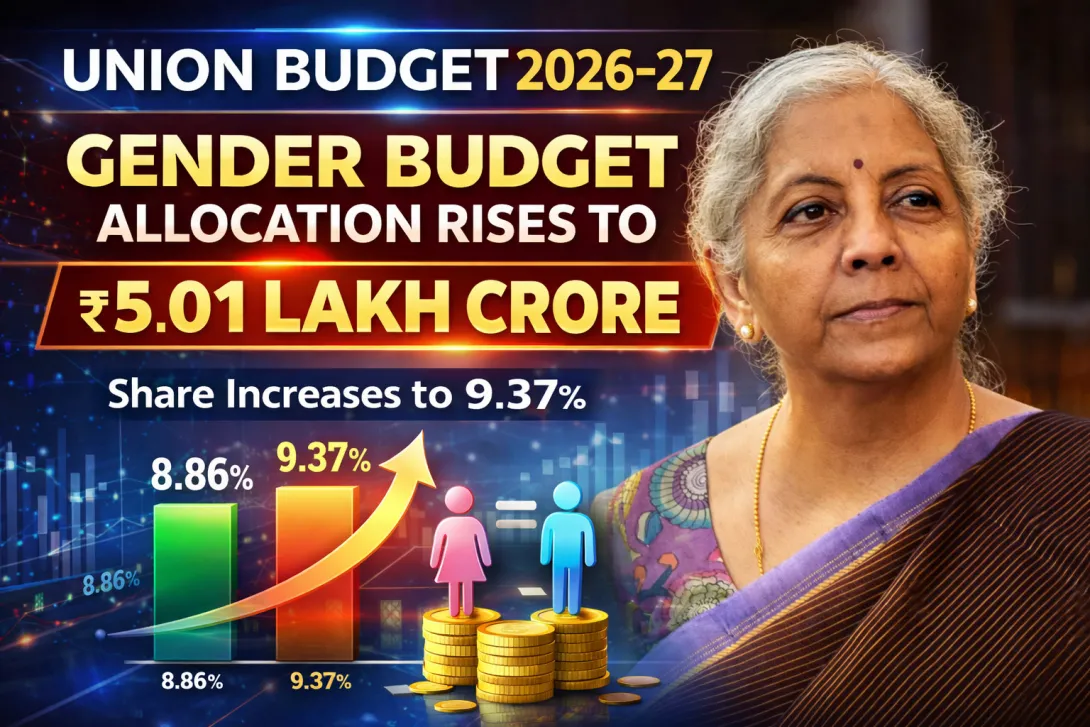
The Union Budget 2026–27 witnessed a significant rise in Gender Budget (GB) allocation. It marked an allocation of ₹5.01 lakh crore, reflecting an 11.55% increase over the previous financial year. The share of the Gender Budget in the total Union Budget increased to 9.37%. A total of 53 Ministries/Departments and five Union Territories (UTs) reported Gender Budget allocations this year.
Meaning and Concept of Gender Budget (GB)
- Gender Budget (GB) is a mechanism to assess whether the government’s gender equality commitments are reflected in actual budgetary allocations.
- It does not create a separate budget exclusively for women.
- It examines the entire Government Budget from a gender perspective, meaning it evaluates how public expenditure impacts women and men differently.
Adoption and Institutionalisation in India
- India formally adopted Gender Budgeting in 2004–05.
- Since adoption, Gender Budgeting has been institutionalized at both national and state levels.
- Gender Budget Cells have been established in various ministries and departments.
- Gender Budget Cells are dedicated units responsible for planning, monitoring, and reporting gender-related allocations.
Classification of Gender Budget
- The Gender Budget is divided into three parts for clarity and transparency.
- Part A includes schemes with 100% allocation for women.
- Part B includes schemes where at least 30% of the allocation is meant for women.
- Part C, introduced in the Union Budget 2024–25, includes schemes where allocation for women is below 30%.
Significance of Gender Budgeting
- Gender Budgeting integrates gender concerns into planning and policymaking.
- It helps reduce structural inequalities.
- Structural inequalities refer to systemic disadvantages faced by women due to social, economic, and institutional barriers.
- It promotes inclusive development.
- Inclusive development refers to growth that benefits all sections of society equitably.
Key Initiatives Promoting Gender Budgeting in India
- The Gender Budgeting Scheme functions under the ‘Samarthya’ sub-scheme of the Mission Shakti Scheme.
- The scheme is implemented by the Ministry of Women and Child Development (MWCD).
- Mission Shakti is a comprehensive programme focused on women’s empowerment and safety.
- The Gender Budgeting Scheme aims for 100% coverage of Gender Budgeting in all central and state Ministries and Departments.
- It also seeks to extend coverage to rural and urban local bodies.
- Rural and urban local bodies are grassroots-level governance institutions responsible for local administration.
- The Gender Budgeting Knowledge Portal (2025) was launched by the MWCD.
- It serves as a digital repository of information related to Gender Budgeting practices.
- A digital repository is an organized online platform for storing and accessing information.
State-Level Efforts
- Odisha adopted Gender Responsive Budgeting (GRB) in 2004–05.
- It implemented GRB through the Women Component Plan.
- Gender Responsive Budgeting (GRB) refers to applying gender analysis in budget formulation and implementation.
- Karnataka developed a gender audit manual.
- The gender audit manual is used to monitor and strengthen Gender Budget implementation.
- A gender audit is a systematic evaluation of whether policies and expenditures effectively promote gender equality.
Ministry-Wise High Gender Allocation (FY 2026–27)
The following 11 Ministries/Departments reported more than 30% of their allocations in the Gender Budget:
- Ministry of Women and Child Development – 81.73%
- Department of Rural Development – 69.92%
- Ministry of Development of North Eastern Region – 48.60%
- Department of Drinking Water & Sanitation – 48.04%
- Department of Food and Public Distribution – 46.34%
- Department of Health and Family Welfare – 40.44%
- Ministry of New & Renewable Energy – 39.05%
- Department of Higher Education – 32.25%
- Ministry of Panchayati Raj – 30.93%
- Ministry of Petroleum and Natural Gas – 30.22%
- Department of School Education and Literacy – 30.10%
This indicates that Gender Budgeting is no longer confined to welfare ministries but is integrated into: Infrastructure, Energy, Education, Rural development and Food security.