Article 360 Financial Emergency: Approval, Effects
What is financial emergency article 360? It is a constitutional provision empowering the President of India to declare a financial emergency if the financial stability or credit of India, or any part of its territory, is severely threatened. This extraordinary measure is designed to restore economic stability through strict executive control over the nation's finances.
Approval and Duration: Once proclaimed, the emergency requires parliamentary approval within two months by a simple majority in both Houses. Unlike other emergencies, once it receives this approval, it continues indefinitely until the President explicitly revokes it. There is no requirement for periodic parliamentary renewals.
Key Effects: The declaration fundamentally alters the federal financial structure. The Centre gains the authority to mandate salary reductions for government employees across both the Union and the States. Uniquely, this includes the power to reduce the salaries of Supreme Court and High Court Judges. Furthermore, the President can direct that all State Money Bills and Appropriation Bills be reserved for their consideration, effectively placing state finances under Union control.
Usage: Despite the sweeping powers it grants, Article 360 has never been invoked in India's history. Even during the severe 1991 economic crisis, the government managed the situation through macroeconomic policy changes rather than constitutional suspension.
Grounds for Declaration and Judicial Review
To understand how a Financial Emergency begins, we must look at the constitutional trigger and how the Supreme Court retains oversight over the President's actions. The President declares this emergency under Article 360(1) on the aid and advice of the Council of Ministers. The specific ground is that the President must be satisfied that a situation has arisen threatening the financial stability or credit of India.
The history of judicial review regarding this satisfaction is a fascinating journey of constitutional amendments. During the 1970s, the 38th Amendment Act of 1975 made the President's satisfaction "final and conclusive." This effectively rendered the declaration immune to judicial review, meaning no court could question the grounds on which the emergency was declared.
However, the political climate shifted, and the 44th Amendment Act of 1978 deleted this restrictive provision. This amendment restored the power of judicial review. Today, the Supreme Court of India can strike down the proclamation if it is found to be malafide, absurd, or based on wholly extraneous grounds. The courts act as a vital check against the arbitrary use of executive power. Any future structural changes to these emergency provisions would require a formal constitutional amendment under Article 368.

Practice Question (2026)
Which of the following statements with regard to Proclamation of Emergency are correct?
I. It cannot be in operation unless approved by the resolution of both the Houses of the Parliament within one month.
II. Proclamation of Emergency can be revoked by the President at any time.
III. The President can issue a Proclamation of Emergency even before the actual occurrence of war or external aggression.
IV. The 44th Amendment Act (1978) made the President's satisfaction subject to judicial review.
- I and III only
- II, III and IV
- I, III and IV
- I and IV only
Correct Answer: I, III and IV. The 44th Amendment Act (1978) restored judicial review for emergency proclamations, ensuring the President's satisfaction is not immune from court scrutiny.
Parliamentary Approval Process and Duration
Let us examine the mechanical process of passing Article 360 through Parliament. You will notice it is relatively easier to pass than a National Emergency, but its effects last much longer. The proclamation must be approved by both Houses of Parliament within two months from the date of issue. This is a more relaxed timeline compared to the strict one-month window provided for Article 352.
Approval requires only a simple majority. This means a majority of the members of that House present and voting is sufficient to pass the resolution. There is a specific constitutional safeguard if the Lok Sabha is dissolved during this two-month period. In such a scenario, the proclamation survives until 30 days from the first sitting of the newly reconstituted Lok Sabha, provided the Rajya Sabha has already approved it in the meantime.
The most distinctive feature of Article 360 is its duration. Once approved by Parliament, it continues indefinitely without requiring repeated parliamentary approval. Contrast this with Articles 352 and 356, which require periodic six-month renewals to remain active. To end the Financial Emergency, the President can revoke the proclamation at any time, and this revocation does not require any parliamentary approval.

Practice Question (2007)
Consider the following statements in respect of financial emergency under Article 360 of the Constitution of India:
1. A Proclamation of financial emergency issued shall cease to operate at the expiration of two months, unless before the expiration of that period it has been approved by the resolutions of both Houses of Parliament.
2. If any Proclamation of financial emergency is in operation, it is competent for the President of India to issue directions for the reduction of salaries and allowances of all or any class of persons serving in connection with the affairs of the Union but excluding the Judges of the Supreme Court and the High Courts.
- 1 only
- 2 only
- Both 1 and 2
- Neither 1 nor 2
Correct Answer: 1 only. Statement 2 is incorrect because the President can explicitly reduce the salaries of Supreme Court and High Court judges during a Financial Emergency.
Effects on Centre-State Relations and State Finances
During a Financial Emergency, the federal structure of India effectively turns unitary in financial matters. The Union executive extends its authority to give directions to states to observe specified canons of financial propriety. This means the Centre dictates how states should manage their budgets and expenditures.
A major blow to state autonomy comes through the control of legislative bills. Under Article 360(4)(b), the President can direct that all State Money Bills (Article 207) and Appropriation Bills (Article 204) be reserved for his consideration after being passed by the State Legislature. While state legislatures are not suspended, their financial autonomy over subjects in the State List (List II of the 7th Schedule under Article 246) is practically overridden by the Centre.
The ripple effects reach down to local governance. Devolution of funds to local bodies can be severely disrupted. State Finance Commissions (Article 243-I) and Panchayat funding mechanisms (Article 243-H) could face strict austerity measures. Furthermore, Statutory Grants from the Centre to the states under Article 275 might be curtailed to save Union funds.
Common Mistake: Students often think State governments are dismissed during a Financial Emergency, confusing it with President's Rule (Article 356). They are not. The state legislature and executive remain completely intact and functional, but their financial autonomy is subordinated to the Union government.
Impact on Salaries (Including Supreme Court Judges)
The most severe austerity measure under Article 360 is its ability to touch the usually untouchable Consolidated Fund of India. The President can direct a reduction in salaries and allowances for all or any class of persons serving the Union or a State.
Normally, the salaries of Supreme Court and High Court judges are charged directly on the Consolidated Fund of India. This is a deliberate constitutional design to safeguard judicial independence, ensuring politicians cannot vary a judge's salary to their disadvantage. However, Article 360 explicitly overrides this protection. It is the only constitutional scenario that allows for the salary reduction of the higher judiciary.
If such a drastic measure were ever implemented, vast numbers of government employees facing salary cuts would likely seek legal recourse. This would result in service disputes flooding the administrative tribunals established under Article 323A and 323B of the Constitution.

Practice Question (2012)
What is the provision to safeguard the autonomy of the Supreme Court of India?
1. While appointing the Supreme Court Judges, the President of India has to consult the Chief Justice of India.
2. The Supreme Court Judges can be removed by the Chief Justice of India only.
3. The salaries of the Judges are charged on the Consolidated Fund of India to which the legislature does not have to vote.
4. All appointments of officers and staffs of the Supreme Court of India are made by the Government only after consulting the Chief Justice of India.
- 1 and 3 only
- 3 and 4 only
- 4 only
- 1, 2, 3 and 4
Correct Answer: 1 and 3 only. Salaries are charged on the Consolidated Fund of India to protect autonomy, a protection that can only be breached during an Article 360 Financial Emergency.
Comparison: Article 352 vs 356 vs 360
For Prelims revision, a rapid comparative framework is highly useful. You must be able to contrast the grounds, approval mechanisms, and fundamental rights impacts of the three emergency provisions.
| Feature | Article 352 (National Emergency) | Article 356 (President's Rule) | Article 360 (Financial Emergency) |
|---|---|---|---|
| Grounds | War, External Aggression, or Armed Rebellion. | Failure of constitutional machinery in a state. | Threat to financial stability or credit of India. |
| Approval Time | 1 month from the date of issue. | 2 months from the date of issue. | 2 months from the date of issue. |
| Majority Required | Special Majority. | Simple Majority. | Simple Majority. |
| Duration | 6 months at a time, can be extended indefinitely. | 6 months at a time, maximum duration of 3 years. | Indefinite duration until revoked by the President. |
| Impact on Fundamental Rights | Affects Fundamental Rights (e.g., Article 19 restrictions under Art 358). Article 21 (life and liberty) and Article 32 (constitutional remedies) cannot be fully suspended post-44th Amendment. | No direct impact on Fundamental Rights. | ZERO impact on Fundamental Rights. |
Practice Question (2018)
Article 352 of the Constitution of India contains provisions related to
- financial emergency
- failure of constitutional machinery in States
- Suspension of the enforcement of rights conferred in part III of the constitution
- general Emergency
Correct Answer: general Emergency. Article 352 deals with National (general) Emergency, whereas Article 360 handles financial emergencies.
The 1991 Economic Crisis: Why Article 360 Was NOT Invoked
Analyzing the closest India ever came to a Financial Emergency helps clarify the exact purpose of Article 360. In 1991, India faced a severe Balance of Payments (BoP) crisis. Foreign exchange reserves fell to approximately $1.1 billion, which was enough to finance only two weeks of essential imports. The nation was on the brink of default.
Students frequently ask why Article 360 was not invoked during this period. The answer lies in the nature of the crisis. The 1991 situation was primarily a liquidity and foreign exchange issue. It was not a domestic insolvency crisis that required mass salary cuts for government clerks or the suspension of state financial autonomy. Cutting domestic salaries in Indian Rupees would not have generated the US Dollars needed to pay for oil imports.
The resolution required macroeconomic policy shifts, not the constitutional sledgehammer of Article 360. The government pledged 46.91 tonnes of gold with the Bank of England and 20 tonnes with the Union Bank of Switzerland to secure emergency loans. They devalued the Rupee by approximately 18-19% in early July 1991 and initiated the New Economic Policy (LPG reforms) via IMF structural adjustment loans. The crisis was solved through economics, keeping the constitutional emergency provisions untouched.
Broad Constitutional Context: DPSP and Welfare
The Constitution envisions India as a welfare state, a vision primarily driven by Part IV (Directive Principles of State Policy). During a Financial Emergency, the extreme austerity measures temporarily conflict with this welfare mandate. The state's capacity to fulfill its socio-economic obligations is severely restricted when funds are tightly controlled by the Centre for survival.
To understand the breadth of welfare obligations that could be paused or underfunded during such a crisis, review the full list of DPSPs from Article 36 to 51:
| Article | Provision |
|---|---|
| Article 36 | Definition of State |
| Article 37 | Application of the principles |
| Article 38 | State to secure a social order for the promotion of welfare of the people |
| Article 39 | Certain principles of policy to be followed by the State (livelihood, resources) |
| Article 39A | Equal justice and free legal aid |
| Article 40 | Organization of village panchayats |
| Article 41 | Right to work, to education, and to public assistance in certain cases |
| Article 42 | Provision for just and humane conditions of work and maternity relief |
| Article 43 | Living wage, etc., for workers |
| Article 43A | Participation of workers in management of industries |
| Article 43B | Promotion of co-operative societies |
| Article 44 | Uniform civil code for the citizens |
| Article 45 | Provision for early childhood care and education |
| Article 46 | Promotion of educational and economic interests of SCs, STs, and other weaker sections |
| Article 47 | Duty of the State to raise the level of nutrition and the standard of living |
| Article 48 | Organization of agriculture and animal husbandry |
| Article 48A | Protection and improvement of environment and safeguarding of forests and wild life |
| Article 49 | Protection of monuments and places and objects of national importance |
| Article 50 | Separation of judiciary from executive |
| Article 51 | Promotion of international peace and security |
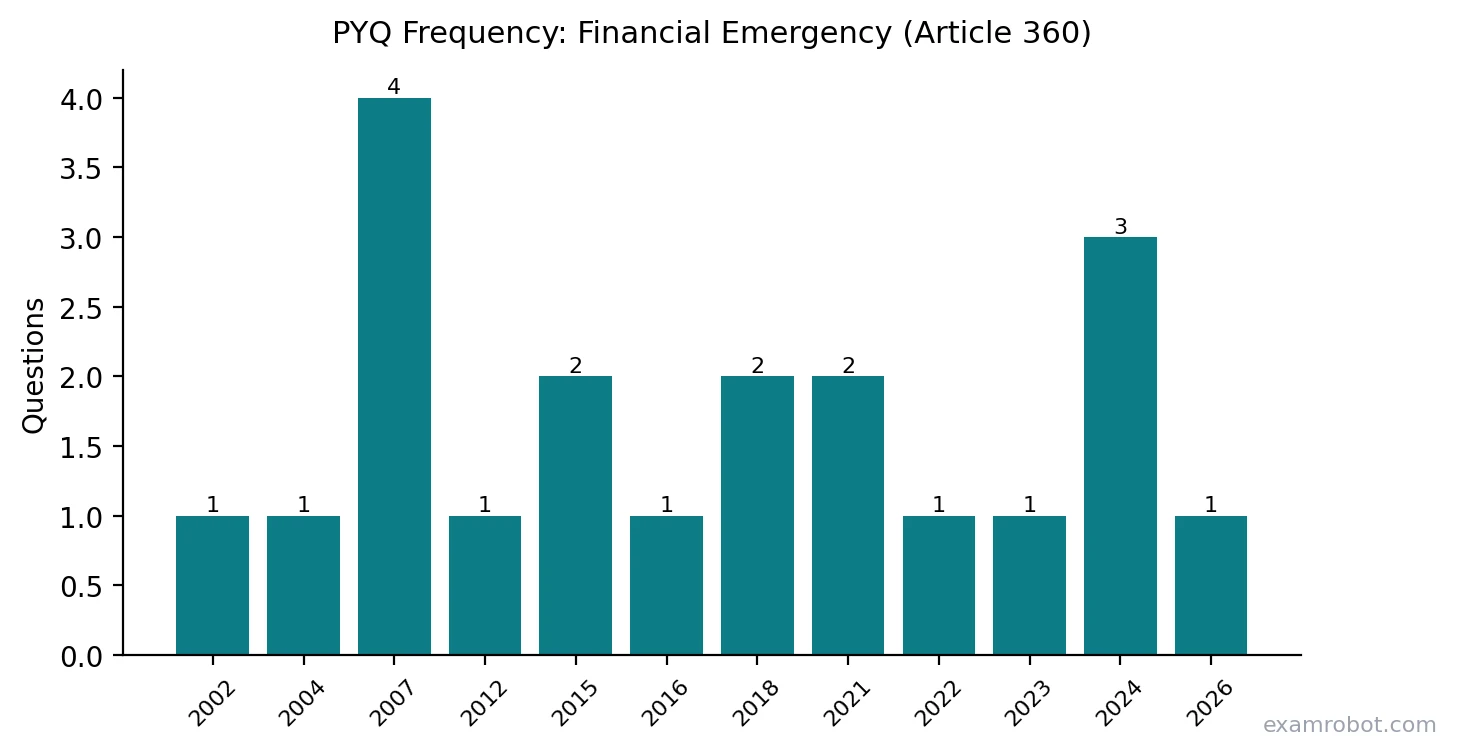
Mains Analytical Focus
Consider this actual Mains question (GS2 2018): "Under what circumstances can the Financial Emergency be proclaimed by the President of India? What consequences follow when such a declaration remains in force? (Answer in 150 words)" View this question
Examiner Analysis: Before 2018, examiners focused heavily on specific executive instruments and sociopolitical consequences. The 2018 question on Financial Emergency tested static procedural mechanics and direct consequences. Since then, the framing has evolved toward structural and comparative analysis, focusing on systemic checks through Parliamentary accountability and comparative constitutionalism. Therefore, mastering the exact mechanical consequences of Article 360 is your foundational step before attempting comparative analysis.
Answer Approach: Begin your introduction by stating that Article 360 empowers the President to proclaim a Financial Emergency when the economic stability or credit of India is threatened. In the body, structure the circumstances for invocation clearly, mentioning the President's satisfaction and the role of judicial review restored by the 44th Amendment. Next, detail the consequences systematically: the Centre's power to dictate canons of financial propriety, the reservation of State Money Bills, and the reduction of salaries, explicitly mentioning Supreme Court and High Court judges. Conclude by noting that this provision has never been invoked, highlighting the resilience of India's macroeconomic management.
In the News
Recent discussions surrounding State Emergency Provisions and the Governor's Role frequently connect back to Part XVIII of the Indian Constitution. These debates highlight the delicate constitutional relationship between the Union and States regarding financial and administrative control during crises, reinforcing the importance of understanding how provisions like Article 360 can centralise power.
Frequently Asked Questions
What is the Article 360 emergency?
It is a Financial Emergency declared by the President of India when there is a severe threat to the financial stability or credit of India or any part of its territory.
How many times has article 360 been invoked?
Zero. Article 360 has never been invoked in India's history, not even during the severe 1991 economic crisis.
Which type of emergency is declared under article 356?
Article 356 deals with President's Rule (State Emergency), declared when there is a failure of constitutional machinery in a specific state.
Can the President reduce the salary of Supreme Court judges under Article 360?
Yes. During a Financial Emergency, the President has the explicit power to direct a reduction in the salaries and allowances of Supreme Court and High Court judges.
Is Article 360 subject to judicial review?
Yes. Following the 44th Amendment Act of 1978, the President's satisfaction in declaring a Financial Emergency is subject to judicial review and can be challenged in court.
What is the maximum period for which a financial emergency can be proclaimed?
There is no maximum period. Once approved by Parliament within two months, it continues indefinitely until it is revoked by the President.
What is financial emergency under article 360 in hindi?
In Hindi, Financial Emergency under Article 360 is known as "वित्तीय आपातकाल" (Vittiya Aapatkaal).