Essay Writing in UPSC Exam: The Ultimate Guide & Strategy
The Essay paper is Paper-I of the UPSC Civil Services (Main) Examination. It carries 250 marks and is a merit-ranking paper, not a qualifying one. The score you achieve here directly impacts your final rank and service allocation.
Candidates must write two essays, choosing one topic from Section A and one from Section B. The total time given is 180 minutes (3 hours), which translates to exactly 90 minutes per essay. The official UPSC instruction dictates a strict word limit of 1000 to 1200 words for each essay.
While historically divided into objective, General Studies-based topics and abstract themes, the recent trend between 2020 and 2024 features almost exclusively philosophical and abstract quotes in both sections. According to Rule 11 of the Civil Services Examination rules, credit is given for "orderly, effective and exact expression combined with due economy of words." This means examiners reward clarity, structured thinking, and precise vocabulary over mere factual dumping.
Anatomy of the UPSC Essay Paper (Paper I)
The Essay paper sets the tone for the entire Mains examination. It is the very first paper you will write, and a strong performance here builds immense psychological momentum. Unlike the SSC CGL exam, GATE exam, NET exam, or AIBE exam, where writing is either absent, purely qualifying, or highly technical, the UPSC essay demands profound perspective and multi-dimensional analysis.
Candidates are presented with eight topics in total, divided equally between Section A and Section B. You must select one topic from each section. The official instructions in the Question-cum-Answer Booklet (QCAB) are strict regarding the 1000 to 1200 word limit. Writing too little demonstrates a lack of intellectual depth, while exceeding the limit risks redundancy and severe time mismanagement.
Rule 11 of the Gazette of India explicitly states that marks are awarded for "orderly, effective and exact expression." Superficial knowledge or a generic dumping of facts is heavily penalised. The phrase "due economy of words" is a direct instruction against tautology and fluff. Every sentence must advance your argument.
Treating the essay like a General Studies paper: General Studies tests your factual knowledge; the Essay tests your personality, perspective, and articulation. Bullet points, heavy sub-headings, and raw data dumps will fetch below-average marks in Paper I.
Consider a broad theme like "Democracy." If this appears in a General Studies paper, the examiner expects constitutional articles, recent parliamentary bills, and Supreme Court judgments. If the same theme appears in the Essay paper, the examiner expects an exploration of the spirit of democracy, its historical evolution, its philosophical necessity, and its impact on human dignity.
| Parameter | General Studies Papers (GS 1-4) | Essay Paper (Paper I) |
|---|---|---|
| Primary Objective | Testing factual knowledge, policy awareness, and analytical speed. | Testing personality, ethical grounding, and depth of perspective. |
| Structure | Point-wise format, heavy use of headings, sub-headings, and bullet points. | Paragraph format, narrative flow, smooth transitions, no explicit headings. |
| Content Focus | Data, committee reports, constitutional articles, and exact figures. | Philosophical arguments, historical anecdotes, and multi-dimensional analysis. |
| Word Limit | 150 to 250 words per answer. | 1000 to 1200 words per essay. |
Decoding the Shift to Philosophical Essays
Before 2017, candidates could comfortably rely on standard policy topics. Themes like Women Empowerment, Cyber Security, or Agricultural Reforms were predictable staples. Today, analysing a previous year question paper reveals a complete paradigm shift in the topics for essay writing in the UPSC exam.
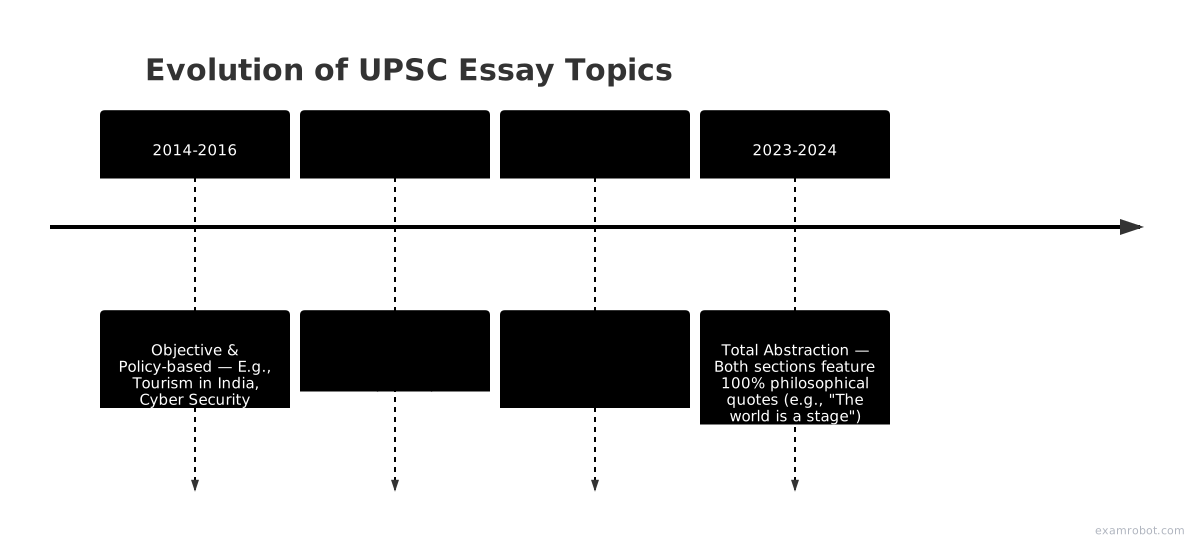
In both 2023 and 2024, every single topic across Section A and Section B was an abstract or philosophical quote. For example, the 2024 paper featured prompts like "The world is a stage and we are all merely players" (a direct quote from Shakespeare) in Section A, and "The best way to find yourself is to lose yourself in the service of others" (attributed to Mahatma Gandhi) in Section B.
Why did the Commission make this shift? Over the years, coaching institutes had commodified policy essays. Candidates were reproducing memorised templates. Abstract topics cannot be mugged up. The Commission uses these quotes as blank canvases to test original thinking, ethical grounding, and the ability to connect abstract metaphors to real-world governance and societal issues.
Take the 2023 topic: "Thinking is like a game, it does not begin unless there is an opposite team." This prompt requires candidates to discuss the dialectical nature of thought. You must demonstrate how thesis and antithesis create synthesis, and then apply this philosophical concept to tangible domains like parliamentary democracy, scientific peer review, and social reform movements.
Brainstorming Frameworks: Generating 1200 Words
Staring at a blank page is the biggest hurdle in the examination hall. Top scorers, including Anudeep Durishetty (AIR 1, 2017), advocate for structured brainstorming before writing a single word. You cannot build a 1200-word mansion without an architectural blueprint.

To generate multi-dimensional content without repeating points, experts rely on three specific frameworks.
The PESTEL Framework
Break the quote down into Political, Economic, Social, Technological, Environmental, and Legal dimensions. This ensures wide coverage and prevents you from getting stuck on a single line of thought.
| Dimension | Application to "The world is a stage" (2024 PYQ) |
|---|---|
| Political | Geopolitics as a theatre; nations acting out roles of superpowers or victims on the global stage. |
| Economic | The illusion of meritocracy; how economic classes are assigned scripts they struggle to rewrite. |
| Social | Societal expectations and gender roles; how society forces individuals to perform accepted scripts. |
| Technological | Social media as the ultimate digital stage, where authenticity is lost to performative metrics. |
| Environmental | Humanity acting as the protagonist, ignoring the fragility of the stage (Earth) itself. |
| Legal | The justice system as a formalised stage where truth is debated through structured roles. |
The Temporal Approach
Analyse the topic chronologically. How was this concept viewed in the past (historical context), how is it relevant in the present day (current affairs), and what is its future trajectory (visionary outlook). This adds a sense of evolution to your essay.
The Stakeholder Lens
View the topic through concentric circles of impact: the Individual, the Family, the Society, the Nation, and the Global community. For the 2024 topic "Character is what you are when no one is looking," you can apply these lenses directly. At the individual level, it is personal ethics and integrity in isolation. At the corporate level, it is governance without strict regulatory oversight. At the national level, it is diplomacy and honouring international treaties when global bodies lack enforcement power.
The Introduction-Body-Conclusion Structure
A brilliant brainstorm is useless without a logical structure. The way you arrange your arguments determines how easily the evaluator can read and reward your essay.

The Hook and Thesis (Introduction)
Start with an engaging hook. This could be a relevant anecdote, a powerful quote, or a historical event. Avoid defining terms like a dictionary. The examiner knows what democracy means; you do not need to quote the Oxford dictionary to prove you own one. For a technology-based essay, instead of writing "Technology is the application of science," start with "When Prometheus stole fire from the gods, he gave humanity its first technology, a tool that could warm a home or burn it down."
By the end of the introduction, clearly state your thesis. The examiner must know exactly what core argument you are about to prove over the next ten pages.
The Body Paragraphs
Dedicate one paragraph to one dimension (using the PESTEL or Temporal frameworks). The secret to a high-scoring essay lies in the transitions. You must ensure a smooth narrative flow between paragraphs using connector words.
- Use connector words like "Furthermore," "Conversely," or "On a macroscopic level" to link paragraphs logically.
- Keep paragraphs concise, ideally between 100 to 150 words each.
- Write a massive 1200-word block of text without clear paragraph breaks.
- Jump abruptly from an economic point to a historical point without a bridging sentence.
The Counter-Perspective
Always include a paragraph that explores the antithesis or limitations of the quote. An essay without a counter-perspective is a monologue; an essay with one is a mature debate. Showing that you understand the exceptions to the rule demonstrates intellectual maturity.
The Conclusion
Synthesise your arguments. Never end abruptly. Connect your final thoughts to visionary goals like Constitutional ideals, the Sustainable Development Goals (SDGs), or a famous optimistic quote. Leave the examiner with a sense of hope and forward momentum.
Time Management Strategy for 180 Minutes
You have 180 minutes for two essays, meaning exactly 90 minutes per essay. Time parity is non-negotiable. Spending 110 minutes on your first essay guarantees a rushed, low-scoring second essay.
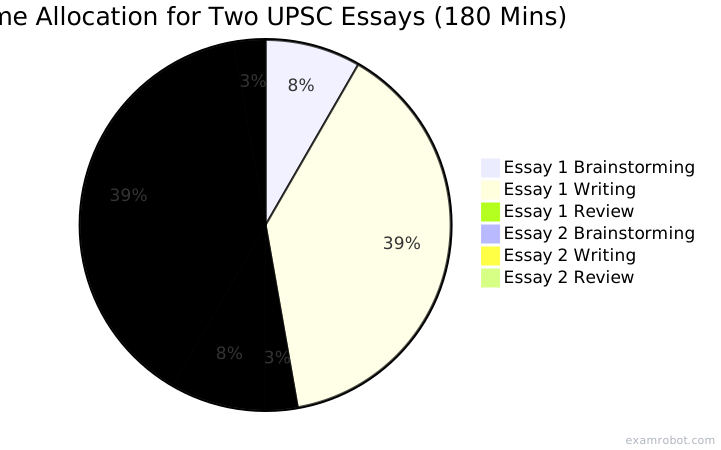
Top scorers like Vikram Grewal (AIR 51) popularised the "15-70-5" strategy for each 90-minute block.
- Brainstorming Phase (15 to 20 minutes): Go straight to the rough pages at the back of the answer booklet. Map out your introduction, your PESTEL dimensions, your counter-perspective, and your conclusion. Do not skip this step. It prevents mid-essay writer's block and ensures your structure is sound before you commit ink to the final pages.
- Writing Phase (65 to 70 minutes): Execute your plan. Because you already have a roadmap, you can focus purely on vocabulary, grammatical flow, and maintaining legible handwriting.
- Review Phase (5 minutes): Proofread for grammatical errors, underline key phrases, and ensure your conclusion ties back neatly to your introduction.
The Subconscious Processing Trick: Write your chosen topics at the very top of your rough sheet immediately after reading the question paper. Your subconscious mind will begin processing ideas for the second topic while you are actively outlining and writing the first.
Sample Walkthrough: Deconstructing a PYQ
To provide a concrete sample of essay writing in the UPSC exam, let us deconstruct a recent past year topic: "A society that has more justice is a society that needs less charity."
Using the "Suggested Answer" mental model ensures you do not just write a generic summary of why charity is good. You must address the comparative friction between systemic justice and temporary charity.
- Introduction: Start with the contrast between systemic empowerment (justice) and temporary relief (charity). Mention how the Directive Principles of State Policy (DPSP) in the Indian Constitution aim to build a society based on justice, thereby reducing the reliance on state or private charity.
- Body Paragraph 1 (Economic): Contrast progressive taxation and fair minimum wages (Justice) against corporate philanthropy (Charity). A worker earning a living wage does not need a charitable food drive.
- Body Paragraph 2 (Social): Discuss the eradication of caste discrimination and untouchability (Justice) versus reserving quotas without deep social integration or dignity (Charity).
- Body Paragraph 3 (Global): Compare climate justice, where developed nations cut their carbon emissions and transfer green technology, to climate charity, where they simply send financial aid after a developing nation suffers a flood.
- Counter-Perspective: Is charity obsolete? No. In times of acute disaster, such as earthquakes or wars, immediate charity is required to save lives before long-term justice can be institutionalized.
- Conclusion: True development transitions a society from a charity-based model to a rights-based model. Conclude by echoing Amartya Sen's capability approach, where justice is defined by giving citizens the capability to lead lives they value, rendering charity unnecessary.
Common Pitfalls and the "Headings" Dilemma
Despite possessing excellent General Studies knowledge, many candidates score below 100 marks in Paper I. This usually stems from a few specific, avoidable errors.
The Headings Dilemma
Can we use headings? The official UPSC instructions do not explicitly ban headings. However, for philosophical essays, they are heavily discouraged by experts and evaluators. Headings disrupt the narrative flow and make the essay read like a GS answer. Instead of writing a heading like "Economic Impact," use a strong topic sentence: "Beyond the political realm, the economic undercurrents of this philosophy reveal a stark reality."
Penalty Marks
The Commission explicitly penalises rule-breaking. According to Appendix II of the CSE Rules, marks are deducted for "illegible handwriting" and for writing in a medium other than the one authorised. Furthermore, avoid drawing unnecessary symbols, religious marks (like "Om" or "786"), or writing your name anywhere in the booklet. These are flagged as identifying marks and will attract severe penalties.
Losing the Core Theme
The most common reason for low scores is tangent-writing. Candidates see a single keyword in the quote and write a 1000-word essay on that keyword, ignoring the actual philosophical relationship presented. Writing a detailed history of Indian theatre for the prompt "The world is a stage" is a fatal error, though perhaps an entertaining one for the evaluator.
Forcing pre-memorised quotes: A misapplied quote is worse than no quote at all. Do not force a famous saying into your essay if it does not naturally align with the specific philosophical context of the prompt.
Preparation Strategy: Moving from Prelims to Mains
Do not wait for the upsc prelims 2026 result to start writing essays. Essay writing is a muscle that takes months to develop. Integrating these tips for essay writing in the UPSC exam into your daily routine is critical.
- Maintain an Anecdote and Quote Bank: Create a digital or physical notebook categorised by themes (Education, Women, Technology, Democracy, Environment). Collect real-life stories from newspapers. The struggles and triumphs of recent Padma Shri awardees make for excellent, fresh introductions.
- Read Non-Fiction: Improve your vocabulary and thematic understanding by reading authors who write with clarity and depth. Books by Amartya Sen, Ramachandra Guha, or Yuval Noah Harari offer brilliant examples of how to structure complex arguments.
- Peer and Expert Evaluation: You cannot grade your own essay objectively. Regularly write full-length upsc previous year question paper essays and get them evaluated for flow, structure, and depth. Feedback is the only way to calibrate your writing style to the Commission's expectations.
Learn from Editorials: Read the editorials of major newspapers not just for the facts, but to observe how the author structures their arguments. Notice how they open with a hook, transition smoothly between paragraphs, and close with a forward-looking synthesis.
Quick Revision: UPSC Essay Strategy
- Paper I is a 250-mark merit-ranking paper requiring two essays of 1000 to 1200 words each within a total of 180 minutes.
- Modern UPSC essays consist almost entirely of philosophical and abstract quotes, testing original thought over rote memorisation.
- Utilise the PESTEL and Temporal frameworks during a dedicated 15-minute brainstorming session before writing.
- Structure your essay with a compelling hook, a clear thesis, multi-dimensional body paragraphs, and a visionary conclusion.
- Avoid using headings in philosophical essays; rely on smooth paragraph transitions instead.
- Practice regularly by deconstructing previous year questions and maintaining a dedicated quote and anecdote journal.
Frequently Asked Questions
How much time is given for essay writing in UPSC?
You are given a total of 180 minutes (3 hours) to write two essays. Top scorers recommend dedicating exactly 90 minutes to each, split into 15 minutes of brainstorming, 70 minutes of writing, and 5 minutes of reviewing.
Is an essay paper qualifying in UPSC?
No, the Essay paper (Paper I) is not qualifying. It is a merit-ranking paper carrying 250 marks, and its score is added to your final tally to determine your rank and service allocation.
How many essays are there in UPSC?
Candidates must write exactly two essays. The question paper is divided into Section A and Section B, each containing four topics. You must choose one topic from each section.
What are the types of essay in UPSC?
Historically, they were a mix of objective (policy/economy) and abstract topics. However, in recent years (especially 2023 and 2024), almost all topics in both sections are philosophical or abstract quotes.
What is the word limit for UPSC essay?
The official UPSC instructions state that each essay should be written in approximately 1000 to 1200 words.
Can we use headings in UPSC essay?
While not explicitly banned by UPSC rules, using headings in philosophical essays is highly discouraged by experts. It breaks the narrative flow. Instead, use strong topic sentences at the beginning of each paragraph to guide the reader.
How to write essay in upsc exam?
Start with a 15-minute brainstorming session using frameworks like PESTEL. Write an introduction with a strong hook, develop body paragraphs that explore multiple dimensions (past, present, global, individual), and end with a synthesised, visionary conclusion.