How to Do UPSC Prelims PYQ Analysis: The 2027 Strategy
Mastering previous year questions is not merely about checking your answers against an official key. True analysis requires you to reverse-engineer how the examiner frames questions and constructs incorrect options. By dissecting these papers, you transition from a passive reader to an active investigator who understands the exact mechanics of the examination.
Your first task is to identify high-yield themes. Categorising past questions reveals recurring micro-themes that standard textbooks often bury. For instance, the Reserve Bank of India's monetary policy tools or the specific schedules of the Wildlife Protection Act appear with reliable frequency. Once you spot these patterns, you can streamline your reading list and eliminate unnecessary study material.
Next, you must decode the option traps. You need to analyse why the three incorrect options were chosen by the examiner. Today's incorrect distractors frequently become tomorrow's main questions. You then trace every question back to its origin, whether that is a specific chapter in an NCERT textbook, a table in M. Laxmikanth, or a recurring current affairs portal.
Finally, compile these insights into a dedicated revision journal or a topic-wise PDF. This journal becomes your most valuable asset in the final thirty days of preparation, containing your personal notes on recurring traps, static-dynamic linkages, and the precise phrasing the commission uses to test your conceptual clarity.
The 4-Step Methodology for Reverse-Engineering PYQs
Moving beyond the amateur approach of merely solving papers to calculate a score requires a fundamental shift in perspective. True analysis treats every question as a complex four-part puzzle consisting of the stem, the correct answer, the distractors, and the source material. Top scorers routinely spend up to three hours analysing a single two-hour paper, generating ten to fifteen pages of detailed notes per year of previous questions.
- Step 1: Solve and Categorise
Attempt the paper in a strictly timed environment to simulate exam pressure. Once completed, categorise every single question by subject and micro-topic. Do not just label a question as 'Polity'. Label it specifically as 'Polity, Parliament, Money Bill'. This granular tagging is what eventually reveals the hidden patterns in the syllabus. - Step 2: Source Mapping
Actively search for the exact page in your standard books where the answer resides. Open your NCERTs or your copy of M. Laxmikanth and physically locate the paragraph. If the fact is not in your standard static books, identify the current affairs source. This exercise teaches you exactly which chapters yield the highest return on your reading time. - Step 3: Distractor Deconstruction
Research the three incorrect options meticulously. The commission rarely invents random distractors. They are usually related concepts, historical figures, or scientific terms that the examiner considered relevant. By studying these distractors, you prepare yourself for the next iteration of the exam. - Step 4: Trend Prediction
Log the underlying concept in your revision journal. If the commission asked about the Prisons Act of 1894 in the 2023 exam, you must note that colonial-era justice laws undergoing current reforms are a new focus area. You then anticipate similar questions on outdated acts being replaced by new legislation.
Consider a concrete example from the 2020 paper. The commission asked a question about the 'Probing of Near-Earth Objects'. The incorrect options provided were the 'Cassini-Huygens' and 'Voyager' missions. Candidates who merely checked the correct answer missed a golden opportunity. In subsequent years, questions about those exact space missions appeared on the paper. The examiner had already telegraphed their interest in those specific planetary probes.

Common Mistake: Treating previous year papers purely as a mock test to gauge your score. Your final score on a five-year-old paper is entirely irrelevant. Your deep understanding of the question structure and the examiner's logic is the only metric that matters.
Decoding Option Traps and The Demise of Traditional Elimination
The structural changes introduced in recent years were designed specifically to combat rote memorisation and blind guessing. Understanding these shifts is non-negotiable for anyone planning a serious attempt.
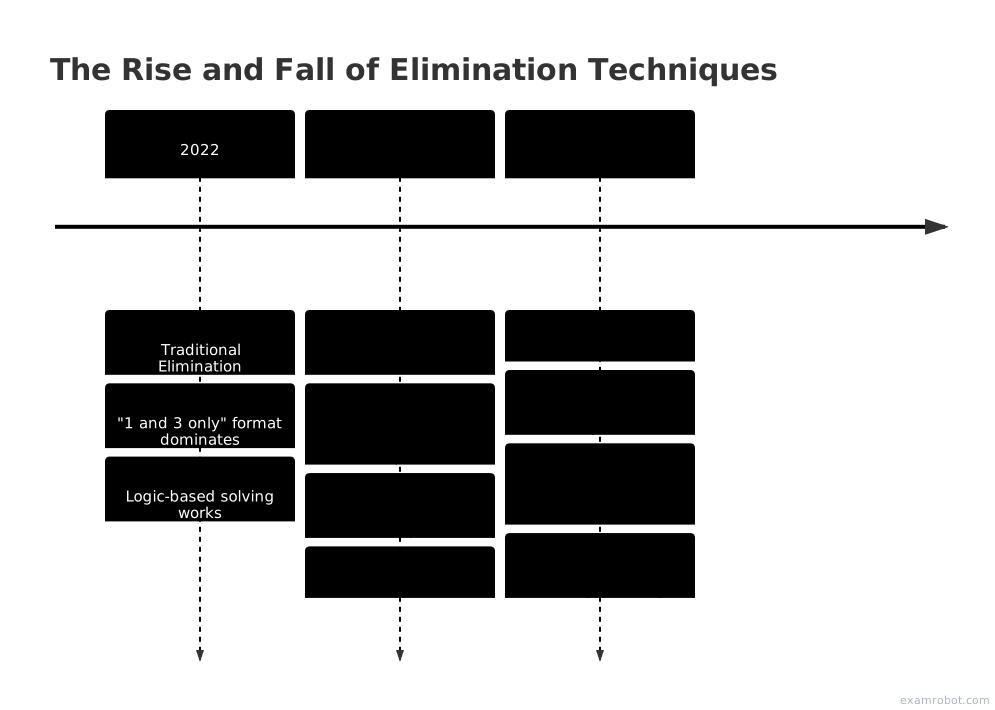
The 2023 paper delivered a massive shock to the aspirant community. The commission introduced 47 questions featuring options like "Only one pair", "Only two pairs", "All three pairs", and "None". This format mathematically destroyed the traditional elimination technique. Previously, knowing that a single statement was definitively false could often lead you straight to the correct answer. The new format requires you to know the exact truth value of every single statement to secure the marks. This shift caused the General category cut-off to plummet to a historic low of 75.41 marks, the lowest since the introduction of the CSAT qualifying paper in 2015.
Furthermore, the 2023 paper saw the reintroduction of assertion-reasoning style questions, with 18 questions using a 'Statement-I and Statement-II' format. This requires candidates to determine not only the factual correctness of both statements but also whether the second statement serves as the logical explanation for the first. This tests the causal link between facts, forcing a much deeper conceptual clarity.
However, the 2024 paper introduced a hybrid correction. The dreaded "Pairs" format dropped significantly to just 17 questions. Meanwhile, traditional multiple-statement options (such as '1 and 3 only') returned with 43 questions, particularly in subjects like Economy and Polity. This return allows for a balanced approach, rewarding candidates who possess both deep factual knowledge and sharp logical deduction skills.
Despite these structural changes, extreme word traps remain highly reliable indicators. Words like "drastically", "completely", "steadily", and "always" are frequently used to construct incorrect statements. This is especially true in the Economy section. A statement claiming that a particular economic metric has "steadily increased over the last decade" is rarely true given the natural volatility of global markets.
To illustrate the brutality of the pairs format, look at a 2023 Geography question about ports. Knowing that Kamarajar Port is a major port was insufficient. Because of the "Only two pairs" format, you had to definitively know the exact status of Mundra and Visakhapatnam ports as well. Partial knowledge yielded zero marks.
Pro Tip: Do not abandon logical deduction entirely. While blind elimination is dead, knowledge-backed deduction remains vital. Knowing exactly why a statement is conceptually absurd will save you when factual memory fails.
UPSC Prelims Subject Wise Weightage Trends (2014-2024)
Allocating your study hours based on a data-backed breakdown of subject weightage is the most efficient way to secure a high return on investment. The last decade of question papers reveals distinct patterns that should dictate your daily schedule.
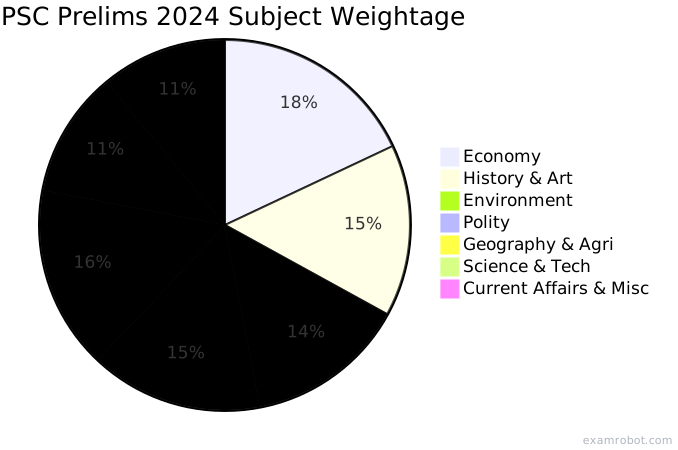
Economy and Environment consistently form the bedrock of the examination. In the 2024 paper, Economy saw approximately 18 questions, focusing heavily on Digital Public Infrastructure, the Banking sector, and the Capital Account. Environment accounted for 14 questions. Mastering just these two subjects covers nearly a third of the entire paper. The weightage for Environment remains artificially high because the preliminary exam is shared with candidates for the Indian Forest Service, forcing the commission to include rigorous ecological and botanical queries.
Polity serves as the scoring anchor for serious candidates. It consistently delivers between 14 and 16 questions. The 2023 paper featured 15 questions in Indian Polity. Unlike History, Polity questions are highly sourced from a single standard book and have a very high accuracy rate among well-prepared aspirants. If you make mistakes in Polity, you immediately fall behind the competition.
History remains the most unpredictable section. Its weightage fluctuates wildly, usually sitting between 13 and 15 questions. The 2023 paper included 13 questions, while the 2024 paper increased to 15. More notably, the focus has shifted heavily away from the traditional Modern Freedom Struggle. Recent papers show a deep obsession with obscure Ancient and Medieval administrative terms, archaeological sites, and Sangam-era literature.
Science and Technology rarely tests pure basic science. The 10 to 12 questions in this section focus heavily on applied technologies. You are far more likely to see questions on Biotechnology, Space missions, Artificial Intelligence, and Digital Public Infrastructure than on basic Newtonian physics.
The five-year average weightage breaks down as follows: Economy (16 percent), Environment (15 percent), Polity (15 percent), Geography and Agriculture (14 percent), History and Art (15 percent), Science and Tech (11 percent), and Current Affairs or Miscellaneous (14 percent).
- Allocate at least forty percent of your revision time strictly to Economy, Environment, and Polity.
- Focus History preparation on recurring themes like Buddhism, Jainism, and administrative terminology.
- Spend months memorising obscure medieval kings for a minimal return on exam day.
- Ignore the agricultural aspects of Geography, which now dominate the physical geography questions.
Theme Mapping: Economy, Environment, and Geography Topic Wise Analysis
Moving from macro-subjects to micro-themes is where true mastery begins. Identifying the exact sub-topics the examiner is obsessed with allows you to predict the paper with surprising accuracy.
In the Economy section, the Reserve Bank of India is the undeniable favourite institution. Themes like Monetary Policy tools, inflation dynamics, and debt-to-GDP ratios repeat almost every single year. The 2023 paper featured 14 questions covering technical concepts such as 'Sterilization' by the RBI and the classification criteria for MSMEs. By 2024, the focus expanded to include Digital Public Infrastructure and the Capital Account. If you analyse the last decade, the specific mathematical concept of the "Money Multiplier" has been asked three separate times using slightly different phrasing.
For Environment, your focus must be heavily tilted toward the Wildlife Protection Act, specifically the recent amendments and the exact species listed in its schedules. The 2023 paper highlighted invasive species and carbon markets. Over 60 percent of Environment questions in the last five years have been directly linked to an international climate convention or a specific national park mentioned in recent news reports.
Geography has evolved significantly. Pure physical geography questions are declining. The examiner now prioritises mapping questions, specifically places in the news and conflict zones across the Middle East and Africa. Agricultural geography is the other major pillar, with deep dives into crop conditions, soil types, and Minimum Support Price mechanics.
Polity's core focus remains tightly bound to Fundamental Rights, Directive Principles, and the exact phrasing of Constitutional provisions. The 2023 paper specifically tested the nuanced difference between "Due Process of Law" and "Procedure established by law", alongside questions on the 42nd and 44th Constitutional Amendments and the technical differences between a Finance Bill and a Money Bill.

Pro Tip: Create a digital "Theme Tracker" spreadsheet. Whenever you solve a past question, tag it with a micro-theme (such as #Economy_RBI_Liquidity or #Polity_Parliament_Bills) to easily spot repetitions and cluster your revision.
Mapping PYQs to Standard Books (NCERT & Laxmikanth)
Your reading habits must physically alter based on the insights gained from past papers. Reading a textbook cover-to-cover with equal attention is a massive waste of energy.
When reading M. Laxmikanth, use a red pen to mark paragraphs that have been directly tested in the past. You will quickly notice that chapters like 'Parliament' and 'Fundamental Rights' are heavily underlined in red, while other obscure chapters remain entirely blank. For example, the 2023 question on the 'Finance Bill vs Money Bill' could be solved instantly by reading one very specific comparison table located in the 'Parliament' chapter. If you are reading about the President, your red pen should highlight the pardoning powers, as this is a known examiner trap.
Decoding NCERTs requires a similar targeted approach. The commission frequently lifts exact lines from Class 11 and 12 textbooks. Questions regarding Jainism and Buddhism terminology, or specific women reformers and the women's question in the 19th century, are often direct quotes from R.S. Sharma's Ancient India or the modern history equivalents. You must read these texts looking for the specific nouns and definitions the examiner favours.
Instead of reading linearly, transition to thematic reading by creating a topic-wise PDF. After finishing the chapter on the Indian Constitution, immediately solve all past questions related to it. This immediate application solidifies the memory and highlights the gaps in your understanding.
Crucially, this analysis helps you identify "out of syllabus" bouncers. You will realise which questions are deliberately obscure and meant to be skipped. This saves you from the anxiety of buying unnecessary, niche textbooks just to cover one bizarre question from five years ago.
To remember the core books you must map meticulously, use the P-E-N-S mnemonic: Polity requires Laxmikanth, Economy requires standard class notes , NCERTs are non-negotiable for History and Geography, and Shankar is the baseline for Environment.
Integrating Current Affairs with Static Concepts
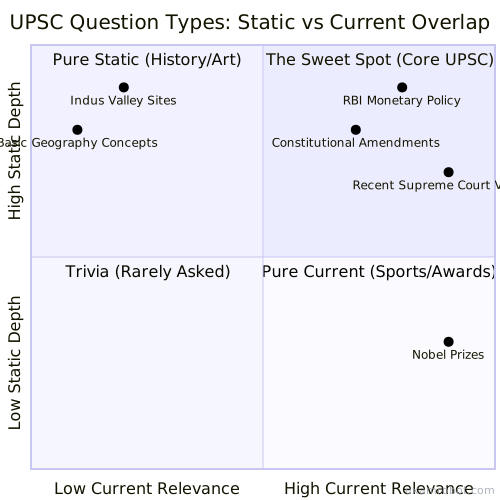
The myth of "pure current affairs" ruins many attempts. The modern examination paper is defined by a strict static-dynamic linkage. The commission rarely asks simple trivia about who won a sports tournament, though 2021 was a rare and bizarre exception.
Instead, the examiner uses the news as a trigger to test static knowledge. If the President of India is in the news for a recent election, the exam will not ask about the political campaign. It will ask a highly technical question about the static constitutional provisions governing the Electoral College and the value of an MLA's vote. If India-China relations are dominating the headlines due to border skirmishes, the resulting question will likely be a static geography map question about the exact mountain passes in the region.
You must learn to reverse-track the news. When you see a question about a specific new mRNA vaccine, realise that it is actually testing your static biology knowledge of T-cells and B-cells. The news article was just the inspiration; the answer lies in a standard biology textbook.
This method filters the noise. It teaches you exactly what to ignore in daily newspapers like The Hindu or The Indian Express. You learn to skip the political bickering and opinion columns, focusing entirely on policy announcements, economic data trends, and new environmental discoveries.
Furthermore, past papers reveal the 18-Month Rule. The commission's definition of "current" spans 18 to 24 months prior to the exam date, not just the last twelve months. During the 2022 Sri Lankan economic crisis, the examiner did not ask about the street protests. They asked a purely static Economy question about the "Real Effective Exchange Rate (REER)", a concept intrinsically linked to currency crises.
Managing Negative Marking and Understanding Cut-Off Trends
Building a risk-management strategy for exam day requires a cold, mathematical understanding of the marking scheme. Yes, there is a strict penalty of one-third of the marks assigned to the question. For General Studies Paper 1, where each question is worth 2 marks, every wrong answer deducts 0.66 marks. For the CSAT paper, where questions are worth 2.5 marks, a wrong answer deducts 0.83 marks.
You must find your personal accuracy rate through rigorous practice. If your historical accuracy is 70 percent, attempting 90 questions yields a highly favourable outcome. You would get 63 correct (126 marks) and 27 wrong (17.82 marks deducted), leaving you with a final score of 108.18 marks, well above any recent cut-off.
Analysing cut-off trends is sobering but necessary. The General category cut-off has steadily declined over recent years. It dropped from 92.51 in 2020 to 87.54 in 2021, then to 88.22 in 2022, before crashing to 75.41 in 2023. This massive drop reflects the increasing difficulty of the options, specifically the "Only Pairs" format, rather than the questions themselves. A cut-off of 75.41 translates to needing only about 38 net correct questions out of 100 to clear the toughest stage of the exam.
This data defines your calculated risk threshold. A student who attempts only 60 questions out of fear, even with a stellar 85 percent accuracy (51 correct, 9 wrong), scores 96.06. In tougher years this is safe, but in a standard year, it leaves absolutely no margin for error. The math strongly favours calculated guessing. You must push your attempts into the 75 to 85 range to build a buffer.
Common Mistake: Fearing negative marking so intensely that you attempt fewer than 65 questions. The mathematical probability strongly favours calculated guessing over extreme caution. Leaving too many questions blank is a guaranteed path to failure.
UPSC Prelims Mock Test vs. Solved PYQ Papers
In the final sixty days of preparation, you must differentiate between the utility of commercial mock tests and official past papers. They serve entirely different purposes.
Use a commercial mock test series primarily for administrative practice. Mocks are excellent for time management, building the physical stamina required for a two-hour sitting, and practising OMR bubbling under pressure. They teach you how to handle exam-day anxiety.
However, coaching institutes cannot perfectly replicate the nuanced, often ambiguous language of the actual examiner. Solved official papers are strictly superior for tuning your brain to the official logic. Many aspirants score 110 or more in coaching mocks but fail the actual exam because they mastered the coaching institute's logic, which often relies on obscure trivia, rather than the commission's logic, which tests the subtle application of core concepts.
Adopt the 3-Iteration Rule for past papers. You should solve the last ten years of papers at least three times. The first iteration is for baseline knowledge. The second iteration is for strict source mapping to your textbooks. The third iteration is purely for option trap analysis and understanding the psychology of the distractors.
This is especially critical for CSAT Paper 2. Do not rely solely on commercial mocks for CSAT reading comprehension. The passages in official papers have a very specific logical flow. Always use the official answer keys to understand exactly how the examiner interprets terms like "crux", "logical corollary", and "inference". Coaching keys frequently get these wrong, leading you down a dangerous path of incorrect reasoning.
- Analysis is a strict 4-step process: Solve the paper, Map the sources to standard books, Decode the distractors, and Extract the recurring themes.
- The 2023 and 2024 "Only Pairs" format severely limits blind elimination; you must focus on deep, factual conceptual clarity.
- Economy, Environment, and Polity are the absolute anchors, consistently yielding 45 to 50 questions combined.
- Always map current affairs back to the static syllabus (for example, news about a presidential election directly links to Electoral College articles).
- Negative marking deducts 0.66 marks in GS1; calculate your personal accuracy to find your optimal attempt rate (usually 75 to 85 questions) to clear the cut-off safely.
How to do pyq analysis for upsc prelims?
Break down each question into four distinct parts: answer the question correctly, map it directly to your standard textbook (like NCERT or Laxmikanth), research the three incorrect options to understand the examiner's traps, and log the core theme in a dedicated revision journal.
Is there negative marking in upsc prelims?
Yes, there is a strict penalty of one-third of the marks assigned to the question. For General Studies Paper 1, this means a deduction of 0.66 marks for every incorrect answer. For CSAT, it is a deduction of 0.83 marks.
What type of questions are asked in upsc prelims?
The exam features multiple-choice questions that blend static syllabus knowledge with dynamic current affairs. Recent trends include complex "Statement I & II" reasoning questions and "Only one pair/Only two pairs" formats that test deep factual accuracy rather than simple elimination.
How to analyse pyq of upsc CSAT Paper 2?
For CSAT, focus heavily on the official answer keys for Reading Comprehension to understand how the examiner defines terms like "logical corollary" and "crux". For the mathematics section, identify recurring formula applications, specifically in number systems and permutations.
What is the subject wise weightage in upsc prelims?
On average, Economy and Environment lead the paper with 15 to 18 questions each. They are followed closely by Polity and History, which average 14 to 16 questions each. Geography, Science & Tech, and Current Affairs make up the remainder of the paper.
Are upsc prelims question papers available in Hindi?
Yes, the official question paper is entirely bilingual. Every question is printed in both English and Hindi. For example, the upsc prelims question paper 2019 in hindi is readily available on the official website and across most preparation platforms.