How to Use ChatGPT for UPSC Preparation: Prompts & AI Tools
To use ChatGPT for UPSC preparation effectively, you must treat the artificial intelligence as a personalised tutor rather than a traditional search engine. The most successful aspirants use AI for concept simplification, answer evaluation, and structured brainstorming, rather than relying on it for blind fact retrieval.
For the Preliminary examination, AI is best utilised to reverse-engineer Previous Year Questions (PYQs). Instead of asking for the correct option, you can prompt the AI to explain the underlying concepts of all four options, simplifying dense topics like the Indian Constitution or macroeconomic indicators. For the Mains examination, prompt engineering allows you to simulate the 7-5-3 rule. By feeding your handwritten answers into the model, you can ask the AI to grade your structure, suggest missing dimensions, and refine your essay introductions.
Top candidates diversify their AI toolkit. They use Perplexity AI for real-time Current Affairs because it cites live web sources. They switch to Claude 3.5 Sonnet for nuanced Ethics (GS4) and Essay evaluation. They rely on ChatGPT's new Canvas feature for drafting and compressing revision notes. However, you must always cross-verify data-heavy queries, such as the exact number of Ramsar sites or specific committee recommendations, against official government sources to avoid AI hallucinations.
How to Use ChatGPT for UPSC Preparation: The Core Strategy
Aspirants often make the fundamental error of treating AI like a standard encyclopaedia. When you use an AI model as a direct replacement for Google Search, you will inevitably experience frustration when the system hallucinates facts. The expert approach involves treating the AI as a Socratic tutor. You use it to test your existing knowledge, simplify academic jargon, and structure your scattered thoughts, rather than blindly copying its generated output into your notes.
The primary difference between standard search and generative AI dictates how you should study. Search engines retrieve existing documents based on keywords. Generative AI predicts the next most logical word based on its training data to synthesise concepts. Understanding this distinction is vital. Because generative models predict rather than retrieve, they are prone to hallucinations. In the context of the Union Public Service Commission (UPSC) syllabus, a poorly prompted AI might invent a fictitious Supreme Court judgment or distort the chronological timeline of the Indian National Movement.
To counter this, you must shift from passive reading to active prompting. Instead of asking the AI to write a note for you, ask it to quiz you on a dense NCERT chapter. Ask it to explain the core philosophy of a topic as if you were a ten-year-old. This forces the model into a simplification role where it excels, rather than a factual recall role where it might fail.
Furthermore, integrating AI into your study ecosystem must be done with the final examination rules in mind. Rule 14 of the UPSC Civil Services Examination Rules 2024 strictly prohibits the use of any programmable device or storage media inside the examination hall. AI is strictly a preparatory tool designed to build your cognitive recall, not a crutch to replace your memory.
NITI Aayog's National Strategy for Artificial Intelligence (#AIforAll) explicitly identifies education as one of the five core sectors where AI can drive societal impact. The strategy emphasises personalised learning, which is exactly the benefit these tools provide for self-study aspirants who do not have access to round-the-clock coaching faculty.
- Prompt the AI with specific constraints: "I understand the Basic Structure Doctrine originated in Kesavananda Bharati. Quiz me on three subsequent cases that expanded it."
- Use AI to explain the mechanics of complex geographical phenomena like the El Nino Southern Oscillation.
- Do not ask open-ended factual questions like "What is the Basic Structure Doctrine?" without verifying the cited cases.
- Do not rely on AI to give you exact statistical data for your Mains answers without checking official government reports.
Relying on AI for highly specific, niche factual data without cross-verifying with official government sources (like the Press Information Bureau or PRS Legislative Research) is a fatal error. AI models will confidently present outdated or fabricated statistics if they lack the specific data in their training weights.
ChatGPT vs Claude vs Perplexity vs Deepseek: Which is Best?
No single AI model is flawless across all subjects. Top aspirants adopt a multi-model approach, routing specific syllabus tasks to the AI engine best suited for the job based on its underlying architecture and performance benchmarks.
Many students ask if Claude is better than ChatGPT for UPSC preparation. The answer is yes, specifically for General Studies Paper IV (Ethics, Integrity and Aptitude) and the Essay paper. Claude 3.5 Sonnet, released by Anthropic on June 20, 2024, demonstrates superior performance in graduate-level reasoning (the GPQA benchmark) compared to GPT-4o. Claude writes with a much more human-like nuance. It avoids the robotic, repetitive tone that ChatGPT often falls into, making it an exceptional evaluator for philosophical essays and ethical case studies.
Perplexity AI operates differently. It functions as a conversational search engine. Instead of relying solely on its internal training data, Perplexity browses the live web and provides inline citations for every claim it makes. This architecture makes it the absolute best tool for Current Affairs, International Relations, and tracking the latest government schemes.
Deepseek (specifically versions V2 and V3) excels in mathematical reasoning and coding logic. This makes it highly effective for the Civil Services Aptitude Test (CSAT). When you need step-by-step breakdowns of logical reasoning puzzles, permutations, combinations, or data interpretation questions, Deepseek often outperforms its competitors by providing clearer mathematical proofs.
Meanwhile, ChatGPT (running on GPT-4o) remains the best all-rounder. It is unmatched for summarising broad General Studies syllabus topics, generating quick revision tables, and utilising advanced interface features like Canvas for long-form note organisation.
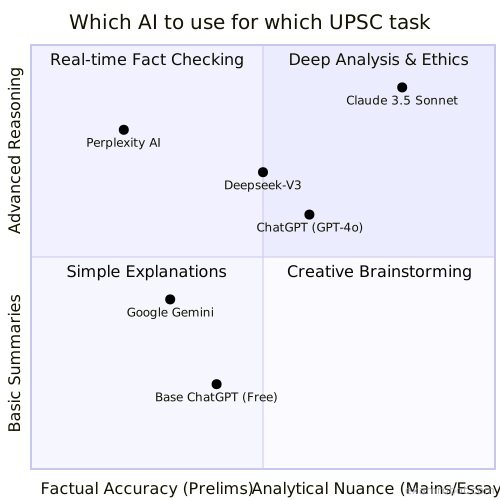
Use Perplexity for Prelims fact-checking where you need live web sources, and switch to Claude 3.5 Sonnet for evaluating your Mains answers where you need nuanced, human-like feedback.
How to Write Prompts for ChatGPT: The UPSC Framework
Generic prompts yield generic, unusable answers. If you type "Tell me about the Indian Economy", the AI will generate a shallow summary that is entirely useless for a competitive examination. To master prompt engineering, aspirants must adopt the RTCF Framework (Role, Task, Context, Format). This method forces the AI into the strict mindset of a UPSC examiner.
The RTCF Framework breaks down as follows:
- Role: Assign a specific persona to the AI. This narrows the probability distribution of the words it generates. Example: "Act as a strict UPSC Mains evaluator with twenty years of experience checking GS2 papers."
- Task: Define the exact action you want the AI to perform. Example: "Evaluate this handwritten GS2 answer on the anti-defection law."
- Context: Provide the syllabus boundaries and specific requirements. Example: "Focus strictly on constitutional articles, the Tenth Schedule, and recent Supreme Court judgments like Kihoto Hollohan."
- Format: Control the visual output to save time during revision. Example: "Limit your feedback to 150 words. Provide a table with Marks out of 10 and three actionable improvements."
This structured approach is the secret to using AI effectively for studying. It transforms the AI from a generic chatbot into a highly specialised academic assistant.
Consider a practical example for General Studies Paper III (Economy). Instead of asking "What is Repo Rate?", an RTCF prompt would look like this: "Act as an expert UPSC Economics faculty. Explain the difference between Repo Rate and Bank Rate. Context: GS3 Economy syllabus, focusing on inflation targeting. Format: A simple comparison table with real-world examples of how the Reserve Bank of India uses them."

Tackling Prelims & PYQs with AI: A Reality Check
While AI is excellent at explaining broad concepts, it struggles significantly with the tricky, multi-statement multiple-choice questions (MCQs) characteristic of the UPSC Prelims. Aspirants must use AI to reverse-engineer these questions and understand why a specific option is wrong, rather than just asking the AI to solve the paper.
The reality of AI performance in competitive Indian examinations is sobering. In a simulated performance test conducted in May 2023, ChatGPT (using the GPT-4 model) scored only 11 marks out of a total of 372 in the JEE Advanced examination, failing to meet the aggregate qualifying cutoff of 86 marks. Similarly, in a simulated attempt of the UPSC Civil Services Preliminary Examination 2022 (General Studies Paper-I), ChatGPT scored only 54 marks out of 200. This represented a mere 27 percent accuracy rate after accounting for negative marking, failing completely to meet the General category cutoff of 88.22 marks. The AI is a tool to aid your study, not a genius that can clear the exam for you.
You should use AI for static syllabus queries where the facts are established. For example, if you ask about the parts of the Indian Constitution, the AI can clearly explain the evolution to 25 Parts and 12 Schedules. It will detail the additions of Parts IV-A (Fundamental Duties), IX-A (The Municipalities), IX-B, and XIV-A, alongside the deletion of Part VII.
However, for dynamic or current queries, standard AI models often fail due to outdated training data. If you ask "How many Ramsar sites are in India?", a standard model might give you a number from 2022. You must use a web-connected tool like Perplexity to ensure you get the latest data. As of August 14, 2024, India has 85 Ramsar sites covering 1.35 million hectares, including recent additions like the Nanjarayan Bird Sanctuary, Kazhuveli Bird Sanctuary, and the Tawa Reservoir.
AI is highly valuable for deep-diving into complex PYQ themes. Poverty estimation is a frequent UPSC topic. You can prompt the AI to compare the specific methodologies of different committees. Ask it to explain how the Tendulkar Committee (2009) shifted the poverty line measurement from a calorie-norm to Monthly Per Capita Expenditure (MPCE) incorporating health and education. Then, ask it to contrast this with the Rangarajan Committee (2014), which estimated the poverty line at ₹972 per month for rural areas and ₹1,407 per month for urban areas.
When solving PYQs, paste the question text and prompt the AI: "Do not give me the correct answer. Explain the core concept behind each of the four options so I can deduce the answer myself."
How to Use ChatGPT for UPSC Mains Preparation
The biggest hurdle in the Mains examination is time management and answer structuring. You have to write extensively under immense time pressure. AI can act as a rapid feedback loop for your daily answer writing practice, helping you simulate the famous 7-5-3 rule.
The 7-5-3 rule is a time and structure management strategy designed for the UPSC Mains. The General Studies papers (I to IV) consist of 20 questions totalling 250 marks, to be completed within a 180-minute duration. The rule breaks down as follows:
- 7 Minutes: The target time to write a 10-mark question (which has a strict 150-word limit). For 15-mark questions (250 words), the time extends to roughly 11 minutes.
- 5 Points: The requirement to provide at least five distinct, multi-dimensional points (Social, Economic, Political, Environmental, Technological) to demonstrate breadth of knowledge.
- 3 Parts: The structural mandate of every answer, comprising an Introduction, a Body, and a Conclusion.
To use ChatGPT for Mains preparation, type out your handwritten answer (or use a text scanner) and paste it into the chat. Prompt the AI: "Evaluate this answer based on the UPSC 7-5-3 rule. Did I provide five distinct dimensions? Is the three-part structure clear? Point out any redundant sentences."
You can also use AI to learn the art of concise writing, which is demanded by UPSC word limits. Ask the AI to generate a detailed 250-word model answer to a PYQ. Once generated, prompt the AI to "compress this exact answer into 150 words while retaining all five core dimensions." Analysing the difference between the two outputs will teach you how to eliminate filler words and write with economy.
For the Essay paper, you can use Claude or ChatGPT for brainstorming hooks. Provide the AI with a philosophical essay topic from a past paper and ask it to generate three different opening styles: a historical anecdote, a relevant quote from a thinker, and a contemporary real-world example.

Visualizing Data: Canva, PPTs & Image Generation
Visual memory significantly aids retention for subjects like Geography, Art and Culture, and Environment. Aspirants can use AI to generate visual study aids, completely bypassing the hours usually spent on manual formatting and design.
If you use the premium version of ChatGPT, you can utilise the Canva plugin available within the GPT store. This allows you to instantly generate infographics for complex cycles. You can prompt the AI to create a visual flowchart of the Nitrogen Cycle or a timeline of the Constitutional Amendments, and it will output a ready-to-save Canva graphic.
For those who prefer slide decks for revision, you can ask ChatGPT to write VBA (Visual Basic for Applications) code. For example, prompt the AI: "Write a VBA script for a PowerPoint presentation on the Causes of the 1857 Revolt, with five slides detailing political, economic, and social causes." You simply copy this code, open PowerPoint, press Alt+F11, paste the code, and run it. The software will auto-generate the text slides for you.
A common question is how many images ChatGPT can generate for free. The free tier of ChatGPT has highly restricted or zero access to the DALL-E 3 image generation engine. If you want free AI images to visualise Geography concepts or historical architecture, you should use Microsoft Copilot. Copilot runs on the exact same DALL-E 3 engine and provides users with 15 free daily generation boosts.
Use AI to generate custom mnemonic acronyms for difficult lists, such as the countries bordering the Black Sea or the chronological order of the Mughal Emperors.
Managing Your Study Workspace: Canvas, Archiving & Exporting
A serious aspirant will generate hundreds of chat threads over a year of preparation. Knowing how to manage this data, customise the interface, and export notes into offline PDFs is critical for organised, stress-free revision.
OpenAI officially introduced a feature called 'Canvas' on October 3, 2024. Canvas opens a side-by-side window for writing and editing, separate from the main chat thread. (Claude offers a very similar feature called 'Artifacts', launched earlier in June 2024). Canvas is perfect for drafting essays. You can highlight specific paragraphs in your essay draft and use built-in shortcuts to ask the AI to "adjust length" (to fit the 150 or 250-word limits) or "change reading level" (to simplify dense articles from the Economic Survey or Yojana magazine) without losing your main document structure.
Exporting these notes for offline study is straightforward. For immediate PDF conversion of a specific chat thread, the fastest technical method is using your browser's print function (Ctrl+P on Windows or Cmd+P on Mac) and selecting "Save as PDF" as the destination.
If you want to perform a bulk export of your entire study history, you must navigate to Settings > Data Controls > Export Data. This action triggers an email from OpenAI containing your complete chat history in HTML and JSON formats, ensuring you have an offline backup of all your GS paper summaries.
To keep your sidebar clean, you can archive old chats. Navigate to Settings > General > Archived Chats to retrieve older study sessions that you previously hid. If your sidebar becomes too cluttered with random, non-study queries, you can go to Settings > General > Clear all chats to start fresh for a new phase of your preparation.
The Future: How Will ChatGPT Change Education & Exam Prep?
Artificial intelligence is fundamentally shifting competitive exam preparation from an environment of resource-scarcity to one of resource-abundance. Previously, success heavily depended on having access to expensive coaching institutes in Delhi. Today, the differentiator is no longer access to information, but the cognitive ability to apply that information critically.
The focus of study is moving rapidly from rote memorisation to critical analysis. AI levels the playing field for rural and self-study aspirants who cannot afford premium coaching. However, AI will not replace the hard work of daily answer writing practice. It will simply replace the aspirants who refuse to use AI to optimise their limited study time.
The Government of India is actively integrating AI into the educational framework. The 'IndiaAI Mission', launched with a massive budget outlay of ₹10,371.92 crore in 2024, aims to foster AI innovation and literacy across the country. Furthermore, the Bhashini Mission (National Language Translation Mission), launched in July 2022, is developing AI-based language tools in 22 scheduled Indian languages. This will soon allow aspirants writing the Mains examination in regional languages to prepare using AI tools translated seamlessly into their mother tongue.
Ethical use and data privacy remain paramount. The Digital Personal Data Protection (DPDP) Act, notified in the Gazette of India on August 11, 2023, governs how AI models handle Indian citizens' data, drawing its legal basis from the Right to Privacy under Article 21 of the Constitution. Additionally, the Ministry of Electronics and Information Technology (MeitY) issued an advisory on March 1, 2024, requiring platforms to ensure their AI models do not permit bias or discrimination. Aspirants should remain mindful of privacy and avoid uploading personal, sensitive documents to public AI models.
- Treat AI as a Socratic tutor to test your knowledge, not as a flawless encyclopaedia; always verify factual data like Ramsar site counts or committee statistics.
- Use the RTCF framework (Role, Task, Context, Format) for precise, UPSC-tailored prompt engineering to avoid generic summaries.
- Utilise Claude 3.5 Sonnet for Ethics and Essays, Perplexity for live Current Affairs, and ChatGPT for summarising dense NCERTs.
- Simulate the 7-5-3 rule by asking AI to evaluate your handwritten answers for multi-dimensional points and strict structural formatting.
- Export important AI-generated notes to PDF and use the new Canvas feature for side-by-side essay drafting and word-count compression.
How to use ChatGPT for UPSC preparation?
Use it for concept simplification, summarising dense government reports, and evaluating Mains answers using structured RTCF prompts. Avoid using it for blind fact-checking without verifying the data against official sources.
Is Claude better than ChatGPT for UPSC preparation?
Yes, specifically for GS4 Ethics and Essay writing. Claude 3.5 Sonnet provides more nuanced, human-like reasoning and avoids ChatGPT's standard robotic tone, making it superior for philosophical evaluation.
What is the 7 5 3 rule UPSC?
It is a strict time and structure management strategy for the Mains examination: 7 minutes per 10-mark question, 5 multi-dimensional points per answer, and 3 distinct parts (Introduction, Body, Conclusion).
How deepseek is better than chatgpt?
Deepseek (specifically V2 and V3) excels in mathematical and logical reasoning, making it highly effective for CSAT preparation, logical puzzles, and data interpretation breakdowns.
How perplexity ai is different from chatgpt?
Perplexity acts as a conversational search engine that actively browses the live web and provides inline citations for its claims, making it far superior for tracking current affairs and recent government schemes.
How much chatgpt scored in jee advanced?
In a May 2023 test, ChatGPT (GPT-4) scored only 11 out of 372 in JEE Advanced, and it failed a simulated UPSC Prelims 2022 with 54 marks. This highlights that AI struggles significantly with complex, multi-layered MCQs.
How will chatgpt change education?
It shifts the educational focus from rote memorisation to critical thinking and personalised learning, effectively levelling the playing field for self-study and rural aspirants who lack access to traditional coaching.