United Nations Organization Organs: UPSC Notes & PYQs
The United Nations (UN) is an international organisation founded in 1945 to maintain global peace and security. Built on the ashes of the Second World War, it was designed to succeed where the League of Nations had failed. There are exactly six principal organs of the United Nations, established by the UN Charter to handle different aspects of global governance. These six organs are the General Assembly, the Security Council, the Economic and Social Council, the Trusteeship Council, the International Court of Justice, and the Secretariat.
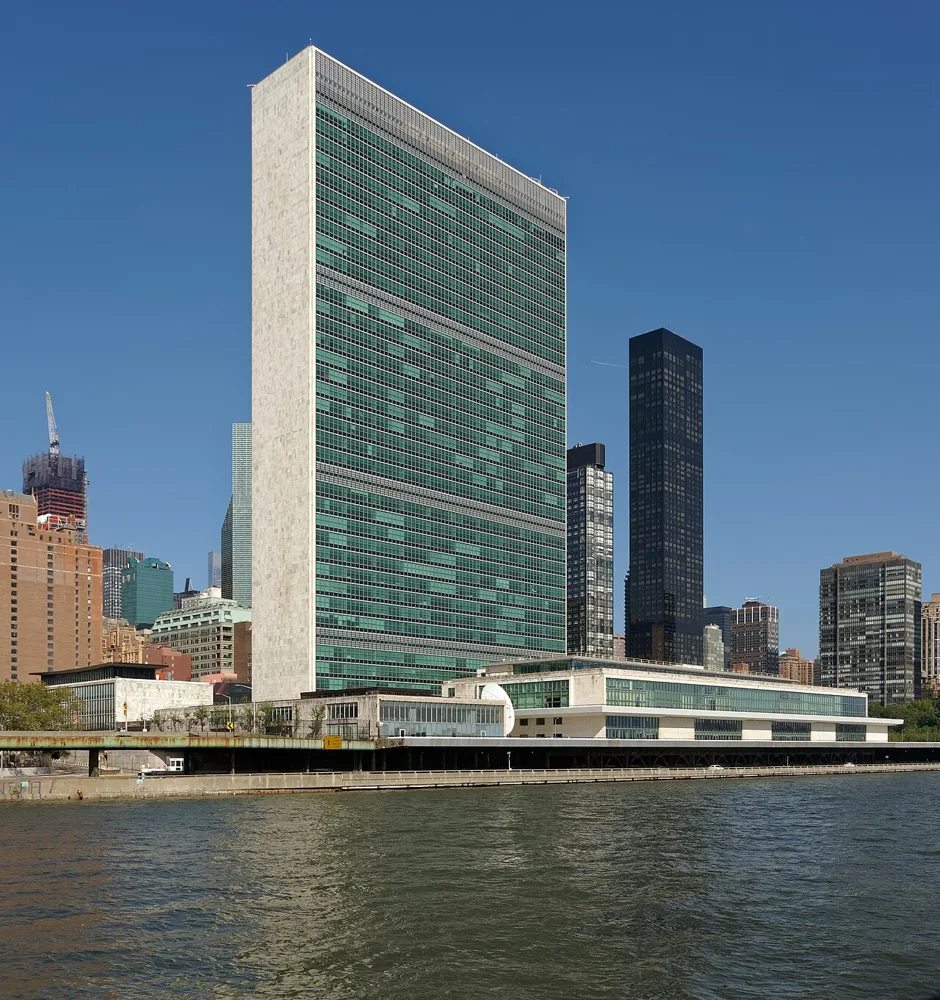
The UN Headquarters is located in New York, USA, except for the International Court of Justice, which is based in The Hague, Netherlands. The Secretariat carries out the daily administrative work of the organisation and is currently headed by UN Secretary-General António Guterres.
Understanding the structure and functions of these six organs is fundamental for the UPSC examination. They frequently appear in both Prelims and Mains, testing your grasp of international relations, diplomatic history, and the evolving nature of global governance.
Evolution and Formation of the UN System
The League of Nations, established after the First World War, ultimately failed to prevent the outbreak of the Second World War. When the fighting stopped, the international community realised that a new body was required, one equipped with the authority and the structural "teeth" to enforce global security. Thus, the United Nations was formed on October 24, 1945, with 51 original member states replacing the flawed League of Nations.
The early days of the organisation required strong administrative leadership to build trust among nations. Trygve Lie of Norway was elected as the first UN Secretary-General, setting the precedent for the administrative backbone of the institution.
Today, the organisation is navigating a completely different geopolitical reality. As the UN approaches its 80th anniversary in 2025, there is a growing consensus that its 1945 architecture needs an overhaul. In September 2024, the UN hosted the "Summit of the Future" in New York. This once-in-a-generation event concluded with the adoption of the 'Pact for the Future', an intergovernmental agreement aimed at reforming global governance. The summit also saw the adoption of the Global Digital Compact, which focuses on international cooperation regarding digital technology and artificial intelligence.
During this summit, India made a strong case for structural changes. Prime Minister Narendra Modi advocated for UN reforms at the 2024 Summit, stating that "Reform is the key to relevance." He emphasised that the success of humanity lies in collective strength, not on the battlefield, making the reform of global institutions an urgent necessity. For more details on the Summit of the Future 2024 and India's push for Digital Public Infrastructure on the global stage, visit our current affairs section.
The Six United Nations Organization Organs
Think of the United Nations as a global government with distinct branches. Just as a nation state divides power among its legislature, executive, and judiciary, the UN Charter establishes six principal organs to divide legislative, executive, economic, and judicial responsibilities. The General Assembly functions much like a global parliament, the Security Council acts as the executive branch with enforcement powers, and the International Court of Justice serves as the judiciary.

Here are the six principal organs of the United Nations:
| Principal Organ | Primary Function |
|---|---|
| 1. General Assembly (UNGA) | The main deliberative, policymaking, and representative organ. |
| 2. Security Council (UNSC) | Responsible for the maintenance of international peace and security. |
| 3. Economic and Social Council (ECOSOC) | The principal body for coordination, policy review, and recommendations on economic and social issues. |
| 4. Trusteeship Council | Administered trust territories (Operations are currently suspended). |
| 5. International Court of Justice (ICJ) | The principal judicial organ, settling legal disputes between states. |
| 6. Secretariat | The administrative backbone that carries out the day-to-day work of the UN. |
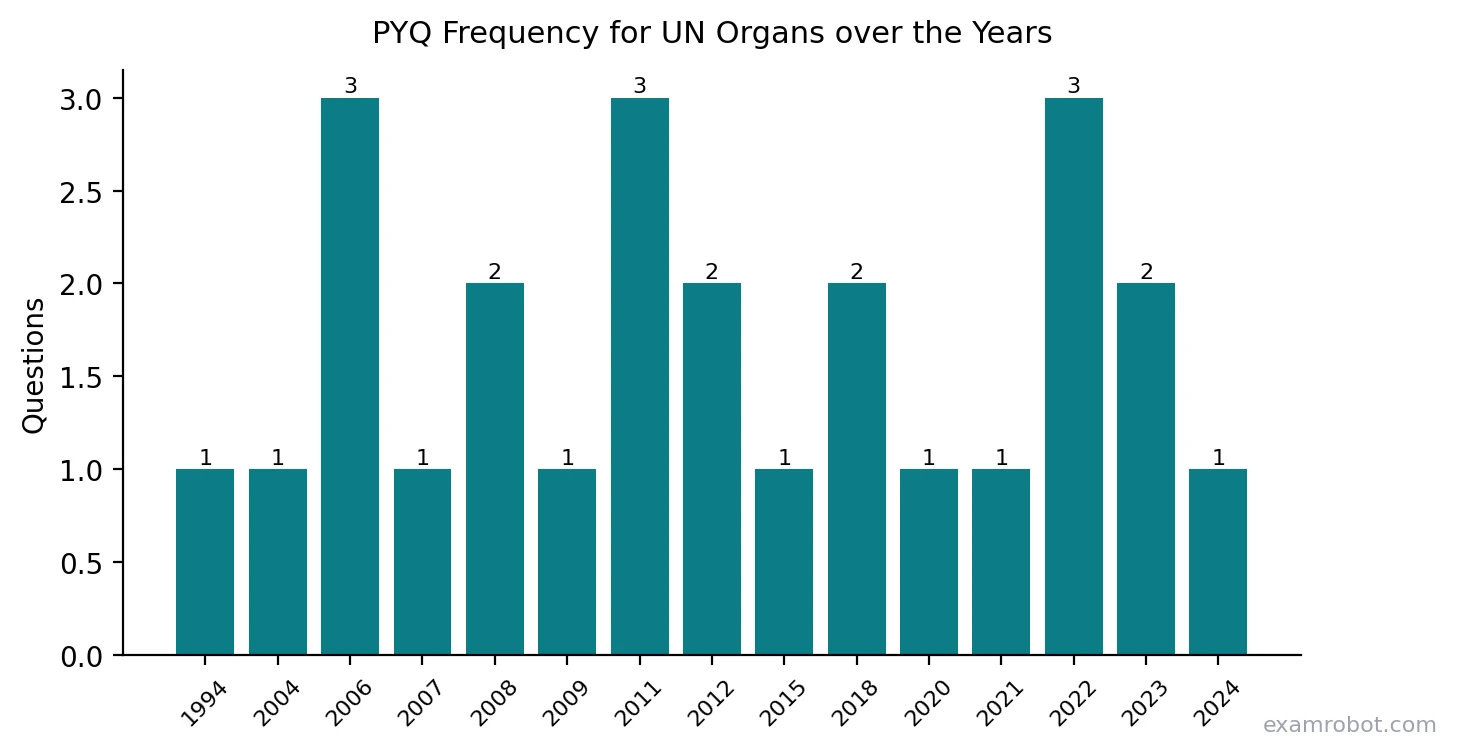
United Nations General Assembly & ECOSOC
The General Assembly is the only UN organ with universal representation, meaning all member states have an equal voice. It is the deliberative heart of the organisation. Beyond full members, the UNGA has the authority to grant observer status to non-member states (such as the Holy See and the State of Palestine) as well as inter-governmental organisations. These Permanent Observers are permitted to maintain missions at the UN headquarters, allowing them to participate in the work of the General Assembly, though they do not have voting rights.
The Economic and Social Council (ECOSOC) is the socio-economic engine of the UN system. It coordinates the work of the 14 UN specialised agencies, ten functional commissions, and five regional commissions. When the UN was founded, ECOSOC originally had 18 members. However, as decolonisation brought many new nations into the UN, the UN Charter was amended to expand ECOSOC to 54 member states. This expansion was done to ensure diverse geographical representation from across the globe. ECOSOC members are elected by a two-thirds majority of the General Assembly and serve a three-year term.
Practice Question (IAS 2022)
With reference to the United Nations General Assembly, consider the following statements :
1. The UN General Assembly can grant observer status to the non-member States.
2. Inter-governmental organisations can seek observer status in the UN General Assembly.
3. Permanent Observers in the UN General Assembly can maintain missions at the UN headquarters.
Which of the statements given above are correct?
- 1 and 2 only
- 2 and 3 only
- 1 and 3 only
- 1, 2 and 3
Correct Answer: d. The UNGA has the authority to grant observer status to non-member states and IGOs, allowing them to maintain missions at the UN headquarters.
Practice Question (IAS 2009)
With reference to the United Nations, consider the following statements :
1. The Economic and Social Council (ECOSOC) of UN consists of 24 member States.
2. It is elected by a 2/3 majority of The General Assembly for a 3-year term.
Which of the statements given above is/are correct?
- 1 only
- 2 only
- Both 1 and 2
- Neither 1 nor 2
Correct Answer: b. ECOSOC consists of 54 member states (originally 18), elected by a two-thirds majority of the General Assembly for a three-year term.
United Nations Security Council Veto Power
The United Nations Security Council (UNSC) is the geopolitical powerhouse of the UN. While the General Assembly can only make recommendations, the Security Council has the power to make decisions that member states are obligated to implement under the UN Charter. The five permanent members (P5) hold the ultimate "kill switch" for global resolutions, creating a disproportionate power dynamic that defines modern international relations.
The UNSC consists of 15 members in total: 5 Permanent members (China, France, Russia, the United Kingdom, and the United States) and 10 Non-Permanent members. This was not always the case. Originally, the Council had 11 members (with only 6 non-permanent seats) until a 1965 amendment to the UN Charter expanded it to its current size.

The 10 non-permanent members are elected by the General Assembly for a two-year term. To ensure global balance, the UN strictly follows a regional distribution for these 10 seats. There are 5 seats allocated for Africa and Asia, 1 for Eastern Europe, 2 for Latin America and the Caribbean, and 2 for Western Europe and Others.
The most debated aspect of the UNSC is the Veto Power, outlined in Article 27 of the UN Charter. Decisions on procedural matters require the affirmative vote of any nine members. However, decisions on all other matters (non-procedural matters) require nine affirmative votes, including the concurring votes of the permanent members. This means that a single negative vote (a veto) from any P5 member stalls a resolution completely, regardless of how much international support it has.
Practice Question (NDA-II 2023)
Which among the following statements regarding the election of non-permanent members to the United Nations Security Council is/are correct ?
1. Five members coming from Africa and Asia, one from Eastern Europe, two from Latin America and two from Western Europe and other states.
2. They are elected for a term of two years by a two-thirds majority of the General Assembly.
Select the correct answer using the code given below:
- 1 only
- 2 only
- Both 1 and 2
- Neither 1 nor 2
Correct Answer: a. The non-permanent seats are distributed exactly as 5 for Africa/Asia, 1 for Eastern Europe, 2 for Latin America, and 2 for Western Europe and Others.
Practice Question (NDA-I 2021)
Which of the following statements about the non-permanent members of the Security Council of the United Nations is/are correct?
1. Their total number is now 10, but was originally only 6.
2. They are elected for a term of two years only.
Select the correct answer using the code given below:
- 1 only
- 2 only
- Both 1 and 2
- Neither 1 nor 2
Correct Answer: c. The UNSC originally had 6 non-permanent members until a 1965 amendment increased the number to 10, all serving two-year terms.
Practice Question (IAS 1994)
Which one of the following statements regarding the "veto" power in the Security Council is correct according to the United Nations Charter ?
- The decisions of the Security Council on all non-procedural matters must be made by an affirmative vote of nine members, including the concurring, votes of the permanent members of the Council
- Every permanent member of the Security Council can prevent any decision from being accepted, by vetoing it
- The term veto was used in Article 27 of the United Nations Charter to enable any permanent member of the Security Council to prevent any resolution from being passed by the majority
- Any member of the Security Council can prevent any resolution from being passed by voting against it
Correct Answer: a. Article 27 explicitly states that decisions on non-procedural matters require nine affirmative votes, including the concurring votes of the permanent members.
Practice Question (CDS-II 2012)
Which one among the following statements about Veto Power with regard to United Nations is correct?
- One veto can stall a Security Council resolution
- It is a kind of positive vote power
- The Secretary General uses this power when not satisfied with any decision of the Council
- All the members of the Security Council possess the veto power
Correct Answer: a. A single negative vote from any of the five permanent members acts as a veto and completely stalls a resolution.
The structural inequalities of the UNSC are a major focus in the UPSC Mains examination. The veto power often leads to institutional deadlock, making reform both necessary and incredibly difficult to achieve.
Mains Practice Question (GS2 2015)
Discuss the impediments India is facing in its pursuit of a permanent seat in UN Security Council. (Answer in 200 words)
Examiner Analysis: While the 2015 question focused on India’s global diplomatic impediments for a permanent UNSC seat, the examiner's lens subsequently shifted toward internal dimensions of security and regional stability. In recent years, the framing moved from international institutional barriers to the multidimensional threats posed by state and non-state actors, specifically focusing on border policing and bilateral crisis management.
Answer Approach: Begin by stating that India’s bid for a permanent seat in the UNSC reflects its role as a leading power, seeking to reform the 1945 post-WWII architecture to mirror contemporary realities. In the body, address the institutional and procedural barriers. Explain the "Veto Paradox", where any amendment to the UN Charter requires approval and ratification by all current P5 members, who are reluctant to dilute their exclusive power. Highlight opposition from regional rivals (like the Uniting for Consensus or Coffee Club) and the lack of a unified African position.
Mains Practice Question (GS2 2025)
"The reform process in the United Nations remains unresolved, because of the delicate imbalance of East and West and entanglement of the USA vs. Russo-Chinese alliance." Examine and critically evaluate the East-West policy confrontations in this regard. (Answer in 250 words)
Examiner Analysis: The examiner has transitioned from testing institutional survival within specific economic frameworks to analysing systemic paralysis caused by geopolitical polarity. The 2025 framing elevates the discussion to a structural East-West deadlock that blocks global reform processes. The shift moves from normative concerns to a realist evaluation of superpower entanglements.
Answer Approach: Introduce the topic by noting that the United Nations faces a legitimacy crisis as its structures fail to reflect contemporary geopolitical realities. The deadlock in reform stems from a new Cold War dynamic, where the Security Council has become a theatre for the strategic rivalry between the Western bloc (led by the USA) and the Eurasian axis (Russia and China). In the body, evaluate the structural veto deadlock. Explain how frequent use of the veto on issues like Syria, Ukraine, and the Middle East paralyses the system. Critically examine how both blocs use UN reform proposals not to improve global governance, but to prevent the other side from gaining a strategic advantage.
International Court of Justice & Trusteeship Council
The International Court of Justice (ICJ) is the principal judicial organ of the UN, tasked with settling legal disputes submitted by states and giving advisory opinions on legal questions. The ICJ consists of 15 judges, and to maintain strict impartiality and global representation, no two members can be nationals of the same State. The election process is rigorous. The General Assembly and the Security Council proceed independently of one another to elect the members of the ICJ, and a candidate must receive an absolute majority of votes in both bodies to be elected.
On the other end of the spectrum is the Trusteeship Council, which can be thought of as the UN's retired organ. It was originally established to supervise the administration of trust territories and ensure that adequate steps were taken to prepare them for self-government or independence. The Trusteeship Council suspended its operations on November 1, 1994, following the independence of Palau, which was the last remaining UN trust territory.
Common Mistake: Students often assume that the Trusteeship Council was "abolished" after its work was completed. This is incorrect. The Trusteeship Council is merely "suspended". It still exists on paper within the text of the UN Charter, and formally abolishing it would require a complex Charter amendment.
Practice Question (CDS-I 2024)
Which of the following statements about the International Court of Justice is/are correct?
1. The Court consists of members, wherein two members cannot be nationals of the same State.
2. The General Assembly and the Security Council proceed independently of one another to elect the members of the Court.
Select the correct answer using the code given below:
- 1 only
- 2 only
- Both 1 and 2
- Neither 1 nor 2
Correct Answer: c. The ICJ has 15 judges of different nationalities, elected independently by both the UNGA and the UNSC.
Practice Question (CDS-II 2011)
Which one among, the following statements about United Nations organs is correct ?
- Decisions of the General Assembly are binding on all members
- The term of the non-permanent members of the Security Council is for three years
- International Court of Justice has 20 Judges elected for a period of five years
- The Trusteeship Council has been suspended since 1 November 1994
Correct Answer: d. The Trusteeship Council suspended its operations on November 1, 1994, following the independence of Palau.
United Nations Secretariat & Secretary-General List
While the General Assembly and Security Council make the headlines, the Secretariat is the administrative backbone that actually keeps the United Nations running. It carries out the day-to-day work of the organisation, from administering peacekeeping operations to surveying economic trends. The Secretariat is headed by the Secretary-General, who acts as the chief administrative officer of the UN.
The history of the Secretaries-General is frequently tested in UPSC exams, particularly regarding their backgrounds and chronological order. For instance, Kofi Annan of Ghana was the first UN Secretary-General to be appointed from the ranks of the UN staff, having worked his way up through the organisation before serving two terms at its helm.
Here is the chronological order of key Secretary-Generals that you must remember for the exam:
| Order | Secretary-General | Country of Origin |
|---|---|---|
| 1 | Trygve Lie | Norway |
| 2 | Dag Hammarskjöld | Sweden |
| 3 | U Thant | Burma |
| 4 | Kurt Waldheim | Austria |
| 5 | Javier Pérez de Cuéllar | Peru |
| 6 | Boutros Boutros-Ghali | Egypt |
| 7 | Kofi Annan | Ghana |
| 8 | Ban Ki-moon | South Korea |
| 9 | António Guterres | Portugal (Current) |
Practice Question (IAS 2006)
Consider the following statements:
I. Kofi Annam, the UN Secretary General, is from Nigeria.
II. Kofi Annam is the first UN Secretary General to be appointed from the ranks of the United Nations staff.
III. Kofi Annam was appointed for a second term to the office.
Which of the statements given above are correct?
- I, II and III
- I and II only
- II and III only
- None of these
Correct Answer: c. Kofi Annan was from Ghana, not Nigeria, and he was the first Secretary-General appointed from the UN staff, serving two terms.
Practice Question (CDS-II 2008)
Which one of the following is the correct chronological order of the Secretary Generals of the United Nations ?
- U. Thant, K. Waldheim, B.B. Ghali, K. Annan
- K. Waldheim, U. Thant, B.B. Ghali, K. Annan
- U. Thant, K. Waldheim, K. Annan, B. B. Ghali
- K. Waldheim, B. B. Ghali, U. Thant, K. Annan
Correct Answer: a. The correct sequence of their tenures is U Thant, followed by Kurt Waldheim, Boutros Boutros-Ghali, and then Kofi Annan.
Official Languages of United Nations
Clear communication is the bedrock of global diplomacy. To facilitate this, the UN recognises exactly six official languages for its documents and simultaneous interpretation during meetings. A common trap in the UPSC exam is presenting widely spoken languages as official UN languages. Remember that Hindi, German, and Portuguese are NOT official languages of the UN, despite their massive global speaker bases.
Arabic was the most recent addition to this linguistic framework, becoming an official language of the General Assembly in 1973.
To easily recall the six official languages, you can use the mnemonic FACERS:
| Letter | Official Language |
|---|---|
| F | French |
| A | Arabic |
| C | Chinese |
| E | English |
| R | Russian |
| S | Spanish |
Practice Question (CDS-I 2007)
Which of the following is not one of the official languages of the United Nations ?
- Arabic
- Spanish
- Hindi
- Russian
Correct Answer: c. Hindi is not an official language of the UN; the six official languages are Arabic, Chinese, English, French, Russian, and Spanish.
Practice Question (CDS-I 2006)
Which one of the following is not an official language of the United Nations ?
- Arabic
- Chinese
- Portuguese
- Spanish
Correct Answer: c. Portuguese is widely spoken but is not one of the six official languages of the United Nations.
Practice Question (CAPF 2023)
Which of the following is/are not an official language(s) of the United Nations?
1. Arabic
2. German
3. Spanish
4. Chinese
Select the correct answer using the code given below:
- 1 and 3 only
- 1 and 4 only
- 1 and 2 only
- 2 only
Correct Answer: d. German is not an official UN language, whereas Arabic, Spanish, and Chinese are officially recognised.
Achievements of United Nations & The Kashmir Resolution
When assessing the UN's actual impact over the last eight decades, its achievements are significant. The organisation successfully spearheaded the decolonisation process, helping dozens of nations gain independence and transition to self-government. It drafted the Universal Declaration of Human Rights in 1948, creating a global standard for human dignity that continues to influence domestic constitutions worldwide. Furthermore, its extensive peacekeeping operations have saved countless lives in conflict zones. India holds a proud record here, consistently remaining one of the top troop contributors to UN peacekeeping missions, demonstrating a steadfast commitment to global stability.
However, the UN's historical interventions are not without diplomatic complexities, particularly for India. The United Nations Kashmir Resolution (UNCIP Resolution 47 of 1948) originally called for a ceasefire, a truce agreement, and a plebiscite. Today, India firmly maintains that under the 1972 Simla Agreement, the Kashmir issue is a strictly bilateral matter between India and Pakistan. Consequently, India views the old UN resolutions on Kashmir as obsolete and irrelevant to the current diplomatic framework, rejecting any third-party mediation.
To practice more questions on international organisations, utilise ExamRobot's united nations upsc pyq bank and integrate these united nations upsc notes to thoroughly prepare for your united nations upsc prelims module.
How many principal organs of the United Nations are there?
There are exactly six principal organs established by the UN Charter in 1945.
What are the six principal organs of the United Nations?
General Assembly, Security Council, Economic and Social Council, Trusteeship Council, International Court of Justice, and Secretariat.
What is the function of the United Nations Secretariat?
It serves as the administrative backbone of the UN, carrying out the day-to-day work and implementing policies set by other organs.
Who is the current United Nations Secretary General?
António Guterres of Portugal is the current Secretary-General.
What are the official languages of the United Nations?
There are six: Arabic, Chinese, English, French, Russian, and Spanish.
Is the Trusteeship Council still active?
No, it suspended its operations on November 1, 1994, after Palau gained independence, though it still exists in the UN Charter.