Indus Valley Civilization: Extent, Sites, Town Planning
The Indus Valley Civilization, also known as the Harappan Civilization, was the earliest known urban culture of the Indian subcontinent. It flourished during the Bronze Age, primarily along the Indus River and the Ghaggar Hakra river system.
The Mature Harappan phase, representing its absolute urban peak, dates from 2600 BCE to 1900 BCE. The early formative phase spanned 6000 to 2600 BCE, and the late phase lasted from 1900 to 1300 BCE. This era is distinguished by its highly advanced town planning, standardized weights and measures, an undeciphered script, and a predominantly secular, trade oriented society.
Discovered in the 1920s by Archaeological Survey of India archaeologists, with Dayaram Sahni excavating Harappa and R.D. Banerji uncovering Mohenjo-daro, it remains a massive cornerstone of Ancient Indian History for the UPSC examination. Understanding this topic requires you to look beyond the ruins and see a highly organized, peaceful society that laid the foundational cultural bedrock of modern India.
Geographical Extent and River Systems
Imagine a map of the ancient world. While contemporary cultures in Egypt and Mesopotamia were confined to relatively narrow river valleys, the Harappan culture spread over a vast expanse. It stretched across modern day India, Pakistan, and Afghanistan, making it the largest among the ancient civilizations in terms of geographical area.
The core area flourished in the basins of the Indus River and the Ghaggar Hakra river, which historians frequently identify with the ancient Saraswati river. To understand its massive footprint, we look at its extreme boundary points. In the north, the settlement of Manda in Jammu and Kashmir sat on the banks of the Chenab river. To the south, Daimabad in Maharashtra marked the boundary along the Pravara river. The easternmost limit was Alamgirpur in Uttar Pradesh on the Hindon river, while the western extreme reached Sutkagendor in Balochistan, Pakistan, along the Dasht river.
Recent archaeological developments have fundamentally reshaped our understanding of this spatial extent. The Archaeological Survey of India excavations at Rakhigarhi in Haryana have established it as the largest Harappan site, covering an area of over 350 hectares and officially surpassing Mohenjo-daro in size. Furthermore, sites like Mandi and Hulas show a clear eastward expansion into Western Uttar Pradesh, proving the civilization was constantly moving and adapting.

Common Mistake: Students often assume the civilization was confined strictly to the Indus River basin. In reality, a massive cluster of settlements was located along the dried up Saraswati (Ghaggar Hakra) river basin, which supported a huge percentage of the population.
Practice Question (UPPCS 2025)
Which of the following archaeological sites related to Indus Valley civilization are situated in present day Uttar Pradesh ?
1. Mandi
2. Rakhigarhi
3. Hulas
Select the correct answer from the code given below : Code :
- Only 3
- Only 1
- 1 and 2
- 1 and 3
Correct Answer: 1 and 3. Mandi and Hulas are located in western Uttar Pradesh, while Rakhigarhi is in Haryana.
Indus Valley Civilization Town Planning and Drainage System
Think of a modern planned city like Chandigarh, with its sector grids and distinct administrative zones. Thousands of years ago, the Harappan people implemented a remarkably similar vision. Their town planning remains a defining hallmark, representing a marvel of ancient civic administration and sanitation that modern urban planners still study with awe.
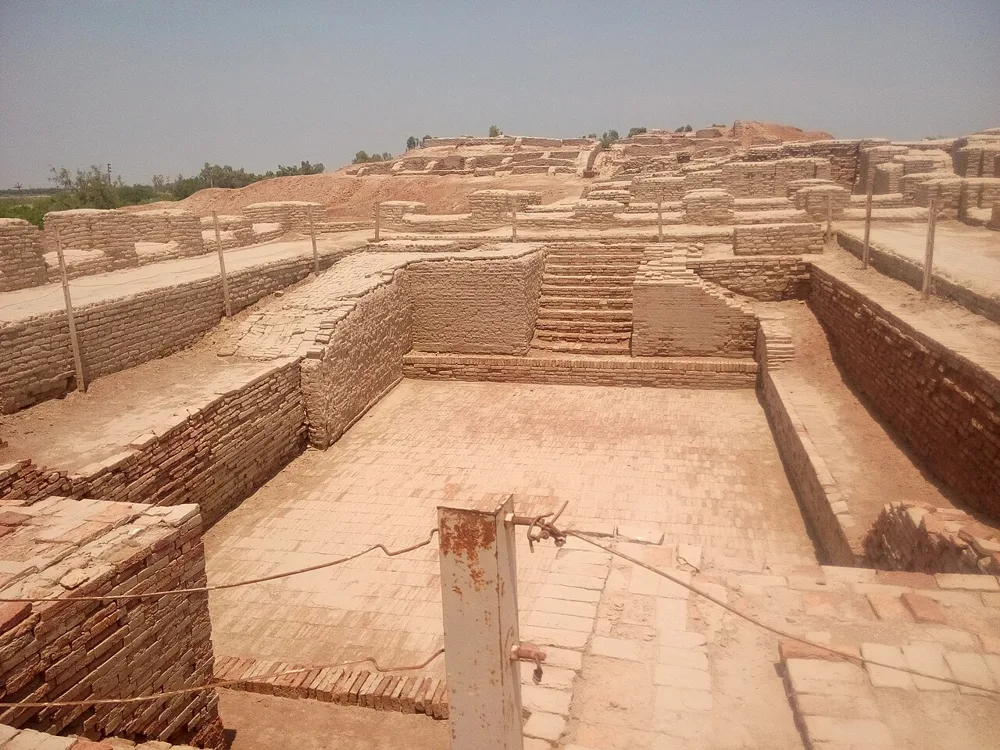
Most cities featured a bipartite structure. They were divided into two distinct parts. To the west lay the raised Citadel, or Acropolis, which housed the ruling class and significant public buildings. To the east was the Lower Town, a much larger area where the commoners resided and conducted their daily business. A notable exception to this rule was Dholavira in Gujarat, which boasted a unique tripartite planning system comprising a Citadel, a Middle Town, and a Lower Town.

The residential areas followed a strict grid system. Streets intersected at perfect right angles, dividing the city into neat rectangular blocks. The construction materials showed extraordinary uniformity across thousands of miles. Whether baked or sun dried, the bricks strictly followed a standardized ratio of 1:2:4 for height, width, and length. This level of standardization implies a highly centralized authority enforcing building codes.
Perhaps the most impressive feature was the drainage system. Every single house had its own courtyard and private bathroom. The house drains connected directly to street drains, which were meticulously covered with loose bricks or stone slabs to allow for regular cleaning and maintenance. This focus on public hygiene was entirely unmatched in the ancient world.
Practice Question (CGS 2026)
Consider the following statements about town planning in the Lower Town of Mohenjo-daro :
I. The length of the bricks was about twice the height.
II. High platforms were built on which houses were constructed.
III. The house drains first emptied into a sump or cesspit.
- I, II and III
- I and III only
- I and II only
- II and III only
Correct Answer: II and III only. Statement I is incorrect because Harappan bricks strictly followed a 1:2:4 ratio, meaning length was four times the height.
Major Sites of the Indus Valley Civilization
To master the Prelims examination, you must mentally map the major archaeological sites to their unique findings. Think of this as a rapid fire association game where each city reveals a specific aspect of Harappan life and industry.
Harappa, situated on the Ravi river, is famous for its six granaries in a row, circular working floors, and the virgin Goddess seal. Mohenjo-daro, located on the Indus river, yielded the spectacular Great Bath, the Great Granary, the famous Bronze Dancing Girl, the steatite statue of the Priest King, and the seal of Pashupati Mahadeva.
In Gujarat, Lothal sat on the Bhogavo river and functioned as a massive commercial port. It features the oldest known artificial dockyard in the world, alongside terracotta models of boats, evidence of double burial, and a thriving bead making factory. Dholavira, on the Luni river, is celebrated for its advanced water management and reservoirs, as well as a large ten letter signboard. In July 2021, Dholavira was inscribed as India's 40th UNESCO World Heritage Site, making it the first Harappan site in India to receive this prestigious tag. Keeping track of such updates is vital, and you can read more in our current affairs section.
Other significant sites include Kalibangan on the Ghaggar river in Rajasthan, which revealed a ploughed field surface, fire altars, and camel bones. Chanhudaro, located on the Indus river, stands out as the only city without a citadel and was a renowned centre for bead making. Furthermore, coastal sites like Balakot and Nageshwar were exclusively dedicated to shell based production, manufacturing items like bangles and ladles for export.
| Site Name | River Location | Key Archaeological Findings |
|---|---|---|
| Harappa | Ravi | Granaries, working floors |
| Mohenjo-daro | Indus | Great Bath, Bronze Dancing Girl |
| Lothal | Bhogavo | Artificial dockyard, bead making |
| Kalibangan | Ghaggar | Ploughed field, fire altars |
| Dholavira | Luni | Water reservoirs, UNESCO site |
| Rakhigarhi | Drishadvati | Largest site, DNA findings |
| Surkotada | Gujarat Region | Horse remains (debated among scholars) |
| Banawali | Saraswati | Terracotta replica of a plough |
| Nageshwar & Balakot | Coastal Regions | Shell production centres |
Practice Question (CDS-I 2008)
Which one of the following sites of the Indus Valley Civilization had an ancient dockyard?
- Kalibangan
- Lothal
- Rangpur
- Harappa
Correct Answer: Lothal. Located in Gujarat, Lothal features a large rectangular basin identified as the world's oldest known artificial dockyard.
Practice Question (CISF 2021)
Which among the following was/were the shell-based production centre(s) of the Indus Valley Civilization?
- Shortughai
- Lothal
- Balakot and Nageshwar
- Allandino and Dholavira
Correct Answer: Balakot and Nageshwar. These coastal sites were specialized centers for manufacturing shell objects.
Society, Economy, and Trade
If you compare the Harappan people to the later Vedic society, a stark contrast emerges. The Harappans built a peaceful, mercantile civilization rather than a martial one. They focused their collective energies on commerce, agriculture, and civic hygiene instead of territorial conquest.
The society was predominantly secular. While historians have found religious elements like the worship of the Mother Goddess and Pashupati, there were absolutely no large structural temples. Religion simply did not dominate the socio economic scene. Their agricultural practices were highly successful due to the fertile floodplains. They grew wheat, barley, mustard, and sesame. Most notably, the Harappans hold the historical distinction of being the first people in the world to produce cotton.

Trade was the lifeblood of their economy. They maintained extensive inland and foreign trade networks using a sophisticated barter system. Contemporary Mesopotamian texts refer to the Indus region as Meluhha, speaking highly of their exports. This vast trade network was facilitated by a highly uniform system of chert weights, which were binary in lower denominations and decimal in higher ones, ensuring fair trade across the entire civilization.
In terms of metallurgy, they were well acquainted with copper, bronze, silver, and gold. However, iron was completely unknown to them. Their peaceful nature is further evidenced by their weaponry. Unlike the later Rigvedic Aryans, the Harappans left no evidence of using coats of mail, helmets, or horse drawn chariots in warfare.
Practice Question (IAS 2011)
Regarding the Indus Valley Civilization, consider the following statements.
1. It was predominantly a secular civilization and the religious element though present, did not dominate the scene.
2. During this period, cotton was used for manufacturing textiles in India.
- 1 only
- 2 only
- Both 1 and 2
- Neither 1 nor 2
Correct Answer: Both 1 and 2. The civilization was secular with no grand temples, and they were pioneers in cotton cultivation.
Practice Question (IAS 2017)
With reference to the difference between the culture of Rigvedic Aryans and Indus Valley people, which of the following statements is/are correct ?
1. Rigvedic Aryans used the coat of mail and helmet in warfare whereas the people of Indus Valley Civilization did not leave any evidence of using them.
2. Rigvedic Aryans knew gold, silver and copper whereas Indus Valley people knew only copper and iron.
3. Rigvedic Aryans had domesticated the horse whereas there is no evidence of Indus Valley people having been aware of this animal.
- 1 only
- 2 and 3 only
- 1 and 3 only
- 1, 2 and 3
Correct Answer: 1 and 3 only. Statement 2 is wrong because the Indus people did not know iron, though they knew gold, silver, and copper.
Seals of the Indus Valley Civilization, Script and Pottery
Because we cannot read their writing, material artifacts form our only reliable source of Harappan history. Among these, the seals of the indus valley civilization are the most revealing artifacts. These standard Harappan seals were square or rectangular and made of steatite, which is a soft stone, rather than clay. Merchants used them primarily for commercial purposes to stamp goods, while individuals likely wore them as protective amulets.
An excellent way to distinguish Harappan artifacts from their contemporaries is through shape. While the Harappans used square stamp seals, the contemporary Mesopotamian civilization preferred cylindrical stone seals that they rolled over wet clay to create continuous patterns.
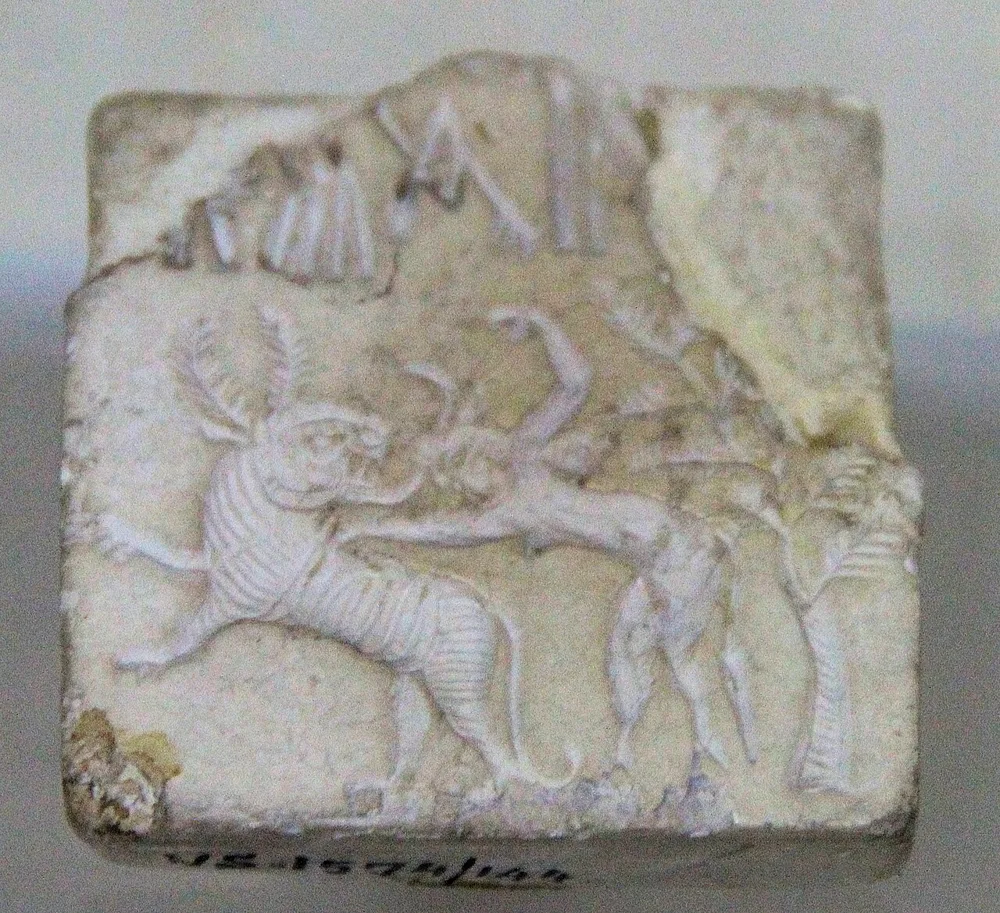
The Indus script remains one of history's great mysteries. It is highly pictographic and completely undeciphered. Scholars have determined that it was written in a boustrophedon style, meaning the writing goes from right to left on the first line, and then left to right on the second line, snaking back and forth. Alongside their unique script, the Harappans were known for their distinct Black on Red ware. This consisted of fine red pottery beautifully painted with black geometric and natural designs.
Practice Question (CDS-I 2010)
Which one of the following statements regarding Harappan civilization is correct?
- The standard Harappan seals were made of clay
- The inhabitants of Harappa had neither knowledge of copper nor bronze
- The Harrapan civilization was rural- based
- The inhabitants of Harappa grew and used cotton
Correct Answer: The inhabitants of Harappa grew and used cotton. The seals were made of steatite, they knew copper and bronze, and the civilization was highly urban.
Practice Question (NDA-II 2016)
The cylindrical stone seals were used in which civilization ?
- Harappan
- Egyptian
- Roman
- Mesopotamian
Correct Answer: Mesopotamian. The Harappans used square or rectangular steatite seals.
Decline of the Indus Valley Civilization
It is time to bust a popular historical myth. The Indus Valley Civilization did not meet a sudden, violent end. Instead, the decline was a gradual process of de urbanization, transitioning slowly into what we call the Late Harappan phase.
The mature phase began declining around 1900 BCE. During the Late Harappan phase, the sophisticated urban grid broke down, the script was lost, and the standardized weights disappeared entirely. The people moved away from the large cities and returned to a rural lifestyle, forming smaller regional cultures.
Historians debate several theories of decline. Ecological degradation is a primary theory, suggesting that severe deforestation and climate change led to extreme aridity. Hydrological changes also played a massive role. Tectonic uplift likely caused the shifting of the Indus river course and the drying up of the Saraswati river, leaving major cities without water. The old Aryan Invasion theory, proposed by Mortimer Wheeler, is now largely discarded by modern historians. A 2019 ancient DNA study conducted on a skeletal remain from the Rakhigarhi cemetery found a complete lack of Steppe pastoralist ancestry, further disproving the violent invasion narrative.
Interestingly, excavations at Sinauli in Baghpat in 2018 revealed three war chariots with solid disk wheels and copper reinforcements dating to roughly 2100 to 1900 BCE. This discovery is contextualized within the Late Harappan or Copper Hoard culture, showing localized martial developments as the broader, peaceful urban civilization waned.

Common Mistake: Do not assume the Late Harappans maintained the same advanced construction techniques. They did not. The late phase was a period of ruralization where civic standards collapsed entirely.
Practice Question (CAPF 2018)
Which of the following statements about Harappa Civilization is/are correct?
1. There is the extraordinary uniformity in artefacts as evident in pottery, seals, bricks and weights.
2. The late Harappa sites also maintain the same construction techniques as were used in mature Harappa sites.
- 1 only
- 2 only
- Both 1 and 2
- Neither 1 nor 2
Correct Answer: 1 only. The late Harappan sites show a clear deterioration in construction techniques and a breakdown of urban planning.
UPSC Mains Analysis: The Cultural Legacy
For the Mains examination, you must look beyond the physical ruins and connect the Indus Valley Civilization to modern India. The UPSC frequently tests the concept of the continuity of civilization.
Unlike the Museum Civilizations of Egypt or Mesopotamia, where the original cultures were completely replaced by subsequent conquests and new religions, the cultural threads of the Harappans survived. We see profound religious continuity. The worship of the Mother Goddess, the reverence for Pashupati as a proto Shiva, Lingam worship, and the deep respect for nature like the pipal tree and the humped bull all continue in modern Hinduism. There is also a secular legacy. The binary and decimal system of weights influenced later Indian metrology, and their grid based town planning remains a benchmark for modern urban projects.
Mains Question (GS1 2015)
The ancient civilization in Indian sub-continent differed from those of Egypt, Mesopotamia and Greece in that its culture and traditions have been preserved without a breakdown to the present day. Comment. (Answer in not more than 200 words)
Examiner Analysis: In 2015, the examiner focused on the continuity of Indian civilization via a comparative lens against extinct ancient cultures like Mesopotamia and Egypt. Subsequently, in 2019, this inquiry into civilizational resilience shifted from a historical perspective to a sociological one, asking what makes Indian society unique in sustaining its culture. By 2020 and 2022, the framing moved toward the tangible and intangible outputs of this continuity. The trend shows that UPSC wants candidates to bridge ancient history with contemporary Indian society, proving you understand how the past lives in the present.
Answer Approach: Begin your introduction by stating that India represents a living civilization where ancient traditions coexist with modernity, unlike the museum civilizations of Egypt or Mesopotamia where original cultural threads were severed by external conquests. In the body, structure your points into categories. First, discuss religious and philosophical continuity, noting the persistence of rituals, the worship of proto Shiva, and nature veneration. Second, highlight material and secular continuity, such as agricultural practices, standard metrology, and traditional crafts. Conclude by summarizing how this unbroken chain forms the bedrock of India's composite culture.
Indus Valley Civilization UPSC Notes PDF
To secure a high score in History, consistent revision is absolutely necessary. For your complete revision, you can download the indus valley civilization upsc notes pdf directly from our portal.
Reading the theory is only half the battle. You must test your knowledge against real exam patterns. Access our complete databank for the indus valley civilization upsc pyq to practice all the historical questions asked in previous years. Consolidate your preparation with our indus valley civilization pdf for competitive exams to ensure you miss no factual details before you enter the examination hall.
Frequently Asked Questions
Who discovered the indus valley civilization?
Dayaram Sahni discovered Harappa in 1921, and R.D. Banerji discovered Mohenjo-daro in 1922. They conducted these excavations under the leadership of John Marshall, who was the Director General of the Archaeological Survey of India.
Is Indus Valley Civilization 7000 years old?
The early formative phase dates back to around 6000 BCE, making those initial settlements approximately 8000 years old. However, the Mature, highly urbanized phase existed between 2600 BCE and 1900 BCE, which is roughly 4600 to 3900 years ago.
What are the 4 oldest civilizations in the world?
The four oldest river valley civilizations are Mesopotamia along the Tigris and Euphrates rivers, Egypt along the Nile river, the Indus Valley Civilization along the Indus and Saraswati rivers, and Ancient China along the Yellow River.
What were the main features of Indus Valley civilization town planning?
The town planning featured a strict grid pattern of streets, a bipartite division into a raised Citadel and a Lower Town, the use of standardized burnt bricks in a 1:2:4 ratio, and an unparalleled covered underground drainage system.
Why did the Indus Valley Civilization decline?
It did not collapse suddenly. It declined gradually around 1900 BCE due to environmental factors such as ecological changes, shifting river courses, and the drying up of the Saraswati river, which ultimately led to complete de urbanization.