Monetary Policy of the Reserve Bank of India (RBI) | UPSC
Monetary policy of the Reserve Bank of India (RBI) refers to the macroeconomic policy laid down by the central bank to manage money supply, interest rates, and credit availability in the Indian economy. Think of it as the mechanism through which the RBI regulates the financial temperature of the country, ensuring it does not overheat with inflation or freeze in a recession.
As per the amended Reserve Bank of India Act of 1934, the primary objective of this policy is to maintain price stability while keeping in mind the objective of growth. The specific target set for the RBI is to maintain Consumer Price Index (CPI) inflation at 4%, with a tolerance band of plus or minus 2%.
To achieve this, the RBI deploys a variety of instruments. Quantitative tools, such as the Repo Rate, Cash Reserve Ratio (CRR), Statutory Liquidity Ratio (SLR), and Open Market Operations (OMO), are used to control the overall volume of money in the system. Qualitative tools, like margin requirements and moral suasion, are used to direct the flow of credit to specific sectors.
Since 2016, the benchmark policy interest rate is fixed by a six-member statutory body known as the Monetary Policy Committee (MPC). Depending on macroeconomic conditions, the MPC adopts different policy stances. It uses an expansionary (dovish) policy by cutting rates during economic slowdowns to boost growth, and a contractionary (hawkish) policy by raising rates to curb inflation.
What is Monetary Policy of India? (Objectives & Framework)
To understand monetary policy, you can compare it to controlling the flow of water in a large dam. The dam represents the banking system, and the water is the money supply. If the authorities release too much water, it causes a flood, which in economic terms is inflation. If they release too little, it causes a drought, leading to an economic recession. The RBI acts as the dam operator, carefully adjusting the gates to ensure a steady, productive flow of money.
Formally, monetary policy is the process by which the monetary authority of a country controls the creation and supply of money in the economy. For decades, the RBI juggled multiple indicators to make these decisions. However, a major structural shift occurred following the recommendations of the Urjit Patel Committee in 2014. The committee recommended shifting to a flexible inflation targeting framework, using the Consumer Price Index (CPI) as the nominal anchor for policy decisions.
This recommendation led to the landmark Monetary Policy Framework Agreement in 2015, signed between the Government of India and the RBI. This agreement formalized inflation targeting in India. To give this framework statutory backing, the government passed the Finance Act in 2016, which amended the RBI Act of 1934.
Under Section 45ZA of the amended RBI Act, the Central Government, in consultation with the RBI, sets the inflation target once every five years. The current target mandates the RBI to keep CPI inflation at 4%, with an upper tolerance limit of 6% and a lower tolerance limit of 2%.
Accountability is a core feature of this framework. Section 45ZN of the RBI Act stipulates that if average inflation falls outside the 2% to 6% band for three consecutive quarters, the RBI is deemed to have failed in its objective. In such a scenario, the central bank must submit a formal report to the Government explaining the reasons for the failure and detailing the remedial actions it proposes to take.
Monetary Policy Committee (MPC) Members & Structure
Historically, the decision to change interest rates rested solely on the shoulders of the RBI Governor. The 2016 amendment marked a historic shift from a single-man decision to a democratic, committee-based approach. This ensures a diversity of views and prevents any single individual from having disproportionate influence over the nation's borrowing costs.
The Monetary Policy Committee (MPC) was constituted under Section 45ZB of the RBI Act of 1934. It is a six-member body designed to balance internal central bank expertise with external macroeconomic perspectives. The committee comprises three internal members from the RBI and three external members appointed by the Central Government.
The external members are experts in economics or finance. They are appointed for a fixed term of four years and are notably not eligible for re-appointment, a rule designed to preserve their independence. Decisions within the MPC are taken by a majority vote. The RBI Governor does not possess a veto power but holds a casting vote to break a tie if the committee is evenly split.
By law, the MPC is required to meet at least four times a year, though in practice it typically meets bi-monthly to review the macroeconomic situation. Following these meetings, the RBI publishes the Monetary Policy Report bi-annually to explain the sources of inflation and the forecasts for the economy.
The full composition of the MPC is structured as follows:
| Position | Role in MPC |
|---|---|
| RBI Governor | Chairperson (ex-officio) |
| Deputy Governor of RBI | Member (in charge of Monetary Policy) |
| RBI Officer | Member (nominated by the Central Board) |
| External Member 1 | Government Nominee |
| External Member 2 | Government Nominee |
| External Member 3 | Government Nominee |
Practice Question (2017)
Which of the following statements is/are correct regarding the Monetary Policy Committee (MPC) ?
1. It decides the RBI's benchmark interest rates.
2. It is a 12-member body including the Governor of RBI and is reconstituted every year.
3. It functions under the chairmanship of the Union Finance Minister.
- 1 only
- 1 and 2 only
- 3 only
- 2 and 3 only
Correct Answer: 1 only. The MPC is a 6-member body chaired by the RBI Governor, not the Finance Minister, and it fixes the benchmark policy rate.

Instruments of Monetary Policy: Quantitative vs Qualitative Tools
To steer the economy, the RBI uses two distinct sets of instruments. You can think of quantitative tools as broad-based measures that affect the total volume of credit in the entire economy. Qualitative tools, on the other hand, are targeted measures that affect the direction of credit to specific sectors without necessarily changing the overall money supply.
Quantitative Tools (General Measures)
These tools impact the balance sheets of all commercial banks simultaneously.
- Cash Reserve Ratio (CRR): This is the percentage of a bank's Net Demand and Time Liabilities (NDTL) that it must keep with the RBI in the form of liquid cash. The RBI pays no interest on this balance. If the RBI raises the CRR, banks have less money to lend, which reduces the money supply.
- Statutory Liquidity Ratio (SLR): This is the percentage of NDTL that banks must maintain in safe, liquid assets such as Government Securities (G-Secs), gold, or cash. Unlike CRR, banks earn a return on SLR investments (like interest on government bonds).
- Liquidity Adjustment Facility (LAF): This is the RBI's primary tool for short-term liquidity management. It consists of the Repo Rate (the rate at which the RBI lends short-term funds to banks against approved collateral) and the Reverse Repo Rate (the rate at which banks park surplus funds with the RBI).
- Standing Deposit Facility (SDF): Introduced in April 2022, the SDF replaced the fixed reverse repo rate as the floor of the LAF corridor. Its unique feature is that it allows the RBI to absorb excess liquidity from commercial banks without providing government securities as collateral.
- Marginal Standing Facility (MSF): This serves as a penal rate for banks that need to borrow overnight funds from the RBI by dipping into their mandatory SLR quota. It is always set higher than the Repo rate.
- Open Market Operations (OMO): This refers to the outright buying and selling of government securities by the RBI in the open market. When the RBI buys securities, it injects cash into the economy. When it sells securities, it sucks liquidity out of the system.
Qualitative Tools (Selective Measures)
These tools allow the RBI to micromanage credit flow to specific areas, such as agriculture or real estate.
- Margin Requirements: The RBI can adjust the Loan-to-Value (LTV) ratio for specific sectors. For example, if the RBI wants to curb speculation in real estate, it might dictate that banks can only finance 70% of a property's value instead of 80%, requiring the borrower to arrange a larger down payment.
- Moral Suasion: This involves the RBI urging or persuading commercial banks to follow its directives and policy signals, often through meetings and official communications.
- Direct Action: This is the ultimate punitive measure, where the RBI imposes financial penalties on banks that fail to comply with its guidelines.
Common Mistake: Students often confuse monetary policy tools with fiscal policy tools. Do not classify Public Debt, Public Revenue, or Taxation as monetary policy tools. Those are instruments of Fiscal Policy managed by the Government of India.
Practice Question (2015)
With reference to Indian economy, consider the following :
1. Bank rate
2. Open market operations
3. Public debt
4. Public revenue
Which of the above is/are component/components of Monetary Policy?
- 1 only
- 2, 3 and 4
- 1 and 2
- 1, 3 and 4
Correct Answer: 1 and 2. Public debt and public revenue are components of fiscal policy, managed by the government.
Practice Question (2017)
The monetary policy in India uses which of the following tools?
1. Bank rate
2. Open market operations
3. Public debt
4. Public revenue
Select the correct answer using the code given below.
- 1 and 2 only
- 2 and 3 only
- 1 and 4 only
- 1, 2, 3 and 4
Correct Answer: 1 and 2 only. Bank rate and OMO are RBI tools, whereas public debt and revenue fall under the government's fiscal domain.
Practice Question (2024)
Consider the following statements regarding instruments of monetary policy :
1. Standing deposit facility (SDF) rate was introduced in April 2022.
2. SDF rate replaced fixed reverse repo rate as the floor of the LAF corridor.
- 1 only
- 2 only
- Both 1 and 2
- Neither 1 nor 2
Correct Answer: Both 1 and 2. The RBI introduced the SDF in 2022 to absorb liquidity without needing to provide collateral, replacing the fixed reverse repo as the corridor floor.
Practice Question (2013)
Consider the following statements :
1. Repo rate is the interest rate at which RBI lends to commercial banks for short period.
2. Reverse repo rate is the interest rate which RBI pays to commercial banks on short-term deposits.
- 1 only
- 2 only
- Both 1 and 2
- Neither 1 nor 2
Correct Answer: Both 1 and 2. These definitions accurately describe the core components of the Liquidity Adjustment Facility.

Hawkish vs Dovish: Expansionary Monetary Policy UPSC
Understanding the stance of the RBI requires grasping the fundamental trade-off between inflation and growth. When you read financial news, you will frequently encounter the terms hawkish and dovish. These terms describe the central bank's approach to managing the economy.
An Expansionary Monetary Policy, often referred to as a dovish or easy money policy, is adopted during economic slowdowns. The primary goal here is to stimulate growth. To achieve this, the RBI cuts the Repo Rate, CRR, and SLR. By doing so, it increases the money supply in the banking system and lowers interest rates. This makes borrowing cheaper for businesses and consumers, which in turn stimulates investment, factory expansion, and consumer spending.
Conversely, a Contractionary Monetary Policy, known as a hawkish or tight money policy, is deployed to combat demand-pull inflation. When too much money is chasing too few goods, prices rise rapidly. To cool down the economy, the RBI raises the Repo Rate, MSF, and CRR. This decreases the money supply, makes borrowing more costly, and curbs aggregate demand, eventually bringing prices down.
There is also a Neutral Stance. When the RBI adopts this posture, it signals that it remains flexible and is ready to move interest rates in either direction based on incoming macroeconomic data, without a pre-committed bias toward hiking or cutting.
Common Mistake: Increasing the Marginal Standing Facility (MSF) rate is a contractionary measure, not an expansionary one. A higher MSF makes emergency borrowing more expensive for banks, which tightens liquidity in the market.
Practice Question (2020)
If the RBI decides to adopt an expansionist monetary policy, which of the following would it not do ?
1. Cut and optimize the Statutory Liquidity Ratio
2. Increase the Marginal Standing Facility Rate
3. Cut the Bank Rate
- 1 and 2 only
- 2 only
- 1 and 3 only
- 1, 2 and 3
Correct Answer: 2 only. Increasing the MSF rate makes borrowing expensive, which restricts money supply and is therefore a contractionary move, not expansionary.
Practice Question (2021)
With reference to Indian economy, demand-pull inflation can be caused/increased by which of the following?
1. Expansionary policies
2. Fiscal stimulus
3. Inflation-indexing wages
4. Higher purchasing power
5. Rising interest rates
- 1, 2 and 4 only
- 3, 4 and 5 only
- 1, 2, 3 and 5 only
- 1, 2, 3, 4 and 5
Correct Answer: 1, 2 and 4 only. Expansionary policies, fiscal stimulus, and higher purchasing power all increase aggregate demand, leading to demand-pull inflation.
Monetary Policy Transmission Mechanism
Formulating policy is only half the battle. The real test is the mechanical linkage between the central bank's decisions and the real economy. When you turn the steering wheel of a car, you expect the front wheels to turn immediately. In economics, this linkage is called the monetary policy transmission mechanism. It is the process through which changes in the central bank's policy rates pass through to the broader economy, affecting market interest rates, inflation, and growth.
The persistent challenge in India has been sluggish transmission. Historically, when the RBI hikes the repo rate, commercial banks are quick to raise their lending rates to protect their profit margins. However, when the RBI cuts rates to stimulate the economy, banks are notoriously slow to lower lending rates for consumers. Banks often cite the high cost of existing fixed deposits and the burden of Non-Performing Assets (NPAs) as reasons for this delay.
To gauge the effectiveness of this pass-through, the RBI closely monitors specific indicators. The most prominent among these are the Weighted Average Lending Rate (WALR) on fresh and outstanding rupee loans, and the Weighted Average Domestic Term Deposit Rate (WADTDR).
To fix the sluggish transmission, the RBI introduced a major reform in October 2019. It mandated that all new floating-rate retail and MSME loans must be linked to an External Benchmark Lending Rate (EBLR), such as the RBI's Repo rate or the yields on government treasury bills. This replaced the older, opaque internal Marginal Cost of Funds based Lending Rate (MCLR) system, ensuring that when the RBI cuts rates, the benefit flows directly and quickly to the borrower.
Practice Question (2024)
Which of the following indicators is/are used to observe the monetary transmission mechanism in the economy?
1. Weighted average lending rate
2. Weighted average domestic term deposit rate
3. 1-year median MCLR
4. SDF rate
- 1 and 2 only
- 1, 2 and 3
- 3 and 4
- 4 only
Correct Answer: 1, 2 and 3. The RBI tracks WALR, WADTDR, and MCLR trends to see how effectively its policy rate changes are being passed on to consumers by commercial banks.

Monetary Policy vs Fiscal Policy
Macroeconomic management requires coordination between two distinct authorities, acting as the two hands of the economy. The RBI controls the money supply through monetary policy, while the Government of India controls the public purse strings through fiscal policy.
The authority formulating the policy is the primary distinction. Monetary policy is executed by the Central Bank, whereas fiscal policy is managed by the Ministry of Finance. Their instruments also differ vastly. While the RBI uses interest rates, reserve ratios, and open market operations, the government uses taxation, public expenditure, and public debt management.
Their objectives, though complementary, have different focal points. Monetary policy primarily targets price stability and liquidity management. Fiscal policy focuses on broader structural goals like economic growth, infrastructure development, employment generation, and income redistribution.
A unique feature of fiscal policy is the presence of automatic stabilizers. These are built-in features, such as progressive personal income tax or unemployment benefits, that automatically dampen economic fluctuations without requiring discretionary legislative action. For instance, during a boom, higher incomes automatically push people into higher tax brackets, cooling down excess demand.
Sometimes, the UPSC tests how these two policies interact. For example, if an economy needs to raise interest rates unambiguously and appreciate its currency, it requires a specific combination. It needs a contractionary monetary policy (to reduce money supply and raise rates) combined with an expansionary fiscal policy (where the government borrows heavily to spend, competing for limited funds in the market, which drives interest rates even higher).
| Feature | Monetary Policy | Fiscal Policy |
|---|---|---|
| Authority | Reserve Bank of India (RBI) | Government of India (Ministry of Finance) |
| Core Instruments | Repo Rate, CRR, SLR, OMO, SDF | Taxation, Public Expenditure, Public Debt |
| Primary Objective | Price stability (Inflation targeting) and liquidity | Economic growth, infrastructure, income equality |
| Speed of Action | Fast (MPC can change rates immediately) | Slow (Requires budget approval in Parliament) |
Practice Question (2011)
Which one among the following is not a component of fiscal policy ?
- Taxation policy
- Public debt policy
- Trade policy
- Public expenditure policy
Correct Answer: Trade policy. Fiscal policy deals specifically with government revenue (taxation) and expenditure (public debt and spending).
Practice Question (2021)
Which one of the following functions as an automatic stabilizer in the context of fiscal and monetary policies of an economy?
- Personal income tax
- Reverse repo rate of bank
- Open market operation
- Bond price
Correct Answer: Personal income tax. As incomes rise during an economic boom, progressive taxation automatically withdraws more money from the system, stabilizing demand.
Practice Question (2023)
Which of the following policies help to raise interest rate unambiguously and thereby lead to appreciation of currency?
- Expansionary fiscal and monetary policy
- Contractionary fiscal and monetary policy
- Contractionary fiscal policy and expansionary monetary policy
- Contractionary monetary policy and expansionary fiscal policy
Correct Answer: Contractionary monetary policy and expansionary fiscal policy. Tight money supply by the RBI combined with high government borrowing creates a severe shortage of loanable funds, driving interest rates up sharply.
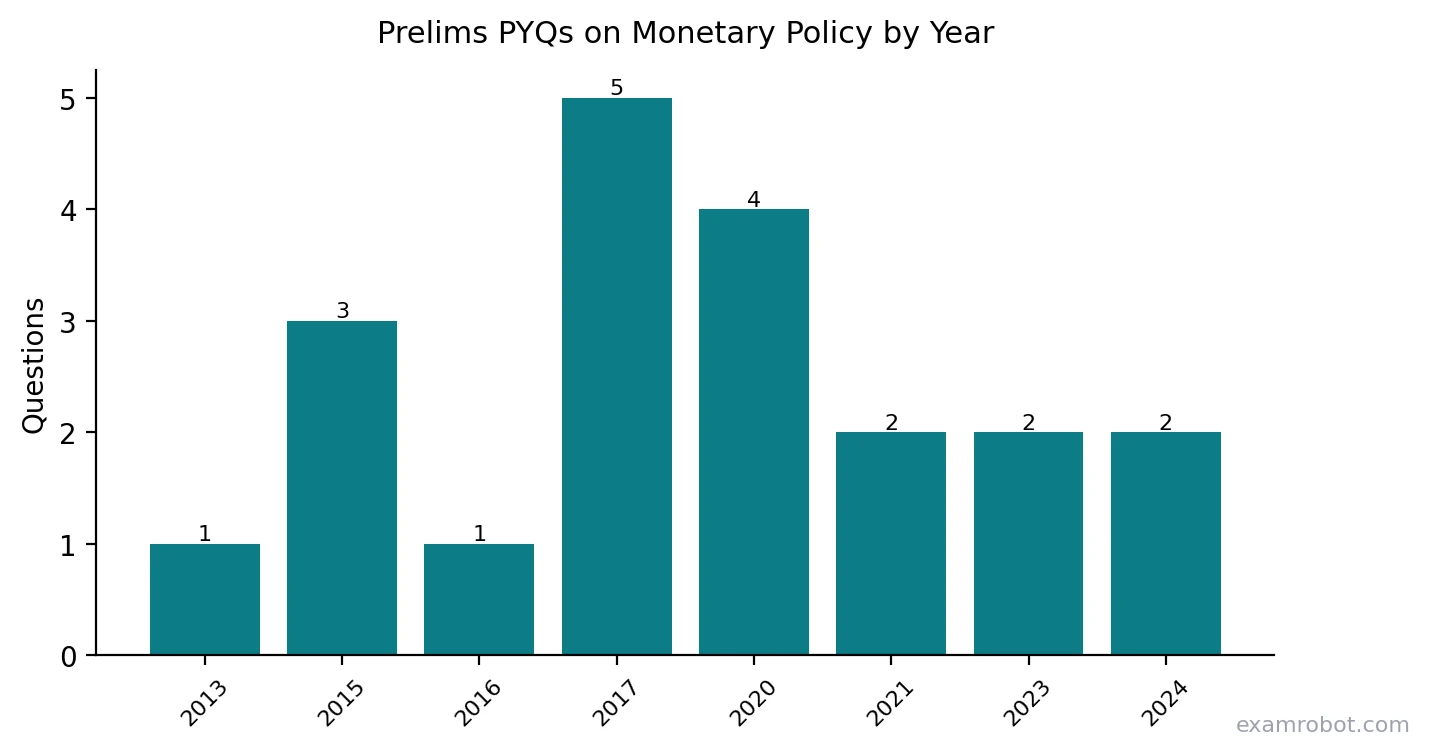
Practice Monetary Policy UPSC PYQ & Mains Questions
Mastering your monetary policy notes requires rigorous practice of real past year questions. The UPSC frequently tests the mechanical application of these tools, expecting you to know exactly what happens to inflation when the CRR is cut or the MSF is increased.
For the Mains examination, the pattern has evolved significantly. The examiner's focus has shifted from basic definitions to linking monetary policy with real-world macroeconomic frictions. Before 2024, questions often centered on the socio-economic causes of hunger or food processing infrastructure. However, recent trends show a demand for analyzing the limitations of monetary tools in addressing supply-side issues, such as the persistent food inflation seen recently.
Mains Practice Question (GS3 - 2024)
What are the cause of persistent high food inflation in India? Comment on the effecticencess of the monetary policy of the RBI to control this type of inflation. (Answer in 150 words) 10
Examiner Analysis & Approach: The examiner is testing your ability to distinguish between demand-pull inflation (which the RBI can control) and supply-side inflation (which is harder for the RBI to fix). Start your answer by defining food inflation using the Consumer Food Price Index (CFPI). Next, list the supply-side structural causes, such as climate vulnerability (El Nino impacting Tomato, Onion, Potato crops) and inefficient supply chains. Finally, critically analyze the RBI's effectiveness. Explain that while monetary policy can cool down general aggregate demand, raising interest rates cannot fix a broken supply chain or produce more tomatoes, highlighting the limitations of monetary tools in combating structural food inflation.
Staying updated with current affairs is equally vital for this topic. For instance, you should track the evolution of the RBI's monetary policy stance, such as transitions from easing to a neutral position over a financial cycle. You must also be aware of specific liquidity management operations. A recent example is the RBI conducting an Overnight Variable Rate Repo (VRR) auction under the LAF on July 28, 2026. VRR auctions involve competitive bidding by banks to determine the repo rate for a specific auction, serving as a precise instrument to maintain the overnight interbank rate within the policy corridor. Read more live updates at the ExamRobot current affairs portal.
Test your readiness by solving the monetary policy MCQ bank on ExamRobot, and ensure you download the summary PDF for quick revision before your Prelims.
Frequently Asked Questions
What is the difference between monetary policy and fiscal policy?
Monetary policy is managed by the RBI using interest rates and liquidity tools to control inflation and money supply. Fiscal policy is managed by the Government using taxation and public spending to drive economic growth.
What is monetary policy by the RBI?
It is the macroeconomic policy used by the Reserve Bank of India to regulate the money supply, manage interest rates, and ensure price stability while supporting economic growth.
What are the six tools of monetary policy?
The primary quantitative tools include the Repo Rate, Reverse Repo Rate (now largely replaced by SDF as the floor), Cash Reserve Ratio (CRR), Statutory Liquidity Ratio (SLR), Marginal Standing Facility (MSF), and Open Market Operations (OMO).
Who are the members of the monetary policy committee?
The MPC is a 6-member body: the RBI Governor (Chair), the Deputy Governor in charge of monetary policy, one RBI officer, and three external experts appointed by the Government of India.
What is expansionary monetary policy?
It is a dovish policy stance where the RBI cuts interest rates (like the Repo rate) and reserve ratios to increase the money supply, making borrowing cheaper to stimulate economic growth during a slowdown.
How does the RBI control inflation through monetary policy?
To control demand-pull inflation, the RBI adopts a contractionary (hawkish) policy by raising the Repo rate and CRR. This makes borrowing expensive, reduces the money supply in the market, and cools down consumer demand and prices.