Global Indices and their Publishing Organizations
The Global Hunger Index (GHI) is released annually by the European non-governmental organisations Concern Worldwide and Welthungerhilfe. Historically, the International Food Policy Research Institute (IFPRI) was involved in its calculation, a fact that appears in older UPSC questions.
The Global Gender Gap Index and the Global Competitiveness Report are published by the World Economic Forum (WEF), a major focus area for Prelims.
The Global Multidimensional Poverty Index (MPI) is jointly published by the United Nations Development Programme (UNDP) and the Oxford Poverty and Human Development Initiative (OPHI).
The World Development Report is the flagship publication of the World Bank (IBRD).
The Global Environmental Outlook (GEO) is the flagship environmental assessment of the UN Environment Programme (UNEP).
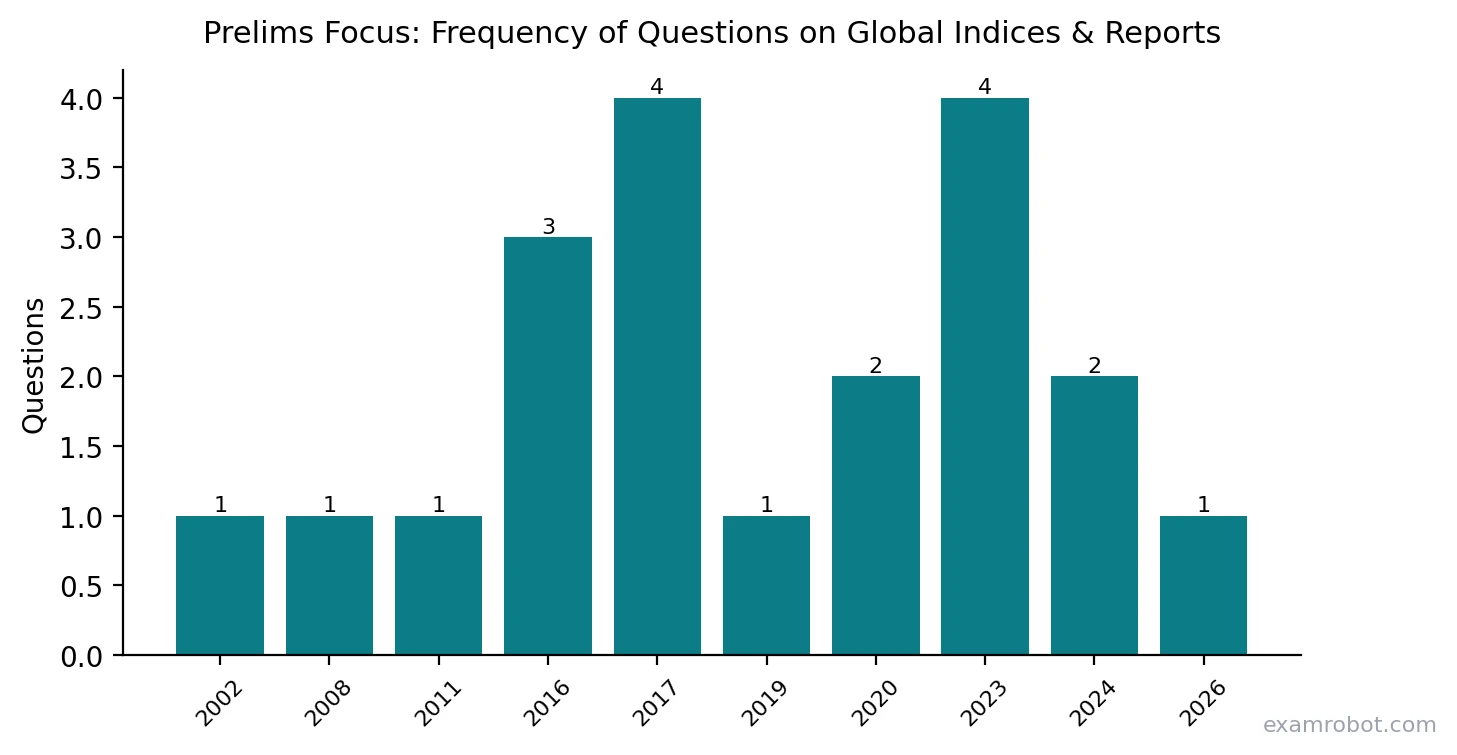
UPSC Prelims frequently tests the exact mapping between a report and its publishing organisation, as well as the specific indicators used in indices like the GHI and MPI. Memorising these associations and understanding the methodology behind them will secure easily attainable marks in the examination.
Major Global Indices by Publishing Organization
Think of global indices as the report cards of international governance. Just as you would look at the signature on a report card to know which examiner issued it, UPSC expects you to know exactly which international body publishes which index. Knowing the examiner is the most frequently tested pattern in the Preliminary examination.
The international system relies on specific institutions to track different aspects of human progress. The World Economic Forum (WEF) focuses heavily on the corporate and economic spheres. It publishes the Global Gender Gap Index, the Global Competitiveness Report, and the Global Risks Report. The World Bank (IBRD) issues the World Development Report, the Logistics Performance Index, and the Ease of Doing Business Index (which has now been discontinued but remains relevant for historical context).

In the social and developmental sphere, the United Nations Development Programme (UNDP) takes the lead. It publishes the Human Development Index (HDI), the Gender Inequality Index (GII), and the Gender Social Norms Index (GSNI). The International Labour Organization (ILO) publishes the World Social Protection Report, which monitors global progress towards Sustainable Development Goal 1.3 regarding universal social protection. Finally, the World Intellectual Property Organization (WIPO) publishes the Global Innovation Index.
In recent news, the United Nations has also begun establishing a UN Global AI and Digital Governance Architecture. This relates directly to the UN's emerging function in publishing digital and artificial intelligence governance indices, reflecting the changing nature of global benchmarks. You can read more about these developments in our current affairs updates.
| Publishing Organization | Major Reports and Indices |
|---|---|
| World Economic Forum (WEF) | Global Gender Gap Index, Global Competitiveness Report, Global Risks Report |
| World Bank (IBRD) | World Development Report, Logistics Performance Index, Ease of Doing Business (Discontinued) |
| United Nations Development Programme (UNDP) | Human Development Index, Gender Inequality Index, Gender Social Norms Index |
| International Labour Organization (ILO) | World Social Protection Report |
| World Intellectual Property Organization (WIPO) | Global Innovation Index |
Common Mistake: Do not confuse the Gender Inequality Index (published by the UNDP) with the Global Gender Gap Index (published by the WEF). The UNDP focuses on health and empowerment inequalities, while the WEF focuses on economic and political parity.
To remember the WEF's focus areas, use the mnemonic CGR: Competitiveness, Gender, and Risks. Conversely, the UNDP focuses strictly on Human Development and Inequality.
Practice Question (2002)
“World Development Report” is an annual publication of
- United Nations Development Programme
- International Bank of Reconstruction and Development
- World Trade Organisation
- International Monetary Fund
Correct Answer: b. The World Development Report is the World Bank Group’s annual flagship report, published by the IBRD since 1978.
Practice Question (2019)
The Global Competitiveness Report is published by the
- International Monetary Fund
- United Nations Conference on Trade and Development
- World Economic Forum
- World Bank
Correct Answer: c. The Global Competitiveness Report is published by the World Economic Forum to assess the competitiveness of countries across various parameters.
Practice Question (2016)
India's ranking in the 'Ease of Doing Business Index' is sometimes seen in the news. Which of the following has declared that ranking?
- Organization for Economic Cooperation and Development (OECD)
- World Economic Forum
- World Bank
- World Trade Organization (WTO)
Correct Answer: c. The Ease of Doing Business Report was published annually by the World Bank based on quantitative regulatory indicators.
Practice Question (2023)
World Social Protection Report is published by
- World Bank
- International Labour Organization
- World Economics Forum
- World Health Organization
Correct Answer: b. The World Social Protection Report is a flagship publication of the International Labour Organization (ILO).
Global Hunger Index Released By
If you rely on outdated study materials, you will likely lose marks on the Global Hunger Index. Over the years, the publishing authority has shifted, making it a prime target for examiners looking to test your current awareness. Let us clarify the exact publishers and indicators.
The Global Hunger Index is currently released jointly by two European non-governmental organisations: Concern Worldwide and Welthungerhilfe. In the past, the International Food Policy Research Institute (IFPRI) was a co-publisher, which is why older UPSC questions mention IFPRI. Today, it is strictly an NGO-led initiative.
The index calculates hunger based on four core indicators. You must memorise these exact terms:
| Indicator | Definition |
|---|---|
| Undernourishment | The share of the population with insufficient caloric intake. |
| Child Stunting | The share of children under age five who have low height for their age, reflecting chronic undernutrition. |
| Child Wasting | The share of children under age five who have low weight for their height, reflecting acute undernutrition. |
| Child Mortality | The mortality rate of children under the age of five. |
In terms of India's performance, the 2024 report placed India at the 105th rank out of 127 countries. With a score of 27.3, India falls into the "serious" severity category. This ranking frequently sparks debate, making it a highly relevant topic for both Prelims and Mains.
Common Mistake: Many students mistakenly believe that the Food and Agriculture Organization (FAO) or the World Health Organization (WHO) releases the GHI because it deals with food and health. Remember that it is an NGO-led index published by Concern Worldwide and Welthungerhilfe.
Practice Question (2016)
Which of the following is/are the indicator/indicators used by IFPRI to compute the Global Hunger Index Report?
1. Undernourishment
2. Child stunting
3. Child mortality
Select the correct answer using the code given below.
- 1 only
- 2 and 3 only
- 1, 2 and 3
- 1 and 3 only
Correct Answer: c. The composite score is based on four indicators: undernourishment, child stunting, child wasting, and child mortality.
Practice Question (2011)
Consider the following statements with regard to the Global Hunger Index :
1. India ranks within the top ten among the developing countries in the Global Hunger Index 2010
2. According to the Global Hunger Index 2010 the...
- 1, 2 and 3
- 2 and 3 only
- 1 and 2 only
- 3 only
Correct Answer: b. (Historical question reflecting older data patterns).
Global Gender Gap Index 2025 India Rank
Measuring gender equality requires looking at multiple tracks of human progress simultaneously. The World Economic Forum's flagship gender report does exactly this, providing a benchmark that UPSC frequently uses to test your knowledge of social issues.
The Global Gender Gap Index is published by the WEF. It assesses gender parity across four distinct dimensions:
- Economic Participation and Opportunity
- Educational Attainment
- Health and Survival
- Political Empowerment
For the 2024-2025 examination cycle, you should refer to the latest available data. In the 2024 report, India ranked 129th out of 146 countries. This represents a slight decline from its 127th rank in 2023. Examiners often ask about the specific dimensions, so ensure you can distinguish between the WEF's four dimensions and the indicators used by other organisations.
Practice Question (2017)
Which of the following gives 'Global Gender Gap Index' ranking to the countries of the world ?
- World Economic Forum
- UN Human Rights Council
- UN Women
- World Health Organization
Correct Answer: a. The Global Gender Gap Index is published by the World Economic Forum, ranking countries on their status of gender equality.
Global Innovation Index 2025 India Rank
A rising rank in a global index often reflects years of structural reform. India's trajectory in the Global Innovation Index (GII) is one of the most significant success stories of the past decade, making it a high-probability topic for both Prelims and Mains, particularly when discussing the "Make in India" initiative and scientific progress.
The GII is published by the World Intellectual Property Organization (WIPO) in partnership with the Portulans Institute. In the 2024 GII, India secured the 39th position out of 133 economies. This marks a dramatic and consistent rise from its 81st rank in 2015. This improvement is driven by a strong innovation ecosystem, an increase in IT exports, and a growing volume of scientific publications.
Global Peace Index 2025 India Rank
Peace is not merely the absence of war; it is the presence of societal security. The Global Peace Index (GPI) serves as a key metric for understanding both international relations and internal security contexts.
The GPI is published by the Institute for Economics and Peace (IEP), a global think tank. The index measures the state of peace using three broad themes: the level of societal safety and security, the extent of ongoing domestic and international conflict, and the degree of militarisation. In the 2024 Global Peace Index, India is ranked 116th out of 163 independent states and territories.
Global Environmental Outlook and Global Stocktake
Environmental health requires a planetary health check-up. The United Nations manages several frameworks to monitor environmental degradation and climate action, and UPSC heavily tests the distinction between these reports and treaties.
The Global Environmental Outlook (GEO) is the flagship environmental assessment published by the UN Environment Programme (UNEP). It provides a detailed review of the state of the global environment. The upcoming seventh edition (GEO-7) is scheduled for release in December 2025.
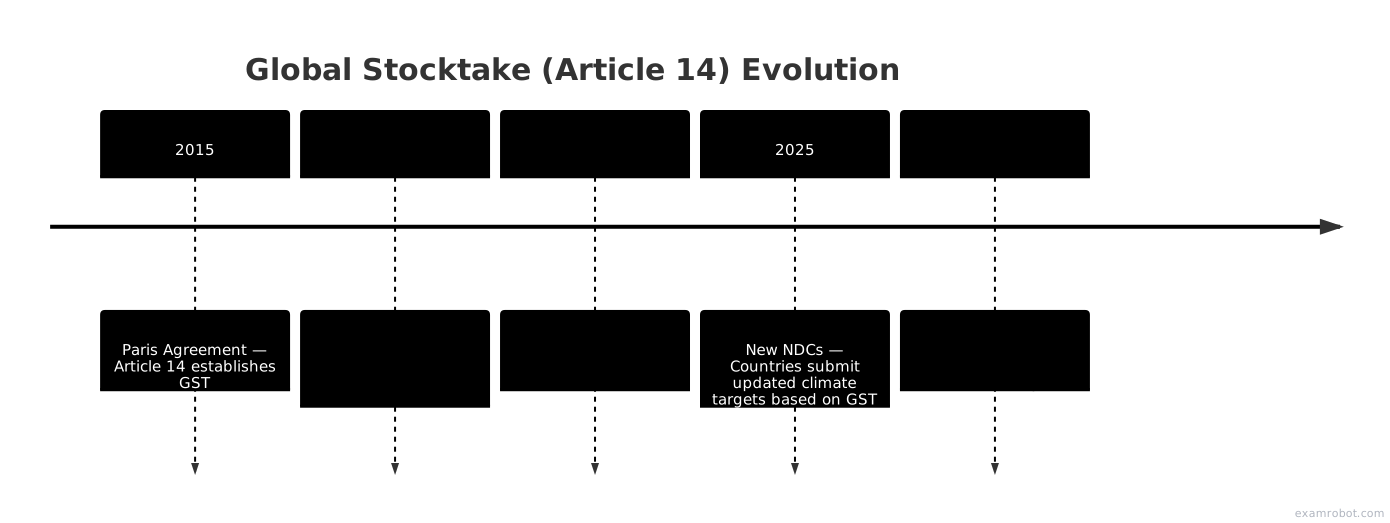
Parallel to this reporting is the Global Stocktake (GST). Established under Article 14 of the Paris Agreement, the GST is a formal process for countries to evaluate their collective progress towards meeting long-term climate goals. The first-ever GST concluded at COP28 in Dubai in 2023. The landmark outcome of this stocktake, known as the UAE Consensus, explicitly called for "transitioning away from fossil fuels in energy systems" to achieve net zero by 2050. It also set a target to triple global renewable energy capacity by 2030.
Global MPI UPSC and UNDP Reports
Poverty is a lived experience, not just a line drawn on a graph based on daily income. The shift from measuring poverty solely by income to measuring it by access to basic needs is captured by the Multidimensional Poverty Index. Differentiating between the global and national versions of this index is critical for your exam preparation.
The Global Multidimensional Poverty Index (MPI) is published jointly by the UNDP and the Oxford Poverty and Human Development Initiative (OPHI). The Global MPI comprises 3 dimensions and 10 specific indicators:
| Dimension | Indicators |
|---|---|
| Health | Nutrition, Child Mortality |
| Education | Years of Schooling, School Attendance |
| Standard of Living | Cooking Fuel, Sanitation, Drinking Water, Electricity, Housing, Assets |
The 2024 report highlights that India has 234 million people living in multidimensional poverty, which is the world's largest absolute number. However, the report also acknowledges a massive achievement: India successfully moved 415 million people out of poverty between the years 2005/2006 and 2019/2021.
At the domestic level, India uses the National MPI published by NITI Aayog. This localised version uses 12 indicators. It retains the global 10 but adds Maternal Health and Bank Accounts to better align the index with national developmental priorities.
In relation to demographic indicators that often overlap with health dimensions, a recent UNFPA survey (dated 13 Jul 2026) noted that India's Total Fertility Rate (TFR) is currently 1.9 children per woman, falling below the replacement level of 2.1. This data feeds into the broader State of World Population Report published by the UNFPA. You can track such demographic updates via our current affairs section.
Common Mistake: The World Bank does NOT publish the Multidimensional Poverty Index. The World Bank publishes the international poverty line data (currently set at $2.15 a day). The MPI is strictly the domain of the UNDP and OPHI.
Practice Question (2024)
Who prepares/publishes the Global Multidimensional Poverty Index (MPI) report ?
1. World Bank and International Monetary Fund (IMF)
2. Oxford Poverty and World Health Organisation (WHO)
3. Oxford Poverty and Human Development Initiative (OPHI)
4. United Nations Development Programme (UNDP)
- 2 and 4
- Only 4
- 1 and 4
- 3 and 4
Correct Answer: d. The Global Multidimensional Poverty Index is developed and published by the Oxford Poverty and Human Development Initiative (OPHI) and the UNDP.
Global South Nations and Global Commons
Geopolitics is often defined by shared developmental challenges rather than strict geography. Two terms that dominate current International Relations questions in the Mains examination are the Global South and the Global Commons.
Global South Nations refers broadly to developing, less-developed, and underdeveloped countries. These nations are primarily located in Africa, Asia, and Latin America. It is vital to understand that this is a geopolitical and economic grouping, not a geographical one. For example, Australia is located in the southern hemisphere but belongs economically to the Global North.
India has actively positioned itself as the "Voice of the Global South". India hosted three Voice of Global South Summits (January 2023, November 2023, and August 2024). During these summits, India launched the 'DAKSHIN' initiative, which serves as a Global South Center of Excellence to share developmental expertise and technological advancements with other developing nations.
The Global Commons, on the other hand, are defined by the United Nations as resource domains that fall outside the jurisdiction of any single country. International law identifies four specific global commons: the High Seas, the Atmosphere, Antarctica, and Outer Space. The governance and protection of these commons frequently appear in questions related to environmental treaties and space law.
Frequently Asked Questions
Who releases the Global Hunger Index?
It is currently released jointly by the European NGOs Concern Worldwide and Welthungerhilfe. Historically, IFPRI was also a co-publisher.
What is India's rank in the Global Gender Gap Index 2025?
In the latest available 2024-2025 cycle report, India ranked 129th out of 146 countries, published by the World Economic Forum.
Which countries are considered part of the Global South?
The Global South comprises developing and emerging economies primarily located in Africa, Asia, Latin America, and the Caribbean. It is an economic and geopolitical term, not strictly geographical.
Who publishes the Global Environmental Outlook?
The Global Environmental Outlook (GEO) is the flagship environmental assessment published by the United Nations Environment Programme (UNEP).
What is the Global Innovation Index 2025 India rank?
In the latest 2024-2025 cycle, India secured the 39th position out of 133 economies, reflecting a massive improvement from its 81st rank in 2015.
What are the 3 pillars of global sustainability in reports?
Global sustainability and multidimensional indices (like the MPI) typically rest on three core pillars: Economic Development, Social Inclusion (Health/Education), and Environmental Protection (Standard of Living/Ecology).
Who publishes the Global Multidimensional Poverty Index?
It is jointly published by the United Nations Development Programme (UNDP) and the Oxford Poverty and Human Development Initiative (OPHI).