Mauryan Art and Architecture: Salient Features, Pillars
The Mauryan period marks a watershed in Indian art, representing the definitive transition from perishable wood to monumental stone architecture. Broadly, historians classify this era's output into Court Art, which includes state-sponsored palatial buildings, monolithic pillars, and stupas, and Popular Art, comprising individual or guild-sponsored caves, pottery, and sculptures. A defining characteristic of this epoch is the 'Mauryan polish', a brilliant, mirror-like finish applied meticulously to stone surfaces, primarily using buff-coloured Chunar sandstone.
Architecture during this time was heavily influenced by Buddhism, particularly under Emperor Ashoka, who ingeniously used art as a medium to propagate his policy of Dhamma. The aesthetic of the period reflects a fascinating synthesis of indigenous traditions and foreign influences, notably from the Achaemenid or Persian empire, which were skillfully adapted to suit Indian sensibilities. Understanding these facets provides a clear window into the administrative might and cultural sophistication of ancient India's first great empire.
Classification of Mauryan Art: Court Art vs. Popular Art
To understand the art of any great empire, it helps to look at who was paying for it. The renowned historian Ananda Coomaraswamy proposed a very practical way to study Mauryan creativity by dividing it into two distinct streams based on patronage. On one side, we have the grand imperial projects, and on the other, the everyday crafts of the masses.
Court Art was initiated by Chandragupta Maurya and reached its absolute zenith under Ashoka. This stream was driven entirely by the political and religious objectives of the state. Conversely, Popular Art was driven by local governors, wealthy guilds, and individual patrons, reflecting the everyday socio-religious life and beliefs of ordinary people.
| Category | Key Characteristics | Prominent Examples |
|---|---|---|
| Court Art | State-sponsored, driven by political and religious objectives, monumental scale. | Palaces (Pataliputra), Pillars (Ashokan Edicts), Stupas (Sanchi, Dhamek). |
| Popular Art | Individual or guild-sponsored, reflecting everyday socio-religious life. | Cave Architecture (Barabar), Sculptures (Yaksha/Yakshini), Pottery (NBPW). |

Capital of Mauryan Empire & The Palace at Pataliputra
Imagine building a grand capital city from scratch. Before the complete mastery of stone, early empires relied heavily on the materials around them, primarily wood. Pataliputra, the heart of the Mauryan Empire, perfectly illustrates this transition. Situated at the strategic confluence of the Ganga and Son rivers, the city was a marvel of urban planning.
The Greek ambassador Megasthenes described Pataliputra in his work Indika as a massive parallelogram surrounded by a formidable wooden wall. This wall boasted 64 gates and 570 watchtowers, rivalling the grandeur of the great Persian cities of Susa and Ecbatana. The sheer scale of the city reflected the immense centralised power of the Mauryan state.
Archaeological excavations conducted by D.B. Spooner between 1912 and 1915 at modern Kumrahar in Patna brought the remains of this grand palace to light. The most striking discovery was the famous 80-pillared hall, consisting of eight rows of ten monolithic sandstone pillars. While these pillars exhibited the signature Mauryan polish, the substructure, including the floor and the heavy roof, remained entirely wooden. Because wood is highly perishable, the palace was likely destroyed by a massive fire. Centuries later, the Chinese traveller Fa-Hien visited the surviving ruins and was so awestruck that he described the palace as being made by spirits, believing human hands could not have lifted such massive stones.
Evolution of Ashokan Pillars and their Symbolism
Think of Ashokan pillars not just as beautiful stone carvings, but as the imperial mass media of the ancient world. Erected strategically along busy trade routes and restive borders, they were designed to communicate the emperor's policy of Dhamma directly to his subjects.
These majestic columns were carved from a single piece of buff-coloured Chunar sandstone, quarried near Mirzapur and Varanasi. Transporting these massive blocks across the empire required immense logistical coordination. They were strictly monolithic, meaning they were not built in segments, and they stood up to 40 to 50 feet tall. The Sarnath Lion Capital remains the most iconic example of this craftsmanship, so much so that it was adopted as India's National Emblem on January 26, 1950.
| Component | Architectural Description |
|---|---|
| Shaft | A monolithic, smooth, and tapering cylindrical structure forming the main body. |
| Capital | A bell-shaped or inverted lotus structure, attached to the top of the shaft via a hidden copper bolt. |
| Abacus | A circular or rectangular platform resting above the capital. At Sarnath, it features four moving animals (Elephant, Bull, Horse, Lion) separated by Dharma Chakras. |
| Animal Figure | The crowning majestic animal, such as the four lions sitting back-to-back at Sarnath or the single bull at Rampurva. |
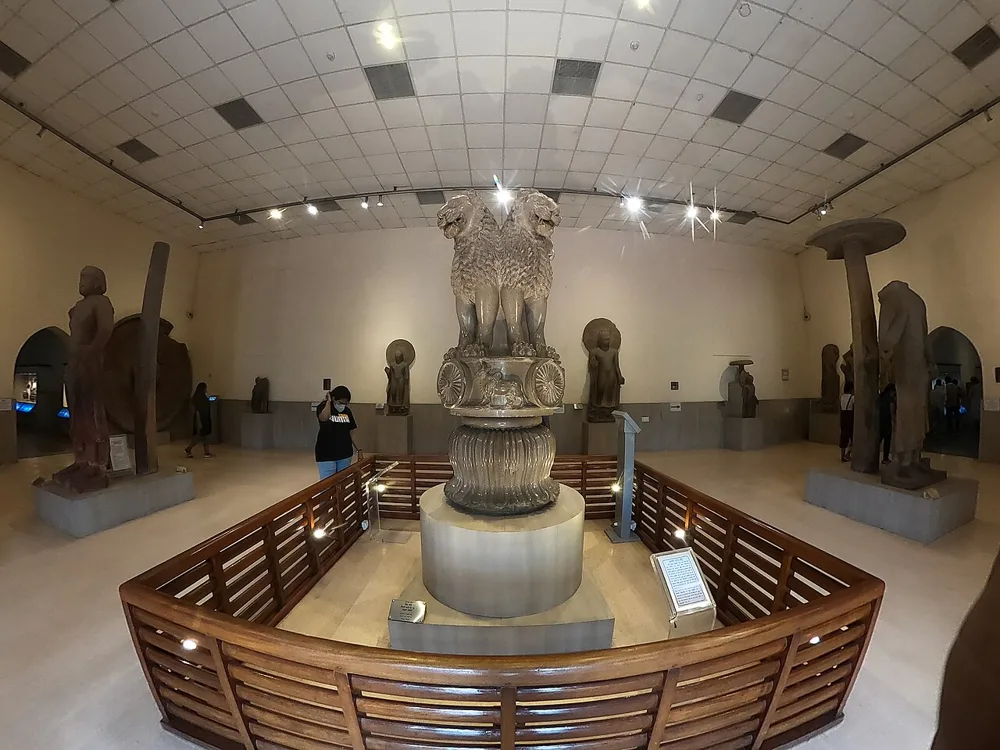
Common Mistake: Thinking Ashokan pillars were made of metal. The famous Iron Pillar in Delhi belongs to the Gupta period (Chandragupta II), not the Mauryan era. Ashokan pillars are strictly monolithic stone structures.
Practice Question (CDS-I 2013)
The highly polished monolithic Ashokan Pillars were carved out of single pieces of a buff- coloured sandstone, usually mined from the quarries of,
- Chunar near Mirzapur
- Lauriya in Nandangarh
- Samath near Varanasi
- Udayagiri near Bhubane- shwar
Correct Answer: a. The monolithic Ashokan pillars are renowned for their exceptional craftsmanship and unique mirror-like polish, primarily carved from buff-coloured sandstone quarried at Chunar near Mirzapur.
Practice Question (CISF 2018)
Which of the following statements about the Ashokan pillars is/are not correct ?
1. The 14th century Tarikh-i-Firuz Shahi makes reference to the Ashokan pillars.
2. The writer Shams Siraj Afif gives an account of the Ashokan pillars.
3. The Ashokan pillars are monolithic structures.
4. The Ashokan pillars are produced in gold, iron, or bronze.
- 1 only
- 2 only
- 2, 3 and 4 only
- 4 only
Correct Answer: d. Statement 4 is incorrect because Ashokan pillars were monolithic stone structures carved from Chunar sandstone, not produced in metals like gold, iron, or bronze.
Mains Question (GS1 2022)
Discuss the significance of the lion and bull figures in Indian mythology, art and architecture. (Answer in 250 words)
Examiner Analysis: The pattern narrative shows that before 2022, examiners focused on the macro-relationship between philosophy and monuments. The 2022 question tightened this focus to specific zoomorphic motifs (lion and bull) across mythology and art, marking a shift from abstract ideas to tangible symbolism. This requires a precise understanding of how these animal figures evolved from primitive totems to sophisticated symbols of authority.
Answer Approach:
- Introduction: Note that the lion (Simha) and bull (Vrishabha) are seminal motifs in the Indian cultural landscape, evolving from primitive totems to sophisticated symbols of temporal and spiritual authority across the Indus Valley, Vedic, and Mauryan epochs.
- Mythological and Religious Significance: For the lion, highlight its representation of power and sovereignty, linking it to Vaishnavite and Shaivite traditions (such as Narasimha). For the bull, discuss its association with Lord Shiva (Nandi) and its representation of fertility and dharma.
- Art and Architecture: Connect these motifs directly to Mauryan pillars, specifically the Sarnath Lion Capital and the Rampurva Bull Capital, explaining how they symbolised imperial power and the spread of Buddhist Dhamma across the subcontinent.
Difference Between Mauryan and Persian Pillars
A persistent myth in ancient history is that Mauryan artists simply copied the grand pillars of the Persian Achaemenid Empire. While the initial idea of polishing stone might have travelled across borders, the execution was distinctly Indian. Let us contrast their structural differences to see how Mauryan artisans adapted the concept.
| Feature | Mauryan Pillars | Persian (Achaemenid) Pillars |
|---|---|---|
| Composition | Monolithic, carved from a single massive block of stone. | Segmented, built by stacking multiple pieces or stone drums. |
| Location and Function | Free-standing monuments erected independently. | Structural supports attached to buildings, such as the Apadana palace. |
| Shaft Surface | Smooth, highly polished, and gently tapering towards the top. | Fluted, featuring vertical grooves carved along the length. |
| Base Structure | No base; they were planted directly deep into the ground. | Stood on an elaborate bell-shaped or moulded stone base. |
Development of Stupa Architecture
Architecture often evolves by taking a simple, existing concept and scaling it up. The stupa began as a humble Vedic funeral mound, known as a tumulus, but under Ashoka, it was transformed into a monumental repository for sacred relics.
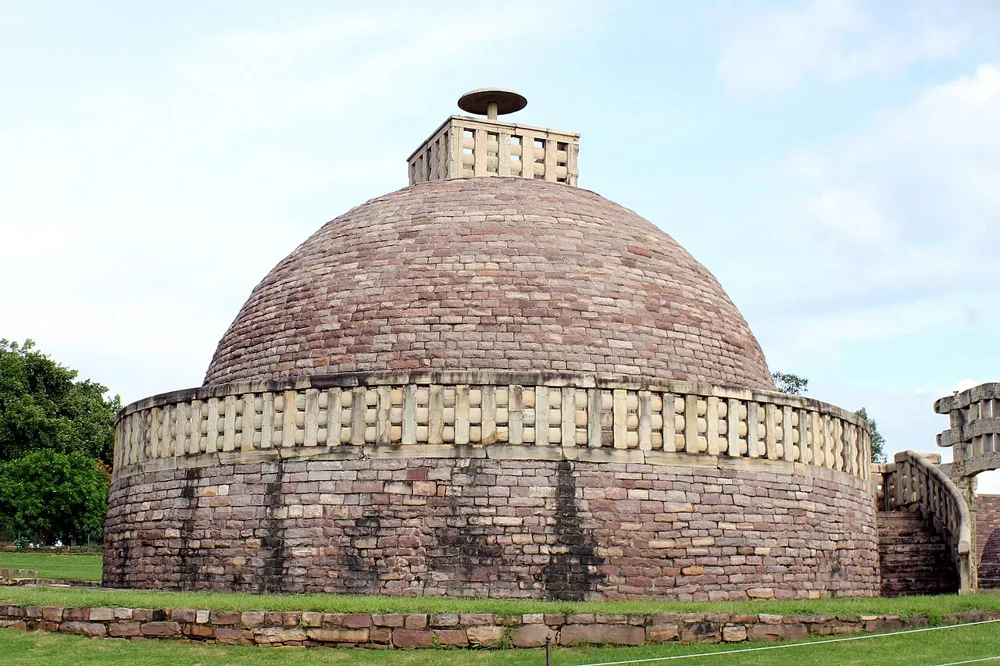
While the concept of a burial mound is Vedic in origin, Buddhism adopted and popularised the stupa as a votive and commemorative structure containing the physical relics of the Buddha or prominent monks. During Ashoka's reign, these simple mounds were expanded into massive brick structures, such as the Great Stupa at Sanchi and the Dhamek Stupa at Sarnath. The core of these early stupas was made of unburnt brick, while the outer surface utilised burnt brick covered with a thick layer of plaster for protection against the elements.
| Component | Architectural Significance |
|---|---|
| Anda | The solid hemispherical mound symbolising the dome of heaven and enclosing the relics. |
| Harmika | A square balcony-like structure on top of the dome, representing the sacred abode of the gods. |
| Chhatri | The central pillar or umbrella rising from the harmika, signifying the central axis of the universe. |
| Vedika | The stone railing surrounding the stupa, which replaced earlier wooden fences and provided a path for circumambulation. |
| Torana | Elaborately carved gateways at the four cardinal points, mostly added later during the Post-Mauryan Sunga period. |

Practice Question (IAS 2023)
With reference to ancient India, consider the following statements :
1. The concept of Stupa is Buddhist in origin.
2. Stupa was generally a repository of relics.
3. Stupa was a votive and commemorative structure in Buddhist tradition.
How many of the above statements are correct?
- Only one
- Only two
- All three
- None
Correct Answer: b. Statements 2 and 3 are correct, but Statement 1 is incorrect because the architectural concept of the Stupa has Vedic origins as a burial mound before being adopted by Buddhism.
Mauryan Cave Architecture: Barabar and Nagarjuni Hills
Carving a building out of a solid mountain seems like an impossible task, yet the Mauryan period gave us the genesis of Indian rock-cut architecture. More importantly, these caves tell a profound story of religious tolerance.
Located in Jehanabad, Bihar, the Barabar and Nagarjuni Hill caves are the earliest surviving rock-cut caves in India, dating back to the 3rd century BCE. They were commissioned by Emperor Ashoka and his grandson Dasharatha. Though Ashoka was a devout Buddhist, he dedicated these costly excavations to the ascetic Ajivika sect. This act demonstrates the remarkable religious pluralism and state support for diverse philosophies during the Mauryan era.
Architecturally, these caves are famous for their highly polished interior surfaces, which echo sound beautifully, and their arched entrances. The Lomas Rishi Cave features a semi-circular chaitya arch that perfectly imitates contemporary wooden architecture, proving that early stone carvers were still heavily influenced by carpentry techniques.
Common Mistake: Attributing the Barabar caves to Chandragupta Maurya or assuming they are Buddhist. They were built by Emperor Ashoka and his grandson Dasharatha specifically for the ascetic Ajivika sect.
Practice Question (IAS 2013)
With reference to the history of Indian rock-cut architecture, consider the following statements:
1. The caves at Badami are the oldest surviving rock-cut caves in India.
2. The Barabar rock-cut caves were originally made for Ajivikas by Emperor Ashoka.
3. At Ellora, caves were made for different faiths.
Which of the statements given above is/are correct?
- 1 only
- 2 and 3 only
- 3 only
- 1, 2 and 3
Correct Answer: b. Statement 1 is incorrect as the Barabar caves are the oldest surviving rock-cut caves, while statements 2 and 3 accurately describe the religious diversity of Barabar and Ellora.
Practice Question (CDS-I 2013)
Statement I : Lomash Rishi and Sudama caves in the Barabar Hills, modelled on wooden architectural prototypes, are examples of the earliest cave architecture in India.
Statement II : Barabar Hills caves were dedicated by Chandragupta Maurya to the Ajivika monks.
- Both the statements are individually true and statement II is the correct explanation of statement I
- Both the statements are individually true but statement II is not the correct explanation of statement I
- Statement I is true but statement II is false
- Statement I is false but statement II is true
Correct Answer: c. Statement I is true, but Statement II is false because the Barabar caves were dedicated to the Ajivikas by Emperor Ashoka, not Chandragupta Maurya.
Mains Question (GS1 2020)
The rock-cut architecture represents one of the most important sources of our knowledge of early Indian art and history. Discuss. (Answer in 150 words)
Examiner Analysis: The pattern narrative reveals that in 2015, examiners focused on the aesthetic life reflected in Mesolithic rock art. By the 2020 question, the lens shifted toward rock-cut architecture as a formal historiographical source. This tests your ability to view monuments not just as art, but as primary texts that record the socio-religious and political shifts of their era.
Answer Approach:
- Introduction: Define rock-cut architecture as the creation of structures by carving solid natural rock, serving as a lithic record of India's cultural and political evolution starting from the Mauryan era.
- Religious Evolution and Pluralism: Explain how these caves document religious transitions. For instance, the Barabar caves highlight the Mauryan state's patronage of the Ajivika sect, proving royal religious tolerance. Later caves like Ajanta show the shift from Hinayana to Mahayana Buddhism.
- Architectural and Social Insights: Discuss how early caves imitated wooden structures (like the Lomas Rishi arch), providing hard evidence of perishable domestic architecture that no longer survives. Conclude by affirming that these lithic structures are indispensable archives of early Indian history.
Popular Art: Sculptures and Pottery
While the emperor was building massive pillars and stupas, what were the common people creating? Parallel to royal edicts, a vibrant tradition of popular art thrived, reflecting the everyday beliefs and crafts of the masses.
The most prominent examples of sculptural popular art are the large stone figures of Yakshas and Yakshinis. These figures were not confined to one religion; they were worshipped widely across Hinduism, Buddhism, and Jainism as fertility and protective deities. The Didarganj Yakshini, discovered near Patna, is an absolute masterpiece of this genre. Standing 5 feet 4 inches tall and holding a flywhisk (chauri), she features the signature mirror-like Mauryan polish, proving that local artisans had mastered the state's polishing techniques.
In terms of pottery, the Mauryan era is archaeologically identified by Northern Black Polished Ware (NBPW). This was not everyday cookware. NBPW was a highly lustrous, glossy, luxury pottery used primarily by the elites, marking the zenith of ancient Indian pottery making.
Post Mauryan Period: Trends in Indian Art
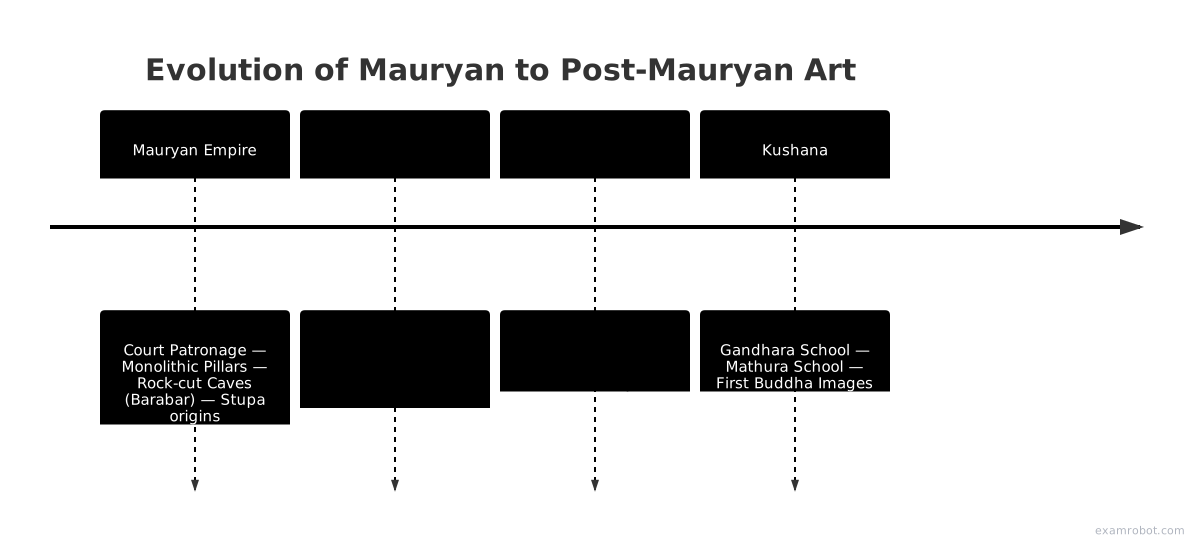
When a massive, centralised empire declines, the funding for art does not disappear; it simply changes hands. Following the Mauryan period, the patronage of art shifted from the emperor to wealthy merchants, local kings like the Sungas, Kanvas, Satavahanas, and Kushanas, and powerful trade guilds known as shrenis.
During this phase, stone completely replaced wood in architecture. A perfect example is the elaborate stone Toranas (gateways) added to the Sanchi Stupa by the Sungas, which feature intricate carvings of Jataka tales. This period also saw the emergence of distinct sculptural schools across the subcontinent. The Amaravati School, patronised by the Satavahanas, became famous for its use of white marble and dynamic narrative art. Meanwhile, in the north, the Gandhara and Mathura Schools under the Kushanas marked a massive theological shift, moving from aniconic or symbolic worship to carving the first physical idols of the Buddha.
Practice Question (CDS-I 2010)
'Use of white marble, long legs and slender frames, human beings as central characters and prominence of kings, princess and palaces' were the characteristic features of which one of the following ancient art forms of India?
- Amaravati School of Art
- Gandhara School of Art
- Mathura School of Art
- Pahari School of Art
Correct Answer: a. The Amaravati School of Art, patronised by the Satavahanas, is uniquely characterised by its use of white marble and dynamic narrative panels focusing on human figures.
Mauryan Art and Architecture UPSC Notes & BPSC Focus
Connecting historical facts to your exam syllabus is how you score marks. For those preparing for state services like the BPSC, the regional heritage of Bihar is central to this topic. You must be thoroughly familiar with the Kumrahar excavations in Patna, the Barabar Caves in Jehanabad, and the Didarganj Yakshini housed in the Bihar Museum.
For UPSC aspirants, understanding the administrative machinery that made this art possible is vital. Art patronage was managed by specific Mauryan officials. Rajukas and Mahamatras oversaw massive public works, while the Sannidhata, the chief treasurer, managed the immense state funds required to quarry, transport, and polish monumental rock-cut architecture. Recognising these linkages between art, economy, and administration will enrich your Mains answers.
In the News
Prime Minister Dedicates 75 Amrit Bharat Stations (18 July 2026)
The ongoing Amrit Bharat Station Scheme emphasises a 'Virasat bhi, Vikas bhi' approach, aiming to redevelop railway stations into modern transit hubs while preserving regional heritage. Modern station facades in the Mauryan heartland, specifically across Bihar and Uttar Pradesh, are being redesigned to incorporate ancient architectural motifs. These include the Ashokan Lion Capital, polished stone aesthetics, and Stupa-inspired elements. This integration of modern amenities with local historical architecture ensures that the legacy of Mauryan art remains visible in public infrastructure today. Read more current affairs
Frequently Asked Questions
What are the salient features of Mauryan art and architecture?
Key features include the transition from wood to stone, the use of monolithic Chunar sandstone, the distinctive mirror-like 'Mauryan polish', and the division into state-sponsored Court Art (pillars, palaces) and individual-sponsored Popular Art (caves, pottery).
How did Ashoka influence Mauryan architecture?
Ashoka catalysed the shift to stone architecture. He commissioned thousands of stupas, erected monolithic inscribed pillars to spread Dhamma, and excavated the first rock-cut caves at Barabar for the Ajivika sect.
What is the difference between Mauryan and Persian pillars?
Mauryan pillars are monolithic (single stone), free-standing, have smooth tapering shafts, and lack a base. Persian (Achaemenid) pillars are built in segments, attached to palace structures, have fluted shafts, and stand on bell-shaped bases.
What was the capital of the Mauryan Empire and its architectural significance?
Pataliputra (modern Kumrahar) was the capital. It featured a massive wooden palisade and an 80-pillared assembly hall made of polished sandstone, representing India's earliest monumental stone architecture.
What are the examples of Mauryan rock-cut architecture?
The Barabar and Nagarjuni Hill caves in Bihar are the primary examples. Built for the Ajivika sect, they feature highly polished interiors and wooden-style architectural imitation, such as the Lomas Rishi cave arch.
What is the significance of the Yaksha and Yakshini figures in Mauryan art?
They represent the 'Popular Art' of the Mauryan period. These figures were widely worshipped across all major religions (Hinduism, Buddhism, Jainism) as fertility and protective deities. The Didarganj Yakshini is the most famous surviving example.