Post-Mauryan Trends in Indian Art: Gandhara, Mathura and Amaravati Compared
Short answer. After the Mauryas (NIOS dates the period c. 200 BC to AD 300), art became predominantly religious. NIOS names two main features: the construction of stupas and the growth of regional schools of sculpture. It names three major schools: Mathura, Gandhara and Amaravati. They differ most clearly in stone and style. Mathura used local red stone with black spots, Gandhara used blue-grey schist with Greek and Roman style, and Amaravati used white marble-like stone with narrative medallions. (NIOS History, Lesson 6, section 6.7, source.)
This page is a school-by-school comparison with an identification exercise. For structural terms such as stupa, chaitya and vihara, see Buddhist Architecture. For the preceding period, see Mauryan Art and Architecture.
Scope note: No past-year question records were supplied for this lesson, so nothing here claims how often the topic appears in UPSC papers. The source base is one school-level text (NIOS) plus short TN state board and NCERT Class VII passages. That is thin for a topic of this size, so treat the chart as a minimum core to learn rather than a complete account.
The general trend: contact, spread and religious art
- After the Mauryan decline (NIOS gives c. 187 BC), many regional kingdoms arose and groups from Central Asia and western China (Indo-Greeks, Shakas, Parthians, Kushanas) entered India. NIOS says this brought India into closer contact with Central Asian politics and culture.
- The TN state board text (Class XI, Ch. 6, p. 77) says these invasions strengthened acculturation and the assimilation of foreign cultures and art forms into Indian society.
- NIOS says Central Asian contacts "brought a fresh wave in the art of sculpture making", and that Gandhara Buddhist sculpture evolved from the amalgamation of Indian and Greek styles.
- NIOS links the many Buddha images to Mahayana, which encouraged worship of the Buddha as a god in human form.
Interpretation (ours): the chain of cause is contact, then patronage by new rulers, then regional styles. Avoid claiming that foreign influence explains every school. Per NIOS, Mathura used local stone and also made Jaina and Brahmanical images, and Amaravati was in the Satavahana-ruled Deccan.
Three schools at a glance
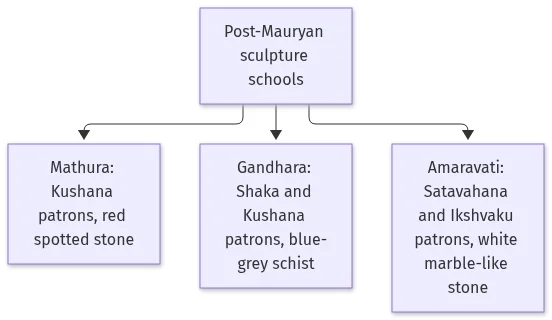
Comparison chart
Each cell is tagged to NIOS 6.7(iii) unless another source is named.
| Feature | Mathura | Gandhara | Amaravati |
|---|---|---|---|
| Patron | Kushanas (NIOS section 6.2: Kanishka patronised the Gandhara and Mathura schools) | Shakas and Kushanas are the chief patrons (NIOS 6.7(iii)); Kanishka also patronised it (NIOS 6.2) | Satavahanas, continued under their successors the Ikshvakus (NIOS 6.7(iii)) |
| Region | Mathura (the packet gives no wider description) | Northwestern part of the subcontinent (NIOS). NCERT VII says the style emerged "in the western regions of Punjab" | Andhra Pradesh, between the lower valleys of the Krishna and Godavari (NIOS) |
| Stone | Local red stone with black spots (NIOS; the NIOS answer key says red sandstone with black spots) | Predominantly blue-grey schist (NIOS) | White marble-like stone (NIOS) |
| Style | NIOS describes local stone and a mix of Buddhist, Jaina and Brahmanical work, without naming a style label. NCERT VII includes Mathura in the Kushana fusion of Indian and Greek styles, so do not call it "purely Indian" in an essay | Graeco-Roman, Indo-Greek or Graeco-Buddhist. Beautiful human figures with distinguished muscles; Buddha in Graeco-Roman drapery with very curly hair (NIOS). Roman techniques assimilated through contact with Rome; half-closed meditative eyes (TN board p. 82) | "Narrative art": medallions depict an incident naturally. Human figures are prominent rather than nature (NIOS) |
| Subject | Buddha images (perhaps carved for the first time here, per NIOS), many Jaina deities, ayagapatas, and Brahmanical deities (Kartikeya, Vishnu, Kubera) | Predominantly Buddhist theme; Buddha and Bodhisattva images | Stories from the Buddha's life, on railings, plinths and other parts of stupas |
| Buddha image treatment | Carved in local stone alongside Jaina and Brahmanical images | Drapery and curly hair in Graeco-Roman fashion; eyes half-closed | Shown in narrative scenes, for example the taming of an elephant by the Buddha |
Where the sources differ in wording
- Gandhara region: NIOS says "northwestern part of the Indian Subcontinent". NCERT VII says "western regions of Punjab". These are not necessarily in conflict, but the wording differs, so use the NIOS wording in an answer and the NCERT wording only if the question asks for it.
- Gandhara date: NIOS says "around the beginning of the Christian era". The TN board says the first century CE.
- Mathura stone: the NIOS text says "red stone with black spots" and the answer key says "red sandstone with black spots". The packet adds no further detail.
Sources: NIOS Lesson 6; TN state board Class XI, Ch. 6, p. 82; NCERT Class VII Exploring Society (revised 2025), Ch. 6 "The Age of Reorganisation", p. 137.
Stupa sites and rock-cut works
This table lists only what NIOS section 6.7 states. The last column marks what the packet does not say, so that no attribution is asserted without a source.
| Site | Stated in NIOS | Not stated in the packet |
|---|---|---|
| Bharhut (M.P.) | Originally built by Ashoka but enlarged later (NIOS's statement for Bharhut and Sanchi). Present form dates to the middle of the second century BC. Important for its sculptures. Railings of red stone. | Who patronised the expansion; any torana attribution. |
| Sanchi (M.P.) | Three big stupas built in this period. The biggest, originally Ashoka's, was enlarged to twice its size sometime in the second century BC. | Who patronised the enlargement; who built the gateways. The packet does not support a Sunga attribution, so none is asserted here. |
| Amaravati (Andhra Pradesh) | Took final shape sometime in the second century AD. Amaravati school sculptures are found on railings and plinths. Stupa sculptures draw on Jataka and other Buddhist stories. | Detailed architectural plan. |
| Nagarjunakonda (Andhra Pradesh) | Named as a prominent stupa of the period. | Dates, stone and features. |
| Rock-cut chaityas and viharas near Pune and Nasik | Cut out under the Satavahanas. A chaitya has a shrine cell with a votive stupa at the centre. A vihara was the monks' residence. | Names of individual caves. |
NIOS adds that no southern stupa has survived in its entirety.
Identification exercise with worked verdicts
These are descriptions we wrote from the NIOS and textbook features. They are not real museum catalogue entries. Decide the school and give two features before reading the verdict.
Decision order
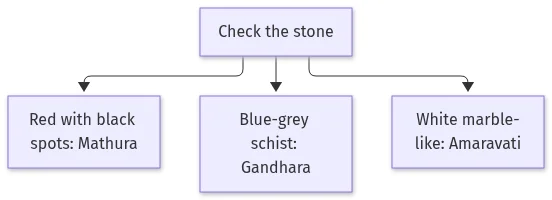
Ask about the stone first, then the style and subject, then whether the work is a free-standing image or a relief on a stupa.
Case 1
A blue-grey schist Buddha with very curly hair, drapery in Graeco-Roman fashion and half-closed eyes.
Verdict
Gandhara. Deciding features: blue-grey schist and Graeco-Roman drapery with curly hair (NIOS); half-closed meditative eyes (TN board p. 82). Tempting wrong answer: Mathura, because both made early Buddha images. It fails on stone, since Mathura used red stone with black spots.
Case 2
A Buddha image in red stone with black spots.
Verdict
Mathura. Deciding feature: the local red stone with black spots. Style alone could mislead, so lean on the stone. Tempting wrong answer: Gandhara, if you focus only on "early Buddha image". The stone rules it out.
Case 3
A red-spotted stone sculpture of a Jaina deity or of Kubera.
Verdict
Mathura. NIOS says Mathura yielded large numbers of Jaina sculptures and, in the Kushana period, Brahmanical deities including Kartikeya, Vishnu and Kubera. Deciding features: the stone and the non-Buddhist subject. Wrong answer: Gandhara, whose theme NIOS calls predominantly Buddhist.
Case 4
A railing medallion in white marble-like stone, showing the Buddha taming an elephant.
Verdict
Amaravati. Deciding features: white marble-like stone and a medallion carved as a natural narrative of one incident (NIOS gives the elephant example). Tempting wrong answer: Gandhara, because it is also Buddhist. It fails on stone and on format: Amaravati sculpture is found on stupa railings, plinths and other parts.
Case 5
A sculpture of a figure with distinguished muscles and a draped garment, in a Buddhist theme but Greek in style.
Verdict
Gandhara. NIOS says the theme is predominantly Buddhist but the style Greek, with human figures shown with distinguished muscles. Wrong answer: Amaravati, which also stresses human figures. Check the stone and whether the piece is a stupa relief telling a story.
Case 6
A relief scene from the Buddha's life on a stupa plinth in the lower Krishna-Godavari region.
Verdict
Amaravati. Deciding features: region, stupa plinth, and a Buddha-life theme. The patrons were the Satavahanas, later the Ikshvakus. Wrong answer: Mathura, which NIOS ties to Buddha images, ayagapatas and Jaina or Brahmanical work.
Common mix-ups: (1) Mathura versus Gandhara on the Buddha image: use stone. (2) Treating Gandhara as the only school with Greek links: NCERT VII puts both Gandhara and Mathura under the Kushana fusion of Indian and Greek styles. (3) Assuming Ashoka-linked stupas were wholly built in this period: NIOS says Bharhut and Sanchi were originally Ashoka's and enlarged later.
Mains-style practice
NIOS Terminal Question 6 reads: "Write an essay on the various schools of sculptural art that emerged after the Mauryan empire." This is a NIOS textbook question, not a UPSC question. The outline below is our own suggested approach, not official guidance.
- Introduction: the Mauryan decline, Central Asian contacts and the rise of religious art; stupas and regional schools as the two main features.
- Mathura: Kushana patronage, red stone with black spots, Buddha images, Jaina and Brahmanical images.
- Gandhara: Shaka and Kushana patrons, blue-grey schist, Graeco-Roman style, curly hair, drapery, half-closed eyes.
- Amaravati: Satavahana and Ikshvaku patronage, white marble-like stone, narrative medallions on stupa railings and plinths.
- Common ground and contrast: religious themes and Buddha images, but different stone, region and treatment. Include the stupa sites briefly.
- Conclusion: the period shows regional diversity and cultural exchange. Do not claim more than the sources support.
Practice and self-check
Try this question from our bank on Gandhara sculpture and the Buddha's mudras: Gandhara sculptures and the preaching mudra (IAS 1994). Check the stored answer and explanation on the live page. It is not an independently verified official key.
Self-check: without the chart, give the stone for each school, the chief patrons of Gandhara, and the region of Amaravati.
Revision takeaway
Stone first: red with black spots means Mathura, blue-grey schist means Gandhara, white marble-like stone means Amaravati. Then check style (Greek drapery versus narrative medallion) and subject (Jaina or Brahmanical versus Buddhist).
FAQs
What kind of stone was used in the Mathura school?
Local red stone with black spots; the NIOS answer key says red sandstone with black spots.
Who were the chief patrons of the Gandhara school?
The Shakas and Kushanas, per NIOS.
Which schools developed in the post-Mauryan period?
Mathura, Gandhara and Amaravati, per NIOS.
How is Amaravati different from the other two?
Its distinctive feature in NIOS is narrative art in medallions, carved in white marble-like stone, with sculptures on stupa railings and plinths. NIOS credits the Kushana-patronised Gandhara and Mathura schools with the earliest Buddha and Bodhisattva images.
Who patronised the Sanchi and Bharhut gateways?
The supplied sources do not say, so this page makes no attribution.