Buddhist Architecture UPSC: Stupas, Caves & Art
Buddhist architecture is a prominent ancient Indian architectural style that evolved from the Mauryan period onwards, closely tied to the life and teachings of Gautama Buddha. Originally, during the Hinayana phase, this architecture was strictly aniconic. Builders used symbols like the empty throne, the Dhamma wheel, or the Bodhi tree to represent the Buddha. Following the Fourth Buddhist Council, the Mahayana phase introduced iconic architecture, bringing anthropomorphic statues of the Buddha directly into the worship spaces.
Key characteristics of this tradition include the excavation of rock-cut caves, the extensive use of brick and stone, and the integration of pre-Buddhist folk motifs, such as Yakshis, into narrative relief sculptures depicting Jataka tales.
| Architecture Type | Primary Function |
|---|---|
| 1. Stupas | Relic mounds housing the bodily remains of Buddha or revered monks. |
| 2. Chaityas | Vaulted prayer halls designed for congregational worship. |
| 3. Viharas | Monasteries serving as residential quarters for Buddhist monks. |
| 4. Stambhas | Freestanding pillars often inscribed with edicts or teachings. |
| 5. Toranas | Elaborately carved gateways marking the entrances to sacred enclosures. |
| 6. Pagodas | Multi-tiered towers that evolved from the Indian stupa in East Asia. |
Evolution and Main Features of Buddhist Architecture
Think of the evolution of Buddhist art as a transition from a simple earthen grave marker to a grand, stone-carved textbook. These structures began as basic mounds and grew into complex lithic (stone) monuments that served as a visual pedagogy, teaching complex philosophy to ordinary people through relatable stories.
The concept of the Stupa is not Buddhist in origin. It actually evolved from ancient Vedic funeral mounds, known as tumuli, which were used to bury the ashes of kings and chieftains. Buddhism adopted this existing structural concept and sophisticated it into a symbol of the cosmos and the Buddha's enlightenment. This is a highly tested fact in the UPSC examination.
Early Buddhist Stupa art successfully expounded Buddhist ideals by depicting familiar folk motifs. By integrating popular deities like Yakshas and Yakshinis (nature and fertility spirits), the builders made complex metaphysical concepts accessible to the masses. Furthermore, rock-cut architecture represents a vital lithic record of early Indian art, marking a clear transition from perishable wooden structures to permanent stone monuments.
Historically, Buddhists in the Deccan region were the first to excavate rock-cut Chaityas and Viharas between 200 BCE and 600 CE. This pioneering architectural template was so successful that it was later imitated by Vaishnava, Shaiva, and Jaina communities in subsequent centuries.
Common Mistake: A frequent examiner trap is claiming that the Stupa is exclusively Buddhist in origin. Always remember that it has Vedic, pre-Buddhist roots as a funerary mound.
Mains Practice Question (GS1 2016)
Early Buddhist Stupa-art, while depicting folk motifs and narratives successfully expounds Buddhist ideals. Elucidate. (Answer in 200 words)
Examiner Analysis: The examiner's lens on Buddhism and Indian art has evolved from testing specific philosophical and symbolic syntheses in this 2016 question toward a regional and external influence framework in later years. The core expectation here is to demonstrate how Buddhism assimilated local cults rather than rejecting them, using familiar visual language to teach new religious doctrines.
Answer Approach: Begin your introduction by stating that early Buddhist Stupas (like Sanchi and Bharhut) transitioned from simple burial mounds to sophisticated instruments of visual pedagogy. They utilised indigenous folk traditions to make complex concepts accessible. In the body, detail the integration of popular cults, specifically mentioning Yakshas and Yakshinis acting as guardians. Explain how Jataka tales carved on Toranas used relatable animal fables to teach the Buddhist virtues of compassion and sacrifice. Conclude by noting that this synthesis ensured the wide popular acceptance of the Dhamma.
Mains Practice Question (GS1 2020)
The rock-cut architecture represents one of the most important sources of our knowledge of early Indian art and history. Discuss. (Answer in 150 words)
Examiner Analysis: Earlier in 2015, examiners focused on the aesthetic and cultural life reflected in Mesolithic rock art, but by the 2020 question, the lens shifted toward rock-cut architecture as a formal historiographical source. The examiner expects you to treat the architecture itself as a primary document that records social, religious, and economic history.
Answer Approach: Introduce rock-cut architecture as a process of creating structures by carving solid natural rock, serving as a lithic record of India's cultural evolution from the Mauryan era to the early medieval period. In the body, discuss religious evolution and pluralism, highlighting the visible shift from Hinayana (aniconic) to Mahayana (iconic) styles in caves like Ajanta and Kanheri. Mention how inscriptions found in these caves document royal patronage and merchant guild donations, providing economic context.
Practice Question (2023)
With reference to ancient India, consider the following statements :
1. The concept of Stupa is Buddhist in origin.
2. Stupa was generally a repository of relics.
3. Stupa was a votive and commemorative structure in Buddhist tradition.
- Only one
- Only two
- All three
- None
Correct Answer: Only two. The concept of the Stupa originated from pre-Buddhist Vedic funerary mounds, making statement 1 incorrect.
Practice Question (2011)
Consider the following statements :
1. The Buddhists in Deccan excavated rock-cut Chaityas and the Vaishnavas, Shaivas and Jainas imitated these in later centuries.
2. The Vaishnavas, Shaivas and Jainas excavated temples.
- 1 only
- 2 only
- Both 1 and 2
- Neither 1 nor 2
Correct Answer: 1 only. Buddhist rock-cut architecture in the Deccan established a structural template that was later adopted by other religious groups.
Buddhist Stupa Sanchi and Amaravati Buddhist Stupa
If a Stupa is a cosmic diagram, its different parts represent the universe. The solid dome is the earth, and the central pillar is the axis of the world. Understanding this architecture is easiest when we compare the two most heavily tested examples in the UPSC syllabus: Sanchi and Amaravati.

Stupas were generally repositories of relics, housing the bodily remains of the Buddha or esteemed monks. They were strategically located close to ancient trade routes to attract merchants and patrons, rather than being hidden away in isolated rural areas. Emperor Ashoka was instrumental in popularising the Stupa cult by opening the original eight relic stupas and distributing the contents across his vast empire.
The Sanchi Stupa in Madhya Pradesh began as a relatively plain brick mound during Ashoka's reign and was significantly expanded later. The elaborate stone railings and richly carved Toranas (gateways) were subsequent additions. Interestingly, historical inscriptions reveal that the Guild of Ivory workers financed a portion of one of these gateways. The site survived into the modern era largely due to the preservation efforts and financial support of Shahjahan Begum and Sultan Jehan Begum of Bhopal.
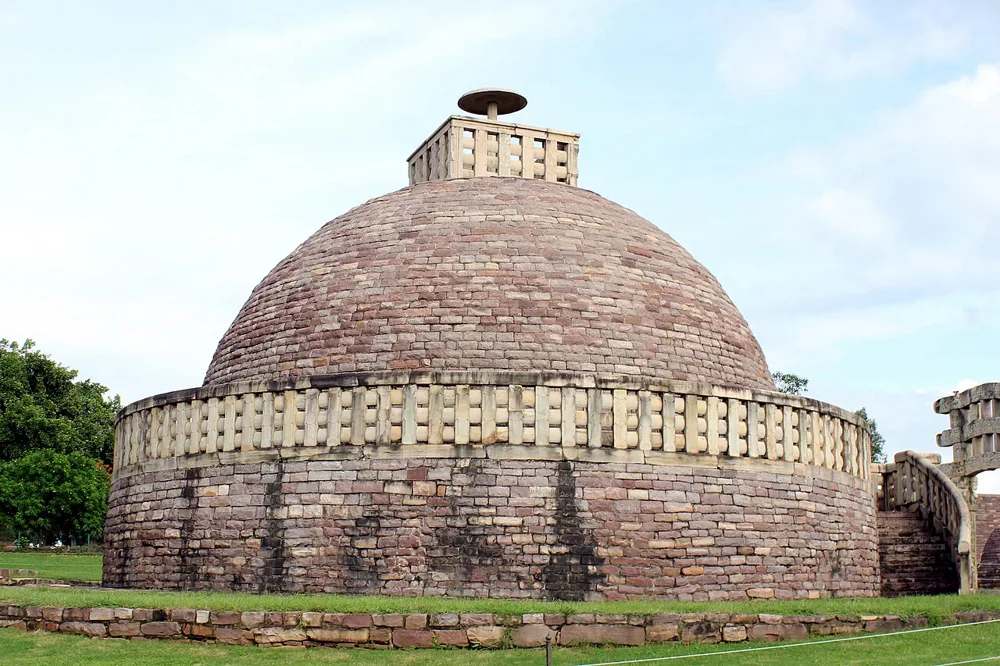
A prominent feature of Sanchi's sculptures is the Shalabhanjika motif, depicting a woman standing gracefully while holding a tree branch, often surrounded by lotuses or elephants. This imagery was derived directly from pre-Buddhist fertility traditions and was not originally inspired by Buddhist ideas.
In contrast, the Amaravati Stupa (Mahachaitya) was located in the lower Krishna valley in modern-day Andhra Pradesh. At its peak, it was actually larger than the Sanchi Stupa. The Amaravati structure is famous for its Ayaka pillars (often written as Aryak pillars in exam papers). These tall pillars were placed on rectangular platforms projecting from the four cardinal points of the central drum, a distinctive feature of the regional architectural school.
Mnemonic: Remember the vertical axis of the Stupa with "Anda, Harmika, Chhatra". The Anda is the hemispherical dome, the Harmika is the square balcony on top, and the Chhatra is the umbrella-like structure representing royalty and protection.
Practice Question (2023)
Consider the following observations about the largest stupa at Sanchi:
1. Going by information available from the inscriptions on the railings of the stupa, the construction of part of one of its gateways was financed by the Guild of Ivory workers.
2. It was preserved by Shahjahan Begum.
- 1 only
- 2 only
- Both 1 and 2
- Neither 1 nor 2
Correct Answer: Both 1 and 2. Inscriptions confirm the ivory workers' donation, and the Begums of Bhopal funded its preservation.
Practice Question (2026)
Which of the following statements on the Amaravati Stupa and its relief sculpture is/are correct?
1. It was located in the lower Krishna valley.
2. In India, it was next only to the Sanchi Stupa in size.
3. The Amaravati stupa was built of red sandstone.
- 1 only
- 1 and 3 only
- 2 and 3 only
- 1, 2 and 3
Correct Answer: 1 only. It was located in the lower Krishna valley. It was actually larger than Sanchi, and it was built using white limestone/marble, not red sandstone.
Practice Question (2018)
Which one of the following statements about Buddhist Stupas in India is not correct?
- Ashoka played an important role in popularizing the Stupa cult.
- They were repositories of relics of Buddha and other monks.
- They were located in rural areas.
- They were located close to trade routes.
Correct Answer: They were located in rural areas. Stupas were strategically placed near urban centres and trade routes to attract patronage.
Practice Question (2025)
Which one of the following sculptures found at Sanchi Stupa is NOT directly inspired by Buddhist ideas ?
- Empty seat
- Shalbhanjika
- Tree
- Wheel
Correct Answer: Shalbhanjika. This motif was adopted from pre-Buddhist fertility and nature traditions.
Buddhist Monastery: Chaitya vs Vihara
Imagine a modern university campus. The grand auditorium where everyone gathers for convocation is the Chaitya, while the surrounding dormitory blocks where students live and sleep are the Viharas.
In rock-cut architecture, there is a clear functional and structural differentiation between these two primary cave types. A Chaitya is a prayer hall designed specifically for congregational worship. Architecturally, it is characterised by a vaulted ceiling, a long rectangular hall, and a stupa located at the far rear end. This layout allowed monks and devotees to perform circumambulation (pradakshina) around the sacred object. In later Mahayana phases, a statue of the Buddha was often carved directly into the front of this interior stupa.
A Vihara is a monastery or a dwelling place for Buddhist monks. It typically consists of a large central square hall surrounded by small, austere residential cells carved into the rock walls.
| Feature | Chaitya | Vihara |
|---|---|---|
| Purpose | Place of worship and congregational prayer. | Residential quarters for monks (monastery). |
| Structure | Long rectangular hall with a vaulted (barrel) ceiling. | Central square courtyard surrounded by small individual cells. |
| Focal Point | A Stupa (or Buddha statue) at the far rear end. | Usually a central assembly space, sometimes with a minor shrine. |
| Famous Examples | Karle Chaitya, Bhaja Caves. | Most caves at Ajanta (e.g., Cave 1 and Cave 2). |
Practice Question (2013)
Some Buddhist rock-cut caves are called Chaityas, while the others are called Viharas. What is the difference between the two?
- Vihara is a place of worship, while Chaitya is the dwelling place of the monks
- Chaitya is a place of worship, while Vihara is the dwelling place of the monks
- Chaitya is a stupa at the far end of the cave, while Vihara is the hall axial to it
- There is no material difference between the two
Correct Answer: Chaitya is a place of worship, while Vihara is the dwelling place of the monks. This is the fundamental functional distinction in Buddhist rock-cut architecture.
4th Buddhist Council and Rise of Mahayana Art
Doctrinal debates in ancient India were not just philosophical exercises; they were the blueprints for new art. When the rules of the religion changed, the architecture immediately transformed to reflect the new beliefs.
The chronological order of the Buddhist Councils is a frequent subject of examination. They occurred at Rajagriha (First), Vaishali (Second), Pataliputra (Third), and Kundalvana in Kashmir (Fourth). A common misconception is that the Third Council, held under Ashoka at Pataliputra, divided Buddhism into Hinayana and Mahayana. This is incorrect. The Third Council actually focused on purifying the Sangha and established the Sthaviravada (Theravada) tradition.
The definitive split occurred at the Fourth Buddhist Council, held in Kashmir during the first century CE under the patronage of the Kushan King Kanishka. This council was presided over by Vasumitra, with Ashvaghosha serving as the vice-president. A major outcome of this gathering was the compilation of the Mahavibhasa, a monumental encyclopaedia of Buddhist philosophy.
The architectural impact of the Fourth Council was profound. It formalised the Mahayana sect, which believed in the divinity of the Buddha. This doctrinal shift directly led to the creation of anthropomorphic Buddha sculptures. Instead of relying on empty thrones or footprints, builders began carving massive Buddha images and integrating them directly inside Chaityas and Viharas.
Mnemonic: For the order of the Councils, remember R-V-P-K (Rajagriha, Vaishali, Pataliputra, Kundalvana). For the patron Kings, remember A-K-A-K (Ajatashatru, Kalasoka, Ashoka, Kanishka).
Practice Question (2025)
Four Buddhist Councils were held at the following places. Arrange them in correct chronological order and select the correct answer from the code given below.
1. Vaishali
2. Rajagriha
3. Kundalvana
4. Pataliputra
- 2, 1, 3, 4
- 1, 2, 3, 4
- 1, 2, 4, 3
- 2, 1, 4, 3
Correct Answer: 2, 1, 4, 3. The correct order is Rajagriha, Vaishali, Pataliputra, and Kundalvana.
Practice Question (2013)
Statement I : Ashoka called the Third Buddhist Council in 252 BC at Pataliputra and it was there that the Buddhist Church became divided into two sects (the Hinayana and the Mahayana).
Statement II : Kanishka called the Fourth Buddhist Council in Kashmir.
- Both the statements are individually true and Statement II is the correct explanation of Statement I
- Both the statements are individually true but Statement II is not the correct explanation of Statement I
- Statement I is true but Statement II is false
- Statement I is false but Statement II is true
Correct Answer: Statement I is false but Statement II is true. The division into Hinayana and Mahayana occurred at the Fourth Council, not the Third.
Practice Question (2014)
The Fourth Buddhist Council was held in Kashmir under the leadership of
- Bindusara
- Ashoka
- Kunal
- Kanishka
Correct Answer: Kanishka. The Kushan king patronised the Fourth Council at Kundalvana.
Regional Schools: Gandharan Buddhist Art, Mathura and Amaravati
Picture three different artists given the same subject to sculpt. The artist in the northwest uses Greek techniques and dark stone, the artist in the centre uses local red sandstone, and the artist in the south uses brilliant white marble. These are the three great post-Mauryan sculptural schools.
The Gandhara School was heavily patronised by the Kushan dynasty and evolved independently in the northwestern frontier. It did not move to Mathura; rather, the two schools developed concurrently. Gandharan art is famous for its strong Greco-Roman influence, visible in the realistic musculature and heavy drapery of the Buddha statues. Initially, sculptors used blue schist and green phyllite as their primary mediums. However, by the third century CE, stucco (a type of plaster) completely replaced stone.
The Mathura School was an indigenous development that utilised spotted red sandstone sourced locally. This school produced some of the earliest iconic images of the Buddha, alongside statues of Jain Tirthankaras and Hindu deities, reflecting a highly syncretic environment.
The Amaravati School flourished in the Krishna and Godavari river valleys under the patronage of the Satavahana and Ikshvaku dynasties. It is instantly recognisable by its use of white marble (limestone). The art here is highly narrative, depicting complex scenes with human figures that have long legs and slender frames. There is also a marked prominence of kings, princesses, and palace life in the reliefs.
Common Mistake: Do not confuse the materials used by the different schools. Gandhara used Schist and Stucco. Mathura used Red Sandstone. Amaravati used White Marble.
Practice Question (1996)
Which one of the following sculptures invariably used green schist as the medium ?
- Maurya sculptures
- Mathura sculptures
- Bharhut sculptures
- Gandhara sculptures.
Correct Answer: Gandhara sculptures. They initially utilised blue schist and green phyllite.
Practice Question (2010)
'Use of white marble, long legs and slender frames, human beings as central characters and prominence of kings, princess and palaces' were the characteristic features of which one of the following ancient art forms of India?
- Amaravati School of Art
- Gandhara School of Art
- Mathura School of Art
- Pahari School of Art
Correct Answer: Amaravati School of Art. These are the defining features of the art produced under the Satavahanas in the Krishna valley.
Practice Question (2010)
Statement I : The Greek influence on the Indian art manifested itself in the form of Gandhara School of Art and moved from Taxila to Mathura and Saranath.
Statement II : During Gupta period art became entirely and truly Indian.
- Both the statements are individually true and statement II is the correct explanation of statement I
- Both the statements are individually true but statement II is not the correct explanation of statement I
- Statement I is true but statement II is false
- Statement I is false but statement II is true
Correct Answer: Statement I is false but statement II is true. Gandhara art did not move to Mathura; the Mathura school evolved independently as an indigenous tradition.
Buddhist Caves Ajanta and Emerging Buddhist Sites in India
While ancient sites like Ajanta give us a window into the classical peak of Buddhist art, continuous modern excavations prove that the story of Indian Buddhism is still being unearthed from the ground today.
The Ajanta Caves are a spectacular series of 29 rock-cut monuments located in Maharashtra. They are uniquely situated in the steep, horseshoe-shaped gorge of the Waghora River. Ajanta is globally renowned for its extensive mural paintings that vividly depict Jataka tales and scenes from the Buddha's life. These murals were created using the tempera technique, which involves layering mud plaster mixed with vegetable fibres and lime, before applying natural pigments.
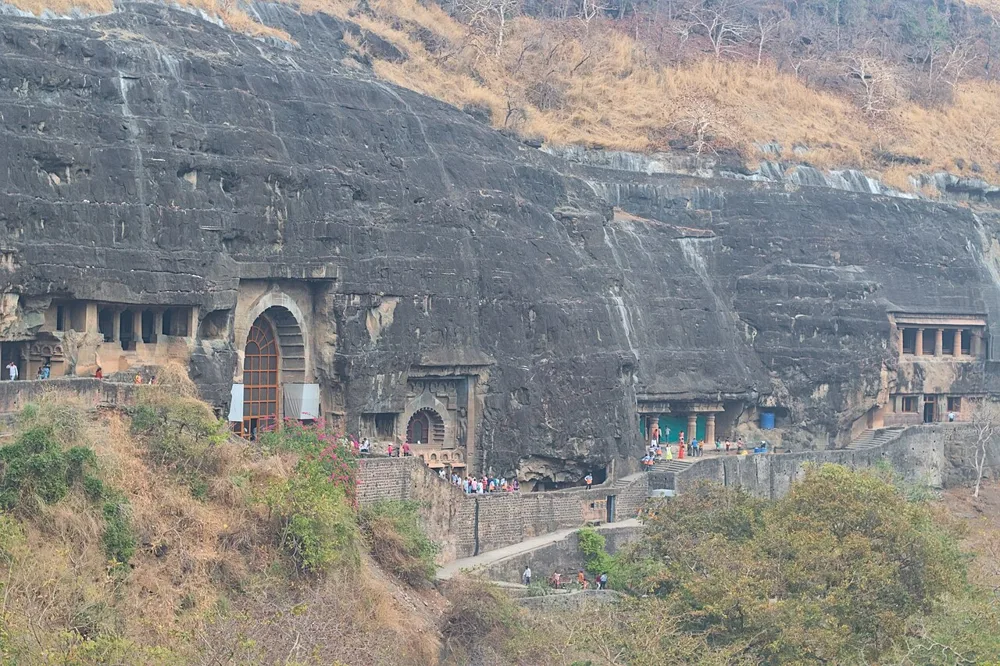
Beyond the well-known sites, recent archaeological work has brought emerging locations to the forefront of the UPSC syllabus. The Phanigiri Buddhist site in Telangana is a major excavation area known for its unique toranas, epigraphs, and a massive stucco Bodhisattva figure. In March 2024, archaeologists discovered a hoard of lead coins belonging to the Ikshvaku dynasty at Phanigiri, proving continuous patronage from the Satavahana to the Ikshvaku periods.
In Odisha, the Aragarh Buddhist Temple site features a significant two-tiered stupa and early antiquities, showcasing the regional Kalinga style of Buddhist architecture. Meanwhile, the Namphake Buddhist Monastery in Assam stands as a living example of the eastward spread of the faith. Inhabited by the Tai Phake community, it showcases a living Theravada tradition that utilises distinct wood and bamboo architectural styles.
These architectural sites are not just historical relics; they are active centres of modern cultural diplomacy. In February 2024, India engaged in significant Buddhist relic diplomacy by sending the sacred Kapilvastu relics of Lord Buddha, along with those of his disciples Sariputra and Maudgalyayana (preserved at Sanchi), to Thailand for a historic exposition. This highlights how ancient stupas and their contents continue to foster international relations under India's shared heritage initiatives. Read more about this in the current affairs updates.
Practice Question (2021)
Which one of the following statements is correct?
- Ajanta Caves lie in the gorge of Waghora river.
- Sanchi Stupa lies in the gorge of Chambal river.
- Pandu-lena Cave Shrines lie in the gorge of Narmada river.
- Amaravati Stupa lies in the gorge of Godavari river.
Correct Answer: Ajanta Caves lie in the gorge of Waghora river. This specific geographical detail is frequently tested.
Practice Question (2013)
Consider the following historical places :
1. Ajanta Caves
2. Lepakshi Temple
3. Sanchi Stupa
Which of the above places is/are also known for mural paintings?
- 1 only
- 1 and 2 only
- 1, 2 and 3
- None
Correct Answer: 1 and 2 only. Ajanta is famous for its Buddhist murals, while Sanchi is known for its stone relief sculptures, not murals.
Master Buddhist Architecture UPSC Notes and PYQs
Consolidating your buddhism upsc notes requires more than just reading; it demands practicing actual exam phrasing. The frequency of questions on buddhist architecture upsc has remained consistently high over the last decade, especially regarding the structural differences of stupas and the doctrinal shifts of the Buddhist Councils.
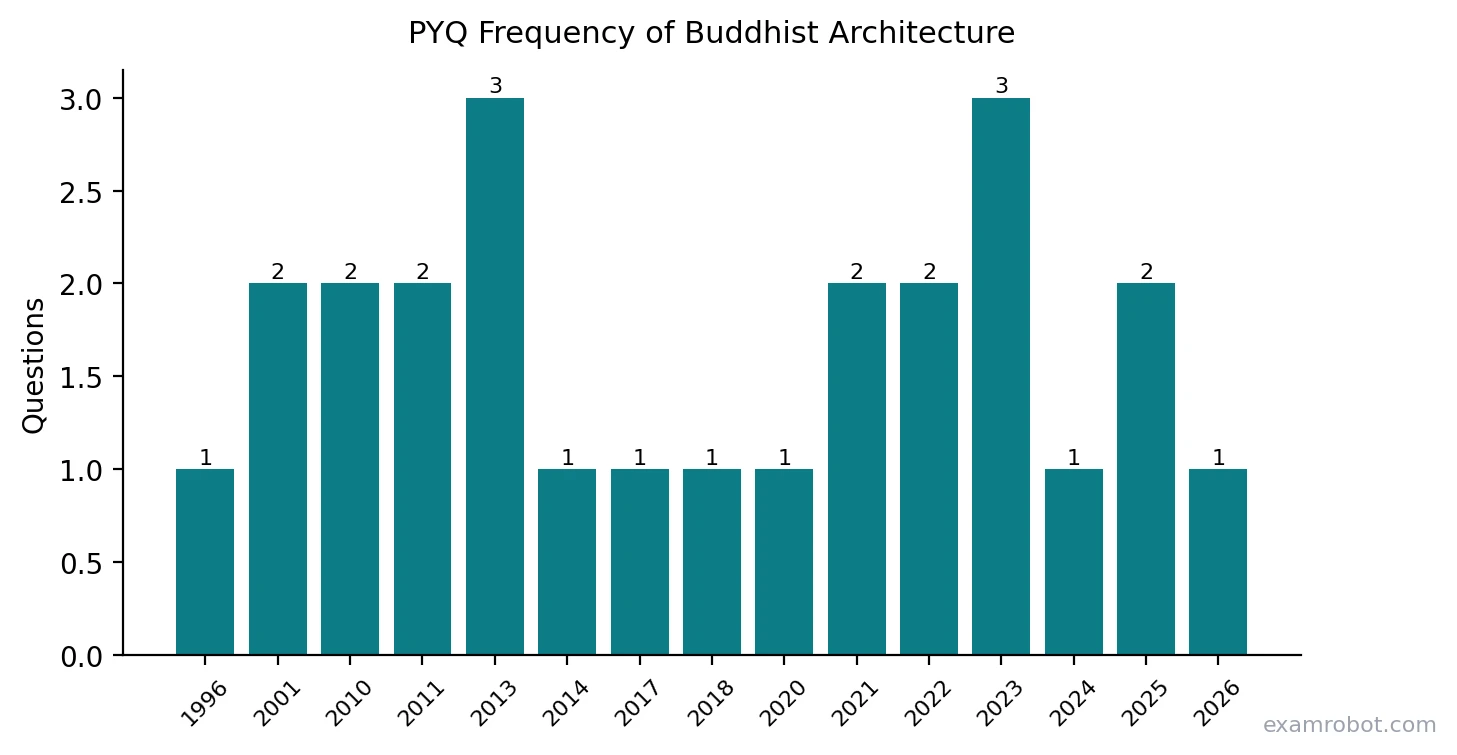
To secure your marks, utilise the buddhism upsc pyq bank to test your knowledge on common traps, such as the Vedic origin of stupas or the specific materials used in Gandharan art. For rapid revision before the Prelims examination, ensure you download the detailed buddhist architecture pdf summary.
Frequently Asked Questions
Which are the six types of Buddhist architecture?
The six primary types are Stupas (relic mounds), Chaityas (prayer halls), Viharas (monasteries), Stambhas (pillars), Toranas (gateways), and Pagodas (multi-tiered towers).
What are the 9 stupas of Buddha?
After Buddha's Mahaparinirvana, his relics were divided into eight parts. Eight stupas were built over these bodily relics at Rajagriha, Vaishali, Kapilavastu, Allakappa, Ramagrama, Vethadipa, Pava, and Kushinagar. A ninth stupa (Kumbha Stupa) was built by the Brahmin Drona over the vessel used to divide the relics.
Can Buddhist nuns marry?
No. According to the Vinaya Pitaka, which dictates the rules of the Buddhist Sangha, fully ordained Buddhist nuns (Bhikkhunis) and monks (Bhikkhus) must observe strict celibacy and cannot marry.
What was Buddha's last meal?
Buddha's last meal was offered by a blacksmith named Cunda in Pava. The meal, called 'Sukaramaddava', is traditionally translated as either a pork dish or a type of mushroom/truffle, which led to his final illness before achieving Mahaparinirvana at Kushinagar.
What are the main features of Buddhist architecture?
Key features include hemispherical domes (Anda) in stupas, vaulted ceilings in rock-cut Chaityas, central courtyards surrounded by cells in Viharas, intricate narrative reliefs on Toranas (gateways), and the transition from aniconic symbols to massive Buddha statues (Mahayana phase).