Konark Sun Temple: Kalinga Style and How to Identify It
Picture a temple that is also a vehicle: a sanctuary designed to look like the processional chariot of Surya, the Sun God, standing on the Bay of Bengal shore. That is the Konark Sun Temple, in Puri district, Odisha. UNESCO dates it to the 13th century and links it to Narasimha Deva I of the Eastern Ganga dynasty (reign AD 1238-1264).
The distinction you must carry into the exam is this: Konark belongs to the Kalingan (Odishan) tradition. Odisha Tourism calls Kalingan architecture "similar to Nagara style of North India yet uniquely different", and UNESCO calls Konark the culmination of Kalingan temple architecture. It is a cousin of Nagara, and it is never Dravida.
Quick routine (an ExamRobot study procedure, not an official method): Region, then Tower and hall form, then Ornament and layout, then Context (R-T-O-C). Never name a style before you have placed the state.
What is the Konark Sun Temple, and where is it?
Think of a ceremonial chariot rendered in stone. UNESCO lists the property as "State of Orissa, Puri District" (area 10.62 ha), on the shore of the Bay of Bengal. Odisha has carried the names Kalinga, Utkal and Odradesha in different periods (Odisha Tourism), which is why "Kalinga" appears in the architectural label.
Builder and date
UNESCO gives the reign of Narasimha Deva I as AD 1238-1264. Use "13th century" or "mid-13th century", or quote the reign span. Do not give a single construction year; the sources do not.
Political context
NCERT Class VIII (Exploring Society, Ch. 2, p. 29) says the Eastern Ganga kingdom of Kalinga, covering present-day Odisha and parts of Bengal and Andhra Pradesh, resisted the Delhi Sultanate. Narasimhadeva I repelled multiple inroads and defeated the Sultanate's governor of Bengal. The textbook says that, partly to commemorate these victories, he built the Surya temple at Konark. UNESCO frames the monument differently, as a testimony to the strength and stability of Ganga rule and to the diffusion of the Surya cult, which it says originated in Kashmir in the 8th century and reached eastern India. UNESCO also calls it one of India's most famous Brahman sanctuaries.
Trap: a precise year such as 1250 as the date of construction is not supported. Stay with the reign span.
Konark Sun Temple architecture: plan, chariot form and parts
Walk the plan from the east, as a worshipper approaching a chariot would: first the dance hall, then the audience hall, then the sanctum that once carried a tall tower.
The chariot
UNESCO describes a temple that represents the chariot of the Sun God, with twelve pairs of wheels drawn by seven horses, evoking movement across the heavens. On the north and south sides are 24 carved wheels, each about 3 m in diameter, with motifs referring to the cycle of the seasons and months. Between the wheels the plinth carries reliefs of fantastic lions, musicians, dancers and erotic groups.
Parts, in plan order from east to west
| Part | What UNESCO says |
|---|---|
| Natmandir | Dance hall, farther east, on a high platform, today unroofed |
| Jagamohana | Audience hall; dominates the ruins with its pyramidal mass |
| Vimana | Principal sanctuary; its high tower with shikhara was razed in the 19th century |
| Subsidiary structures | Found within the enclosed area |
| Enclosure wall | Rectangular, punctuated by gates and towers |
Trap: do not say the shikhara still stands. UNESCO says it was razed in the 19th century, and the dance hall has no roof today.
Note on numbers: UNESCO's detailed text and Odisha Tourism say seven horses, while UNESCO's short description says six. Seven is the commonly stated figure; in exam notes it is safer to remember the 12 pairs of wheels.
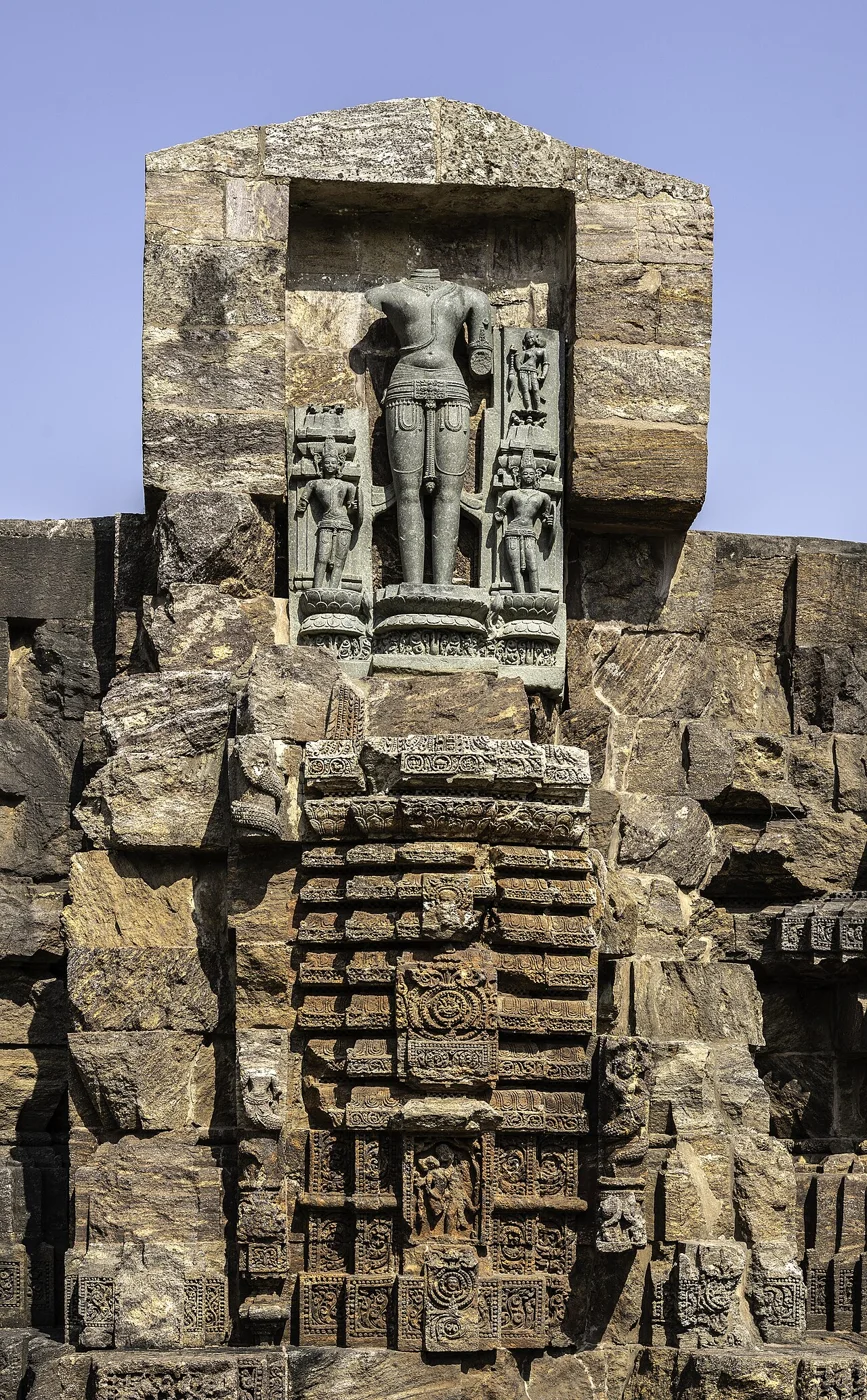

Is Konark Kalinga, Nagara or Dravida?
Think of a map and a vocabulary. First place the two big families, then the Odisha variant: Kalinga is a regional dialect of the northern temple language, not a southern one.
| Kalinga | Nagara | Dravida | |
|---|---|---|---|
| Region | Odisha | North India (NIOS) | South India (NIOS) |
| Core parts | At Konark: vimana, jagamohana, natmandir (UNESCO) | Shikhara, garbhagriha, mandap (NIOS) | Vimana or shikhara, high walls, gateway topped by gopuram (NIOS) |
| Relationship | Similar to Nagara yet uniquely different (Odisha Tourism) | Baseline | Separate southern family |
| Examples in sources | Konark | Dashavatara temple, Deogarh (Gupta, NIOS) | Kailashanath, Kanchipuram (Pallava); Brihadeshwara/Rajarajeshwara (Chola) (NIOS) |
Memory aid: North-Nagara, South-Dravida, Odisha-Kalinga (cousin of Nagara).
Trap: "The Odisha temple has a pyramid-looking hall, so it must be Dravida." The jagamohana's pyramidal mass is a feature of Konark's own plan (UNESCO), not a southern cue. Gopurams and kalyana mandapas belong on the southern side.
Symbolism and sculpture: what is safe to say
Teach symbol reading as observe, then attribute. What the carvings show is one thing; what guides assert is another.
- UNESCO: the wheel motifs refer to the cycle of seasons and months, and the sculptures are a window into the religious, political, social and secular life of the period. The Sun is personified as a divine being with history, ancestry, family, wives and progeny, as adumbrated in the Vedas and classical texts.
- Legend, not fact: UNESCO relates a 12-year project with 1,200 artisans and the story of master builder Bisu Moharana and his son, and itself frames these as legends. Odisha Tourism names the architect as Sibei Samantaray, so the names differ between sources.
- Tourism-page claims: Odisha Tourism says the wheels double as sundials and the seven horses stand for rainbow colours and weekdays. UNESCO does not say this. If you use it, attribute it; do not memorise it as settled fact.
Trap: "Twelve wheels equal twelve months." There are 24 wheels (twelve pairs), and UNESCO says only that the motifs refer to seasons and months.
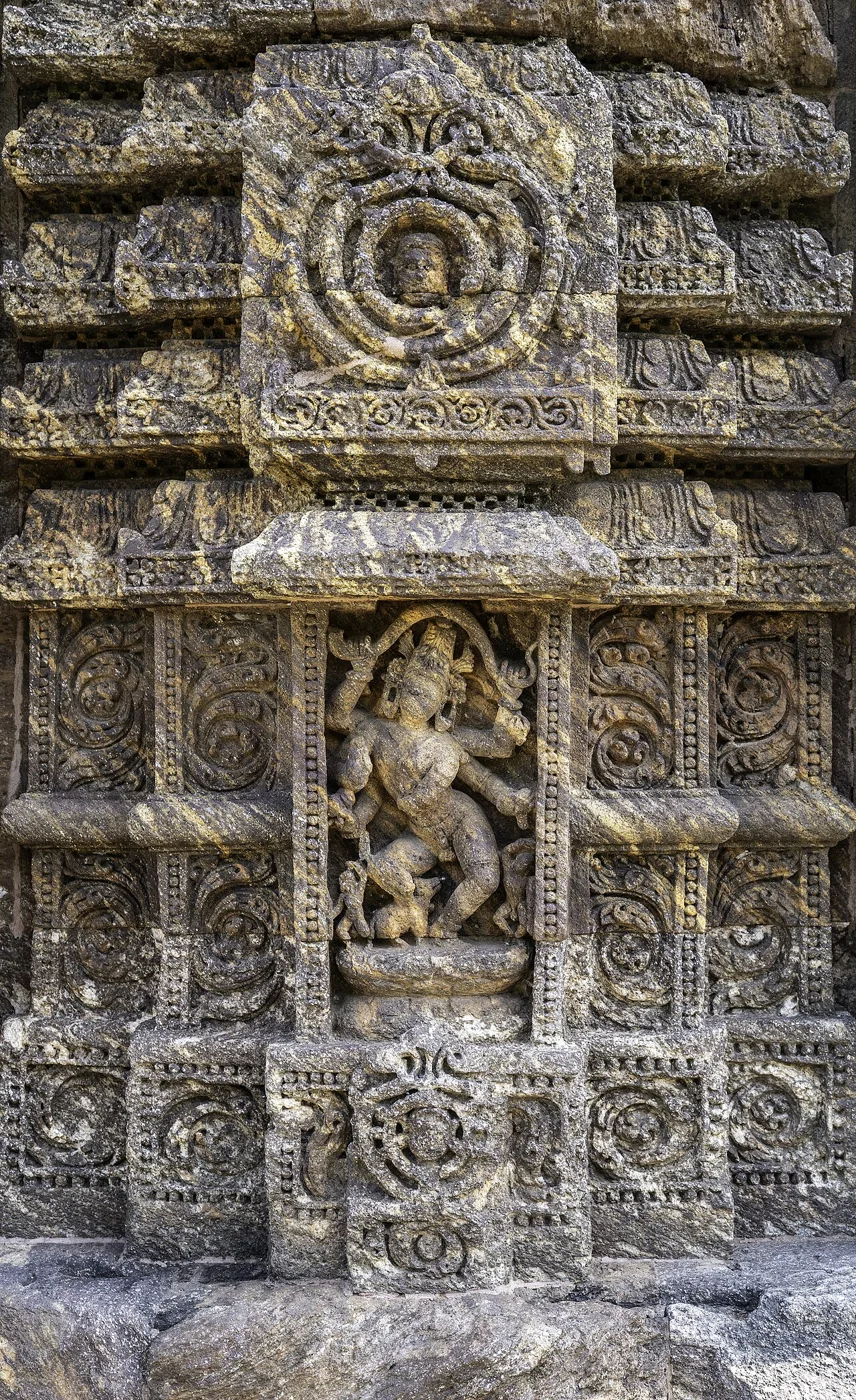

Why is Konark a UNESCO World Heritage Site?
For a Mains answer, map each criterion to a reason. UNESCO inscribed the site in 1984 under criteria (i), (iii) and (vi), all cultural.
| Criterion | Reason (UNESCO) |
|---|---|
| (i) | A unique artistic achievement, a masterpiece of creative genius, with sculptural narrative strength |
| (iii) | Outstanding testimony to the 13th-century kingdom of Orissa |
| (vi) | Directly and materially linked to Brahman beliefs; a link in the diffusion of the Surya cult from Kashmir (8th century) to eastern India |
Conservation and threats (Mains angle)
Use a problem-solution frame for a 150-word answer.
- Law: AMASR Act 1958 and Rules 1959; the Forest Act, Konark Development Act and notified Council Area Act are also relevant (UNESCO).
- Zoning: 100 m outside the property is the prohibited zone and a further 200 m the regulated zone.
- Who conserves: the Archaeological Survey of India, through national, regional and local representatives.
- Threats named: development pressure; environmental pressure (saline breeze, sand blasting, deforestation, microbiological growth); tourism pressure (a 40% increase in tourists is noted); cyclones and floods; local population growth.
- Past damage: erosion of metal cramps by salt air, and monsoon-linked soil erosion.
- Needs: structural and material conservation of the jagamohana and sculptures, better integration of local and central authorities, and bringing the wider landscape into the regulated area.
Claim no more than UNESCO states: it lists threats and needs, not proven outcomes.
The four-step routine for temple identification MCQs
Never name a temple style before you have placed the state.
- Step 1, Region: fix the state or kingdom. Odisha or Kalinga points to the Kalinga/Odishan family.
- Step 2, Tower and hall form: Nagara shikhara versus Dravida stepped vimana and gopuram. Konark's tower is lost, so lean on the jagamohana and overall plan.
- Step 3, Ornament and layout: vimana, jagamohana and natmandir in an enclosure, plinth reliefs, chariot wheels.
- Step 4, Context: Eastern Ganga, 13th century, Narasimha Deva I; for other temples, the dynasty, deity or period.
All four questions below carry ExamRobot stored answers, which are not independently verified official keys. Use them to practise the elimination skill, not as authority.
IAS 2026 label: Nagara-style shikhara (Step 2, Tower form)
Which of the following temples has/have a Nagara-style shikhara? 1. Malegitti Shivalaya, Badami 2. Huchimalligudi Temple, Aihole 3. Dashavatara Temple, Deogarh 4. Virupaksha Temple, Pattadakal. Options: (a) 1 and 2 (b) 2 and 3 (c) 3 only (d) 3 and 4.
Stored answer: (b). Ask what tower each temple has. The stored explanation treats Malegitti (Badami) and Virupaksha (Pattadakal, stepped pyramidal vimana) as Dravida, and Huchimalligudi (Aihole) and Dashavatara (Deogarh) as Nagara. Strike statements 1 and 4. Striking them leaves {2, 3}, which is option (b) only. Option (a) fails because it contains 1, (d) fails because it contains 4, and (c) fails because it leaves out 2. NIOS independently supports Dashavatara at Deogarh as a Gupta temple. Practise this question.
IAS 2009 label: match temple and state (Step 1, Region)
Match A. Vidyashankara temple, B. Rajarani temple, C. Kandariya Mahadeo, D. Bhimesvara Temple with 1. Andhra Pradesh, 2. Karnataka, 3. Madhya Pradesh, 4. Orissa. Options: (a) A-2, B-4, C-3, D-1 (b) A-2, B-3, C-4, D-1 (c) A-1, B-4, C-3, D-2 (d) A-1, B-3, C-4, D-2.
Stored answer: (a). This is pure Step 1. Place Rajarani in Orissa (B-4): options (b) and (d) give B-3 and fall. Place Vidyashankara in Karnataka (A-2): option (c) gives A-1 and falls. That leaves (a). Use the stored explanation only for these state placements. Practise this question.
IAS 2017 label: sun temples (Step 1 and Step 4, place and dedication)
Which of the following is/are famous for Sun temples? 1. Arasavalli 2. Amarakantak 3. Omkareshwar. Options: (a) 1 only (b) 2 and 3 only (c) 1 and 3 only (d) 1, 2 and 3.
Stored answer: (a). Konark is not among the options, so read the options rather than reciting Konark. The stored explanation places Arasavalli in Srikakulam, Andhra Pradesh, as a Surya temple. It describes Amarkantak as the origin of the Narmada and a pilgrimage site, and Omkareshwar (Mandhata, Madhya Pradesh) as a Shiva temple and Jyotirlinga shrine. Strike statements 2 and 3. Option (b) needs both, (c) needs 3, and (d) needs both, so all three fall, leaving (a). Practise this question.
IAS 2019 label: kalyana mandapas (Step 2 and Step 4, hall form and kingdom)
Building 'Kalyaana Mandapas' was a notable feature in the temple construction in the kingdom of: (a) Chalukya (b) Chandela (c) Rashtrakuta (d) Vijayanagara.
Stored answer: (d) Vijayanagara. The hall form (a marriage hall for ceremonial weddings of deities) is the clue, and the stored explanation ties it to Vijayanagara, along with tall gopurams. It says the Chalukyas influenced later temple architecture but are not specifically noted for this feature, and that the Chandela and Rashtrakuta kingdoms had their own distinct styles without this hallmark. So (a), (b) and (c) fall. This is a southern, Dravida-side cue, not part of the Konark identification set. Practise this question.
Trap: four sample questions say nothing about how often temple styles are asked and predict nothing about future papers.
Original practice (not real PYQs)
These are original items for you, not drawn from any exam paper.
Q1. Consider the Konark Sun Temple. 1. It is in Puri district, Odisha. 2. UNESCO describes it as representing the chariot of the Sun God with twelve pairs of wheels. 3. It is a Dravida-style temple with a gopuram. Which are correct? (a) 1 and 2 only (b) 2 and 3 only (c) 1 and 3 only (d) 1, 2 and 3.
Answer and reasoning
(a). Statements 1 and 2 follow UNESCO. Statement 3 contradicts Odisha Tourism and UNESCO's Kalingan description.
Q2. UNESCO's description of the Sun Temple, Konark, mentions which of these? 1. Jagamohana 2. Natmandir 3. Kalyana mandapa.
Answer and reasoning
1 and 2 only. The kalyana mandapa is a Vijayanagara feature (per the stored explanation of the 2019-labelled question) and is not in UNESCO's Konark description.
Mains-style prompt (150 words): "Konark Sun Temple is the culmination of Kalingan temple architecture. Discuss."
Answer outline (our suggested approach)
- Introduction: 13th-century Eastern Ganga context under Narasimha Deva I (UNESCO, NCERT).
- Kalinga as related to Nagara yet distinct (Odisha Tourism).
- Chariot concept and plan: vimana, jagamohana, natmandir, 24 wheels (UNESCO).
- Sculptural narrative on the plinth.
- UNESCO 1984 inscription, criteria (i), (iii), (vi).
- Conclude with a conservation challenge: saline breeze, corroding metal cramps, tourism pressure.
Common mistakes and revision card
- Myth: Konark is Dravida because of a pyramid-like hall. Fact: Odisha Tourism places Kalinga close to Nagara; Dravida is the southern family (NIOS).
- Myth: Konark appears in every sun-temple question. Fact: the 2017-labelled question does not list it.
- Myth: the shikhara still stands. Fact: UNESCO says it was razed in the 19th century.
- Myth: a stored answer is an official key. Fact: all four here are unverified stored answers.
- Myth: twelve wheels equal twelve months. Fact: 24 wheels in twelve pairs; motifs refer to seasons and months.
- Myth: sundial accuracy and rainbow-colour horses are exam facts. Fact: these are tourism-page claims; attribute them.
Revision card: Place: Puri, Odisha. Builder: Narasimha Deva I, Eastern Ganga, AD 1238-1264. Form: chariot with 12 pairs of wheels, seven horses (commonly stated). Parts: vimana, jagamohana, natmandir. Status: UNESCO 1984, criteria (i), (iii), (vi). Law: AMASR Act 1958.
FAQs
Where is the Konark Sun Temple located?
At Konark, Puri district, Odisha, on the Bay of Bengal coast.
Who built it and when?
Narasimha Deva I of the Eastern Ganga dynasty, reign AD 1238-1264 (UNESCO); NCERT Class VIII places him in the mid-13th century.
What kind of architecture is it?
Kalingan (Odishan), similar to Nagara yet uniquely different (Odisha Tourism); UNESCO calls it the culmination of that tradition.
Why does it look like a chariot?
UNESCO describes it as a representation of Surya's chariot, with twelve pairs of wheels drawn by seven horses.
What survives today?
The jagamohana and the unroofed natmandir; the vimana's tower and shikhara were razed in the 19th century.
Why is it a UNESCO site?
Inscribed in 1984 under criteria (i), (iii) and (vi).
Do the wheels tell time?
Odisha Tourism says they double as sundials; UNESCO does not. Treat it as a tourism-page claim.
Related reading: Buddhist Architecture, Mauryan Art and Architecture, and the Topics hub.